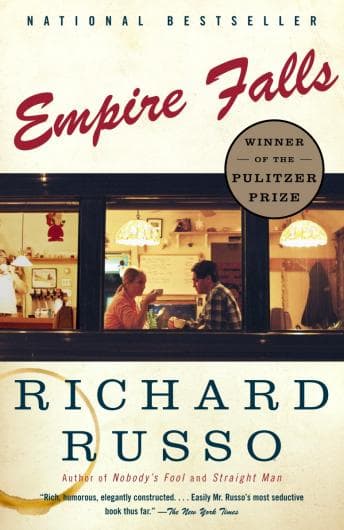

Twenty hours is a commitment. That's what I kept thinking when I started Empire Falls during a particularly brutal week of grading sophomore essays on The Great Gatsby. Fitzgerald would have appreciated the irony—me listening to a Pulitzer Prize-winning novel about American decline while marking papers where students insisted Gatsby's green light was "just a lamp."
But here's the thing about Richard Russo that nobody warned me about: he makes twenty hours feel like visiting family. Complicated, occasionally exhausting family that you genuinely love.
The Grill Where Everyone Knows Your Name (And Your Father's Failures)
Miles Roby runs a diner in a dying Maine mill town. That's the premise. It sounds like the setup for a depressing literary exercise, the kind of book I'd assign to punish juniors who complained about Steinbeck. But Russo does something I've rarely encountered—he writes about desperation without ever becoming desperate himself. The prose has this warmth underneath all the economic decay, like finding a good cup of coffee in a restaurant that should have closed years ago.
Ron McLarty gets this balance exactly right. His narration walks an impossible line between mundane and profound, between characters who've given up and characters who haven't quite realized they should. There's an ironic tone running through his reading that never tips into mockery. When Miles contemplates his life—the college he left, the wife leaving him, the diner that owns him more than he owns it—McLarty finds the humor without losing the heartbreak.
Now, I have to address the elephant in the room. Mainers apparently have strong feelings about their accent, and McLarty's version isn't quite authentic. (I teach in Chicago. I can't tell the difference between Maine and Massachusetts, honestly. My students think all New England sounds like the Kennedys.) If you're from Dexter County, this might pull you out of the story. For the rest of us? Non-issue that doesn't diminish what is otherwise near-perfect voice work.
Fathers, Sons, and the Weight of Staying
This reminds me of what Hemingway said about writing—that the dignity of movement of an iceberg is due to only one-eighth of it being above water. Russo's plotting works the same way. There's a mystery about Miles's mother, about the Whiting family's hold on the town, about what really happened decades ago. But these revelations surface slowly, organically, the way family secrets actually emerge—in offhand comments, in the things people don't say, in the way someone's face changes when a particular name comes up.
Miles's daughter Tick is the emotional center I didn't expect. She's navigating high school with the same quiet determination her father brings to everything—and as someone who's watched teenagers for twenty years, Russo nails adolescence without condescending to it. Tick isn't a precocious movie kid or a troubled stereotype. She's just a smart girl trying to survive her parents' divorce while her town crumbles around her.
The prose deserves to be savored. I listened at 1.0x because Russo chose those words carefully, and McLarty delivers them with the patience they require. This isn't background listening. This is put-down-the-red-pen-and-actually-pay-attention listening.
Who Should Listen (And Who Should Skip)
If you loved Nobody's Fool (also Russo, also brilliant), this is its spiritual successor—though darker, more sprawling, more willing to examine how places die and what happens to the people who stay. If you need plot momentum to keep you engaged, this will test your patience. Empire Falls meanders. It circles back. It spends time with minor characters who matter more than you initially realize.
My students would hate this. Too slow, they'd say. Nothing happens. But that's the point, isn't it? Everything happens in Empire Falls—it just happens the way life actually does, in accumulation rather than explosion. Crime and Punishment works the same way—ordinary life building to something inevitable and devastating. (Though there is an explosion, eventually. Russo earns it.)
Perfect for long walks, for quiet evenings, for anyone who's ever looked at their hometown and wondered what kept them there. Or what might have happened if they'd left. Skip it if you need things to happen fast—this book trusts you to wait.
Worth Pausing the Faculty Meeting For
This won the Pulitzer for a reason. It's not flashy. It's not experimental. It's just devastatingly good at being exactly what it is—a novel about ordinary people in an extraordinary state of decline, rendered with compassion and wit and the kind of patience that literary fiction rarely achieves anymore. McLarty's performance elevates already excellent material.
Twenty hours. Worth every minute. Principal Martinez, I definitely wasn't listening to this during your budget presentation last Thursday. (I absolutely was.)