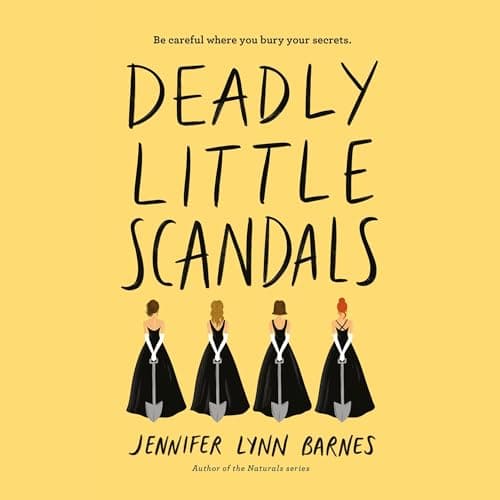

I have a complaint. I teach teenagers five days a week. I grade their essays about symbolism in The Great Gatsby while they text under their desks. I do not need more teenage drama in my life. And yet here I am, 11:47 PM on a Tuesday, supposedly grading a stack of sophomore research papers, and instead I'm nine hours deep into a YA secret society novel about Southern debutantes. Denise walked through the kitchen, saw me with my headphones in and a red pen untouched on the table, and just shook her head. She knows.
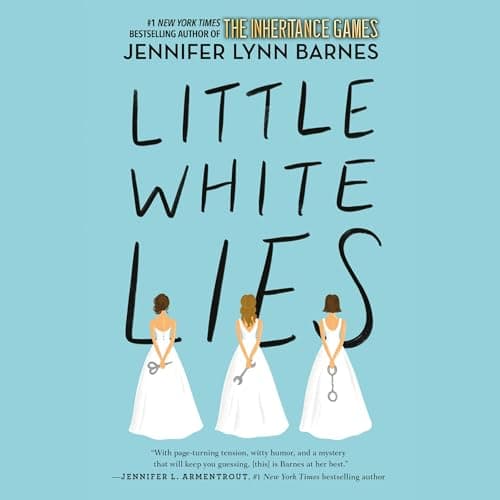
Here's the thing though — Jennifer Lynn Barnes is sneaky smart, and Deadly Little Scandals caught me off guard in ways I wasn't expecting from a book about girls in white gloves.
Barnes Writes Plot Twists Like a Cognitive Scientist (Because She Is One)
I didn't know this going in, but Barnes has advanced degrees in psychology and cognitive science, and you can feel it in the architecture of her plotting. This isn't just "oh here's a surprise." She's constructing the kind of misdirection that actually accounts for how readers process information. Sawyer Taft is searching for her biological father — that's the hook from book one, Little White Lies — but in this sequel, Barnes layers a secret society initiation on top of a cold discovery near the family's summer home, and the way those two threads braid together had me genuinely uncertain which revelation was the real bomb.
The White Gloves society — think Junior League crossed with Skull and Bones, but populated entirely by women who've been keeping receipts for decades — is the kind of institution I'd love to teach a unit on. Power structures, generational secrets, the way Southern gentility becomes its own form of coercion. My students would probably actually pay attention to this one. (Don't tell them I said that.)
Sawyer herself is the kind of protagonist who's easy to underestimate. She's not the loudest person in the room. She watches. She calculates. Barnes writes her interior monologue with this dry, observational wit that reminded me — and I mean this as real praise — of a sharper, younger version of what Donna Tartt does with self-aware narrators. Sawyer knows she's being manipulated. She plays along anyway. That tension between awareness and participation is where the book lives.
Katherine Littrell's Southern Drawl Is Doing Real Work
Let's talk about the narration. Katherine Littrell brings a genuine Southern accent to this, and it's not decoration — it's load-bearing. The entire world of this book runs on the gap between what polite Southern society says and what it means, and Littrell's delivery sits right in that gap. When a character says "bless your heart" in this context, you hear the knife behind it.
Now — fair warning for my fellow Yankees and Midwesterners. There were moments, particularly in rapid dialogue scenes, where the drawl got thick enough that I had to rewind. Not often. Maybe three or four times across nine hours. But if Southern accents aren't something your ear is trained for, you'll want to listen at 1.0x (which you should be doing anyway, but I know nobody listens to me on that). Littrell's real strength is capturing Sawyer's moxie — that stubborn, calculating energy comes through clean in her voice.
I will say the character differentiation isn't as sharp as I'd like. With this many players in the White Gloves — plus Sawyer's cousin Lily, plus the older generation of women pulling strings — I occasionally lost track of who was speaking in group scenes. Single narrator doing ensemble YA is always a tightrope act, and Littrell mostly keeps her balance. Mostly.
The Secret Society Stuff Is Better Than It Has Any Right to Be
I've read — and listened to — a lot of secret society fiction. Dan Brown ruined the genre for a while there. But Barnes understands something most writers miss: the real appeal of secret societies isn't the secrets. It's Not Her worked that same nerve for me — that particular dread of being on the outside of something you can't quite name. It's the belonging. It's the seduction of being chosen. The White Gloves initiation sequences work because Sawyer is simultaneously skeptical of the whole performance and hungry for the access it provides. That psychological honesty is what elevates this above standard YA mystery fare.
The discovery near the summer home — I won't spoil it — shifts the book's energy from soapy fun to something with actual weight. Barnes earns it, too. She's been planting seeds since the first book, and the reveal here connects to the generational secrets in a way that made me set down my (still ungraded) papers and just sit with it for a minute.
At nine hours, the pacing is tight. No bloat. Barnes writes like someone who respects her readers' time, which — as a man who assigns 300-page novels to kids with eight-second attention spans — I deeply appreciate.
Who Gets an Invitation (And Who Gets Left at the Door)
If you burned through The Inheritance Games and wanted that same puzzle-box energy with a Southern Gothic flavor, this is your next listen. If you read Little White Lies first (and you should — this is book two), the payoff here is substantial. And if you're a grown adult who occasionally wants a smart, propulsive YA mystery without feeling like you're slumming it — welcome to the club. There are more of us than you'd think.
Skip this if you need standalone stories — you'll be lost without book one. Skip it if Southern accents genuinely frustrate your comprehension. And skip it if you want deep literary prose — Barnes is a plotter first, and the sentence-level writing serves the machinery rather than the other way around. That's not a flaw. It's a choice. But it's worth knowing.
Final Grade
This reminds me of what Hemingway said about prose — that it should be honest and direct, and the reader should feel more than they understand. Barnes isn't Hemingway (she'd probably laugh at that comparison), but she shares that instinct for efficiency. Every scene does work. Every conversation has a second meaning. Give it the time it asks for — Southern drawl and all.
I gave those sophomore papers a C+ average the next morning. Possibly unfair. But I regret nothing.