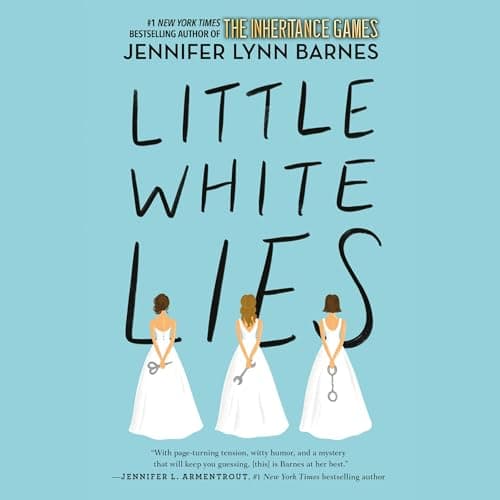

Jennifer Lynn Barnes writes YA mysteries the way my students text — fast, layered, and with about six things happening underneath what's actually being said.
I started Little White Lies during a Saturday lakefront walk with Denise, which turned into a Sunday lakefront walk with Denise, which turned into me sitting on a bench near Montrose Harbor pretending I was "resting my knees" while actually trying to figure out who Sawyer Taft's father is. Denise wasn't fooled. She never is.
Debutante Balls and Daddy Issues — Barnes's Favorite Cocktail
Here's what Barnes does better than most YA writers working today: she builds social systems. If you've read The Inheritance Games, you know she loves dropping an outsider into a world of old money and watching the gears grind. Little White Lies runs the same play — auto mechanic Sawyer Taft gets recruited by her estranged grandmother into debutante season in exchange for a six-figure sum — but the Southern society setting gives it a different texture than the Hawthorne estate ever did. The mystery here isn't "who gets the fortune," it's "who's your daddy," and Barnes strings that question out across nearly ten hours with the patience of someone who teaches psychology for a living. Which, as it turns out, she does.
The book is structured like a contract, literally. Sawyer signs on the dotted line, and everything that follows is a negotiation — with her grandmother Lillian, with the other debutantes, with herself. Barnes is smart about power dynamics. Lillian doesn't just control the money; she controls information, social standing, introductions. Every "bless your heart" in this book is a chess move. My students would probably call this "manipulative grandma goals." They wouldn't be wrong.
What I didn't expect was how much I'd care about the side characters. The debutante friend group — Campbell, Lily, Sadie-Grace — could've been stock Southern stereotypes, and for the first hour or so I was bracing for exactly that. But Barnes gives each of them their own secret, their own motivation, and by the midpoint these girls felt less like accessories and more like co-conspirators. The line "I'm not saying this is Sawyer's fault... but" becomes a running joke that gets funnier (and more ominous) every time it lands.
Katherine Littrell's Southern Drawl — A Feature, Not a Bug
Let's talk about the narrator, because she's going to be a deal-breaker for some people. Katherine Littrell commits hard to the Southern accent. Not a gentle Georgia lilt — this is full Arkansas-meets-cotillion drawl, and she uses it to differentiate class and character in ways that are genuinely clever. Lillian's voice carries the clipped authority of someone who's been running a room since the Eisenhower administration. Sawyer's internal monologue has a different cadence entirely — faster, more skeptical, with a sardonic edge that signals "outsider" without Littrell ever having to announce it.
But here's the thing: if you're not accustomed to a thick Southern accent in your ear for ten hours, the first thirty minutes might feel like wading through molasses. I had to recalibrate. Some listeners apparently gave up before they adjusted, and I get it. Littrell isn't doing subtle. She's doing performance. And she understands that pause is punctuation — she lets Lillian's silences do as much work as her words, which is exactly how Southern matriarchs actually operate. (I've met a few at conferences. Terrifying women. Wonderful manners.)
The character voices are distinct enough that I never lost track of who was speaking, even during the multi-character scenes at parties and luncheons. That's no small thing in a book with this many women talking at once.
Who Gets a Bid and Who Gets Blackballed
If you loved The Inheritance Games and want that same "outsider cracks the code of the elite" energy with more feminine social warfare and less puzzle-box plotting, this is your next listen. If you enjoy Ally Carter's Heist Society or E. Lockhart's brand of sharp, unreliable-narrator YA, you'll find familiar ground here.
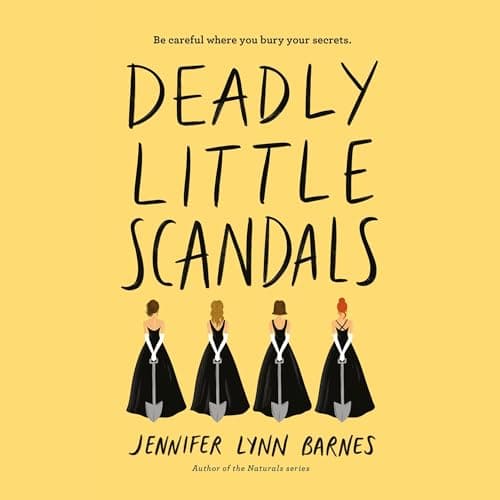
Skip it if you need a fast resolution — this is book one of a duet, and Barnes plants seeds she has zero intention of harvesting until Deadly Little Scandals. The cliffhanger isn't cruel, but it's deliberate. Also skip if heavy accents in narration pull you out of a story. Littrell is all-in, and she's not meeting you halfway.
This reminds me of what Hemingway said about prose — the dignity of movement of an iceberg is due to only one-eighth of it being above water. Barnes writes like that. The debutante dresses and the party planning and the "yes ma'am" politeness are the visible eighth. Underneath, every character is scheming, grieving, or hiding something. Worth pausing the faculty meeting for — and I say that about maybe four books a year.
The Assignment: A Solid B+
Smart, propulsive YA with a narrator who swings for the fences on every line. Not Barnes's absolute best work, but close enough that the distinction barely matters. I finished it, immediately downloaded the sequel, and told Denise she could pick the next lakefront audiobook. She picked a true crime podcast. Marriage is compromise. Though I'll say this — after ten hours of Barnes telling me what I should and shouldn't eat at a debutante luncheon, I appreciated that F*ck It Diet: Eating Should Be Easy takes a considerably less judgmental approach to the whole thing.