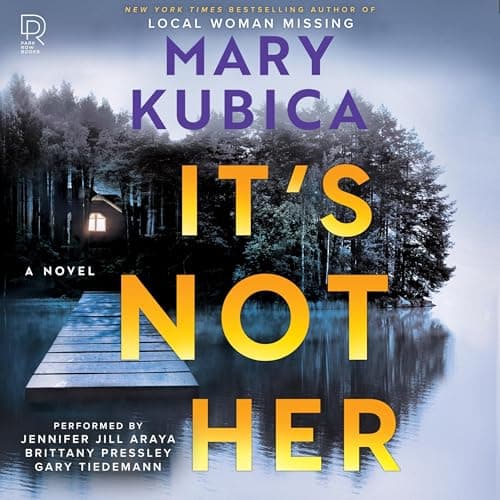

I started this one on the Q train after a 14-hour shift, half a protein bar in my pocket, trying not to miss my stop because my brain was still stuck in a family meeting from earlier that afternoon. Then this book opens with a scream, a lakeside cottage, two bodies, one child missing, and another kid asleep upstairs somehow untouched. Yeah. I was awake.
Mary Kubica knows how to throw you into domestic nightmare fast. Courtney Gray goes from vacation mode to identifying that her brother and sister-in-law are dead, while her niece Reese is gone and her nephew Wyatt is found upstairs unharmed. That specific setup did a lot for me immediately, because it gives you three separate questions at once: who did it, where is Reese, and why is Wyatt okay? Not just "what happened?" — which is a much stronger engine for an 11-hour thriller.
The book also leans hard on dual perspectives and flashbacks, and for the most part, that structure works. You keep getting little pieces of family history and town history, and Kubica is clearly trying to make you distrust everybody in widening circles. Courtney. The locals. The relatives. The whole resort atmosphere. That part? Effective. The lake setting has that nice closed-in feeling even though it's physically open, which is exactly what this kind of story needs.
Where the body was, and where the tension went
What kept me listening was the family dynamic after the murders. Not because these people are especially lovable — they are not — but because Kubica understands that grief and suspicion make everyone ugly in different ways. Reese possibly being victim or killer is the book's best nasty little question, and it changes the emotional temperature of every conversation around her.
But. This is also where the book will lose some people.
There are stretches where the suspicion-loop starts repeating itself. Same accusations, same emotional circling, same sense that people are withholding things because the plot needs them to, not because that's the most organic human choice in the moment. I get why some listeners said the bickering wore them out. It didn't make me turn it off, but I did feel the drag in the middle.
As someone who's actually run a code, I am picky about how people behave in immediate crisis and aftermath. And no, this isn't a medical thriller, so I'm not demanding EMS realism in every paragraph. But human stress responses still need to feel earned. Some of the post-event fighting landed as raw and believable; some of it felt a little too arranged, like everyone had been assigned one emotion and told to repeat it louder.
Kubica is very good at managing suspicion, though. Even when I guessed one piece of where things were heading, I still wanted the exact mechanism. And with thrillers, that matters. Predicting the broad weather pattern isn't the same as knowing where lightning will hit. The Christie Affair pulled the same trick on me — I thought I had the shape of it, and then the specific mechanism still landed like a gut punch.
Three voices, three different kinds of panic
The audio is a big reason this worked for me.
Jennifer Jill Araya, Brittany Pressley, and Gary Tiedemann split the points of view cleanly enough that I never had that annoying "wait, whose chapter is this?" problem. Bless. On a sleep-deprived subway ride, that matters. Brittany Pressley in particular has a way of pushing tension without sounding cartoonishly intense, and Gary Tiedemann gives the male perspective a steadier, grounded texture that helps break up the emotional churn. Jennifer Jill Araya brings the sharpest edge — there's a musical rise and fall to her delivery that fits the more anxious passages well.
Now, a fair warning: if you hate emphatic thriller narration, you may find parts of this performance a little overcooked. I didn't, mostly because this story is already pitched at a high emotional register, so the vocal intensity felt in bounds. But I can see why a few listeners called it overzealous. Nobody here is murmuring their way through a sad little chamber drama.
Production-wise, clean and easy. No weird sound effects, no gimmicks, no muddy edits. Just three narrators doing clear POV work. The medical details are accurate. Finally. Kidding — wrong genre. But the audio details are accurate, and honestly that's its own kind of relief.
If you need every twist to reinvent gravity, maybe not
The ending is going to split listeners. Some people are going to call it shocking. Some are going to say they saw it coming. I landed in the middle: I saw enough shadows to suspect the shape, but I didn't have the full picture. So when the reveal clicked into place, I wasn't stunned silent — I was satisfied. Different thing.
And satisfaction is kind of this book's lane. Not perfect precision. Not maximum plausibility every second. Satisfaction. It gives you a strong hook, a chilly setting, ugly family secrets, a missing child question that actually matters, and enough narrative momentum to keep you leaning forward even when the middle sags.
If you've read Kubica before, I get why some people are calling this one of her better audiobooks. I still think the pacing hiccups keep it from greatness, and if you already bounce off thrillers that feel a touch YA in voice, this won't convert you. But if you like suburban-family horror dressed up as a whodunit, this absolutely has teeth.
Between shifts and salah, this kept me going. Not because it was flawless. Because it knew exactly how to make me suspicious of every person standing near that lake.
My discharge instructions
Listen if: you like your thrillers twisty, voice-driven, and a little mean — especially if multi-narrator audio is your thing and you don't mind family dysfunction turned up loud. Skip if: you need relentless pacing without any middle-act drag, or if repetitive family conflict makes you want to throw your headphones across the room. I didn't yell at my phone on the subway during this one — which, for a thriller with this many moving parts, is basically a compliment.