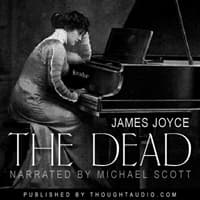

"His soul swooned slowly as he heard the snow falling faintly through the universe and faintly falling, like the descent of their last end, upon all the living and the dead."
I was walking the lakefront with Denise last Sunday evening - one of those late autumn Chicago nights where the wind off the lake makes you feel like the last person alive - when that final passage hit me. I had to stop walking. Denise asked if I was okay. I wasn't, really. Not in a bad way. In that way where a piece of writing cracks something open in you that you forgot was sealed shut.
Let me back up.
The Longest Dinner Party You'll Ever Be Grateful For
Here's the thing about "The Dead" that trips people up, and I say this as someone who's taught Dubliners to juniors who'd rather be literally anywhere else: the first two-thirds of this story is a dinner party. That's it. Gabriel and Gretta Conroy arrive at his aunts' annual holiday gathering, there's dancing, there's goose, there's after-dinner speeches, there's that one drunk guest who won't stop talking about his favorite tenor. Joyce spends what feels like an extraordinary amount of time on table settings and social anxieties and who's standing where.
My students would hate this. I love it.
Because Joyce is doing something sneaky. He's building a world of the living - all that noise, all that warmth, all those bodies pressed together in the Misses Morkan's house - so that when death enters the story, you feel its cold like a draft under the door. The whole structure is a slow turn from the heat of that party to the snow falling on the graves at the end. And at ninety-five minutes, this audiobook gives you just enough time to feel that turn in your bones without demanding a week of your life.
Compare this to, say, Chekhov's party scenes - which I also love - and you'll notice Joyce isn't interested in satirizing these people. He's tender with them. Aunt Julia singing "Arrayed for the Bridal" while she's clearly aging, clearly closer to death than anyone wants to acknowledge - that scene is one of the most devastating things in English literature, and Joyce never once tells you to be sad about it. She's Come Undone does something similar with its most gutting moments - Wally Lamb trusts the reader enough to just show you the thing without narrating your grief back at you. He just describes her singing. The narrator understands that pause is punctuation.
Michael Scott and the Brogue Question
Let's talk about Michael Scott's narration, because this is where opinions split and I understand both sides. His Irish brogue is authentic - not stage-Irish, not Lucky Charms commercial Irish - and for a story set in early 1900s Dublin, among Dubliners, performed at a Dublin party, I think that authenticity matters. When he voices Gabriel's aunts, there's a warmth and fussiness to the delivery that feels right for women who've been hosting this party for thirty years.
But. Some listeners find the accent too thick, and I get it. There were moments - particularly during the dinner conversation scenes where multiple characters are speaking in quick succession - where I had to rewind because the brogue swallowed a phrase or two. If you're not already familiar with the story, this could be genuinely frustrating. I've read "The Dead" probably fifteen times over two decades, so I had a map in my head. A first-time listener might feel lost in the accent before the prose has a chance to work on them.
Scott's real strength is the quiet moments. Gabriel's interior monologue as he watches Gretta on the staircase listening to Bartell D'Arcy sing "The Lass of Aughrim" - that passage needs a narrator who can slow down and let the language breathe. Scott does that. He doesn't rush Gabriel's epiphany. He doesn't overdramatize Gretta's confession about Michael Furey, the boy who died for love of her. He lets Joyce's prose do what it does, which is the highest compliment I can pay a narrator of literary fiction.
The pacing is slow. I know. But listen - this is a story about a man who realizes, in a single evening, that his wife has an entire emotional history he never knew about, that someone loved her with an intensity he may never have matched, and that the snow is falling on every grave in Ireland including the ones not yet dug. That story shouldn't be narrated at a clip.
I listened at 1.0x. The author chose those words.
Who Should Press Play (And Who Should Grab the Book Instead)
If you love Joyce, if you love Irish literature, if you've ever stood at a party and suddenly felt the weight of everyone's private grief pressing against the walls - this is ninety-five minutes well spent. It's perfect for a focused evening walk or a quiet hour before bed. Not background listening. This demands your attention the way a poem demands your attention.
If you've never read "The Dead" before, I'd honestly suggest reading it first, then coming back to the audiobook. Not because Scott's narration fails - it doesn't - but because Joyce's sentences are architectural, and seeing them on the page first helps you appreciate what you're hearing. Some of my 47 podcast listeners will recognize this advice from my Dubliners episode.
And if slow-burn literary fiction isn't your thing? That's fine. Skip it. Go listen to something with a plot that moves. But know what you're missing.
The Snow Was General All Over Ireland
Twenty years of teaching this story and it still gets me. The moment Gabriel looks out the hotel window and thinks about the snow covering all of Ireland - the living and the dead, the ones we love and the ones we've forgotten - that's Joyce doing what the best literature does. Reminding you that you're mortal. That everyone you love is mortal. That the party always ends.
Denise and I finished our walk in silence after it ended. The lake was black. The city was loud behind us. And for a few minutes, I felt exactly what Gabriel felt.
This is why we still read the classics. Worth pausing the faculty meeting for.