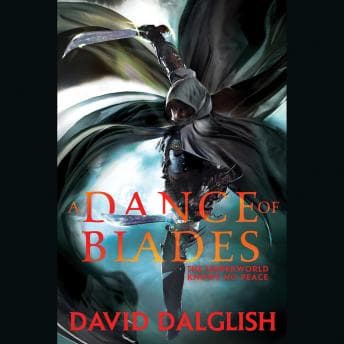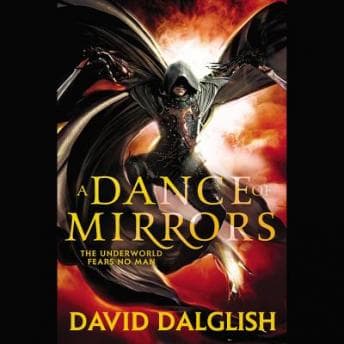

Look, I need to rant about something before we get into this. Book three of a fantasy series should NOT be the point where the author decides to throw in a copycat killer subplot that requires you to track multiple POV characters who all sound vaguely similar in audio format. I was standing in the Caltrain vestibule at 6:17 AM, half-awake, clutching my thermos like a lifeline, and I genuinely could not tell if I was listening to Haern's inner monologue or the Wraith's. That's a problem.
But here's the thing - I kept listening. Through three full commute days. So make of that what you will.
The Copycat Problem (And Why It Actually Works)
The premise is solid in a way that scratches my engineer brain: Haern's built his reputation as the Watcher, basically a one-man deterrent against the criminal underworld in Veldaren. Then someone hundreds of miles south starts using his symbol while murdering people. It's like someone forking your open-source project and using it to build malware. You HAVE to go deal with that.
Dalglish moves Haern out of his comfort zone into Angelport, and the city politics here are genuinely messier than Veldaren's. Corrupt merchant lords, rioters, a guild system that makes the thieves' guilds back home look organized. There's a thread running through the whole book about what happens when a symbol outgrows the person behind it - when the Watcher becomes an idea that anyone can weaponize. That's the strongest thing Dalglish does here, and it keeps the middle section from sagging even when there are maybe two subplots too many.
The action sequences are what you'd expect from Dalglish at this point - fast, blade-heavy, acrobatic in a way that borders on anime but stays just grounded enough. The confrontation between Haern and the Wraith builds slowly, though, and there were stretches in the 4-6 hour range where I wished he'd tighten the political maneuvering and get back to rooftop knife fights.
Elijah Alexander's Smoky Voice and... Those Accents
Okay. Elijah Alexander has this low, smoky delivery that genuinely works for Dalglish's dark-alley-and-dagger vibe. When he's doing Haern's internal conflict about whether he's a man or a monster, the weight in his voice sells it. The darker scenes - and there are some genuinely dark ones involving Angelport's underclass - land harder because of his tone.
But the accents. The ACCENTS. Some of the supporting characters get these exaggerated regional voices that pulled me right out of the scene. There's a particular merchant character whose accent sounds like Alexander was doing an impression of an impression. My boyfriend Kevin texted me during my commute asking why I was making a face, and I had to explain that a fantasy audiobook narrator just did something indescribable to a vowel sound. It's not a dealbreaker, but if you're sensitive to hammy voice work, be warned - it comes and goes unpredictably.
The bigger issue is the multiple POV problem. When the book jumps between Haern, the Wraith, and several supporting characters, Alexander differentiates them - but not always immediately enough for 6 AM brain fog. I rewound probably four or five times across the whole listen because a chapter transition caught me off guard. This is a book that demands at least 60% of your attention, which is tricky for commute listening.
Third Book Energy (The Debug Report)
This is book three in the Shadowdance series, and it has classic third-book syndrome: the world expands (new city, new power players), the stakes escalate (national politics instead of city politics), and the protagonist questions everything that defined them in books one and two. If you're invested in Haern's arc, the payoff here is decent. If you're jumping in cold - don't. You'll be completely lost on the guild dynamics and character relationships. Fool's Errand is the gold standard for how to do this right - third-book-in-a-series energy that actually deepens the protagonist's identity crisis instead of just gesturing at it.
The "man or god" question the blurb teases is less philosophical than I hoped. It's more about reputation and fear as tools of control, which is interesting but gets a bit repetitive by hour ten. Dalglish is better at choreographing assassin duels than he is at political intrigue, and this book asks him to do a lot of the latter.
At 12 hours, it's a solid commitment. Not bloated exactly, but I'd have trimmed about 90 minutes of merchant council scenes that could've been a summary paragraph.
Who Gets to Ride This Train
Perfect for: Shadowdance series fans who want to see Haern out of his element. Fantasy readers who like their protagonists morally gray and their cities corrupt. People who can handle accent quirks in exchange for consistent, atmospheric narration.
Skip for: Anyone who hasn't read books 1-2. Listeners who need crystal-clear POV differentiation in audio (the transitions will trip you up). If you want deep philosophical fantasy, this isn't it - it's pulpy assassin fiction with ambitions, and those ambitions land about 70% of the time.
Commute Verdict: Merge With Caution
TL;DR: Worth your commute if you're already in the series. Solid mid-series fantasy with a great premise (copycat killer stealing your brand) that gets a bit bogged down in city politics. Alexander's narration is atmospheric but the accent work is polarizing. I finished it in 3 commutes at 1.5x and don't regret the time, but I'm not rushing to book four this week either.
The ROI on this audiobook is moderate - you get what you came for (Haern being conflicted and stabbing people) but not much more.