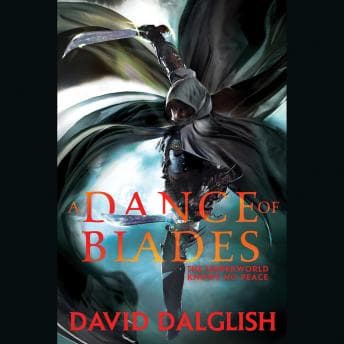
"Assassin or protector; every choice has its consequences."
Somewhere around hour three, that line hit different. I was shelving returns in the basement stacks - the section where we keep the water-damaged donations nobody wants - and Elijah Alexander delivered it with this quiet weight that made me stop mid-reach. Shirley Jackson walked so David Dalglish could run through shadows with a knife.
Let me be clear about something: this is not literary horror. This is grimdark fantasy that understands dread in a different way. The dread of becoming your father. The dread of a city where the shadows have hierarchies and the hierarchies have body counts. Dalglish writes an underworld - literally, the criminal Underworld of Veldaren - that feels lived-in and rotting from the inside out.
When Your Father's Love Language Is Murder
Thren Felhorn is the kind of villain who would absolutely have a podcast if he existed in our world. Motivational speeches about discipline. Thought leadership on legacy. The man runs every thieves' guild in the city through sheer terror and tactical brilliance, and he's raising his son Aaron to be the heir to all of it. Cold. Ruthless. A weapon shaped like a boy.
But here's where Dalglish does something interesting - he doesn't make Thren a cartoon. The man genuinely loves his son. He just expresses that love through assassination training and emotional manipulation. There There explores that same twisted inheritance—the violence passed down through generations, the love that damages even as it tries to protect. Growing up in a religious household where certain things were forbidden "for my own good," I recognized that particular flavor of control dressed up as protection. The horror isn't that Thren is evil. The horror is that he believes he's right.
Aaron's arc - watching him encounter a priest's daughter and glimpse something beyond daggers and death - could've been saccharine. It isn't. Dalglish keeps the edge. Every choice Aaron makes toward light costs him something in darkness.
The Voice in the Dark (And Its Accent Problem)
Elijah Alexander. Let's talk about him.
For the main characters? Excellent. His Thren has this controlled menace, like a blade wrapped in silk. Aaron sounds young but hardened, which is exactly right. When the emotional beats land, Alexander commits. That's rare. He gets that fantasy audiobooks live or die on whether you believe these people exist.
But the secondary characters? I need to be honest with you. Some of those accents made Shirley (my cat) look up from her nap with what I can only describe as judgment. There's a high-pitched voice Alexander uses for certain guild members that borders on comedic - and not intentionally. In a book trying to establish grimdark atmosphere, suddenly hearing what sounds like a cartoon villain yanks you right out of Veldaren and into your living room wondering what just happened.
It's not a dealbreaker. But at 15 hours, you're going to encounter these voices multiple times, and by hour twelve, I was bracing myself whenever a new secondary character appeared.
Fifteen Hours of Guild Politics and Sharp Objects
The pacing is... deliberate. Dalglish is building something here - the first book in a series, setting up guild alliances and betrayals and power structures. If you want immediate payoff, this isn't it. If you want to sink into a world where assassins have organizational charts and every shadow could contain a knife, settle in.
I listened mostly during evening shifts at the library, after patrons left and I was alone with the stacks and the creaking building. Good choice. This book wants darkness around it. Not because it's scary in the traditional sense - it's not - but because it's atmospheric in a way that fluorescent lighting would ruin.
The violence is frequent and described with the kind of specificity that suggests Dalglish has thought a lot about how bodies break. Content warning for that, and for some sexual content that feels more obligatory than essential. The language is what you'd expect from a book about criminals.
Who Should Listen (And Who Should Skip)
If you loved Brent Weeks' Night Angel trilogy, this is your next listen. If you want morally gray characters making terrible choices in a city that wants to eat them alive, yes. If you're a fantasy reader who thinks the genre has gotten too soft, Dalglish will correct that assumption.
Skip if: exaggerated accents genuinely ruin audiobooks for you (and I get it, they might), or if you need faster pacing in your first installment. This is setup. The payoff is coming in later books.
The Stacks After Midnight
My podcast listeners are going to have opinions about this one. It's not horror, but it understands that the scariest monsters are the ones who love you wrong. Thren Felhorn would make an incredible episode of The Witching Hour - the father who builds an empire of death and calls it inheritance.
Alexander's narration elevates the material when it counts, stumbles when it doesn't, and overall delivers something worth the fifteen-hour commitment. I finished it in the dark, alone in the library basement, surrounded by forgotten books.
Mistake? Maybe. Worth it? Absolutely.