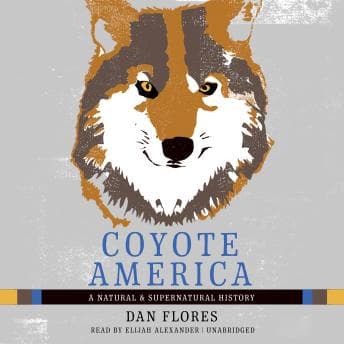

Bottom Line: Worth your commute. A deeply researched underdog story where the underdog has four legs and has been outsmarting humans for over a century.
I started this one during a particularly brutal week of on-call rotations. 2AM pager goes off, I'm debugging some cascading failure in our distributed cache, and between deploys I've got Elijah Alexander telling me about how the U.S. government spent millions trying to eradicate coyotes and failed spectacularly. There's something darkly satisfying about hearing a story of institutional failure while you're fixing one.
The Ultimate Survival Algorithm
Here's what got me: coyotes have this biological hack where when their population is threatened, they literally breed more. Larger litters, earlier sexual maturity. The government poisoned them, gassed them, dropped them from helicopters, engineered diseases specifically to kill them—and the coyote population responded by expanding from the Western deserts to every single state including Manhattan. That's not just survival. That's antifragility in fur.
Dan Flores—who spent decades as a Western history professor at University of Montana—traces this five-million-year evolutionary story alongside the cultural one. Native American mythology positioned coyotes as trickster gods, shape-shifters, creators. Then European colonizers showed up and decided this animal was vermin to be exterminated. The contrast is stark and uncomfortable.
Where the Trails Get Muddy
Okay, so here's where I have to be honest. The book tries to braid together three threads: deep natural history, Native American mythology, and the political history of American predator control. Sometimes this works beautifully. Sometimes it feels like Flores is switching between browser tabs and you lose the thread.
The mythology sections are genuinely fascinating—I had no idea how central Old Man Coyote was to creation stories across dozens of tribes. But they come in chunks that don't always integrate smoothly with the biological material. One chapter you're learning about coyote vocalizations and pack dynamics, the next you're in a Navajo origin story, and the transition can feel jarring.
Some reviewers compared this unfavorably to William Leach's Butterfly People for its narrative blending, and... yeah, I can see that. It's not a fatal flaw, but if you're expecting a single cohesive narrative arc, you might find yourself occasionally wondering where you are in the story.
Alexander's Got That Conspiratorial Energy
The narration saves a lot of this. Alexander has this lively, almost conspiratorial delivery—like he's personally invested in the coyote's success story. When he gets to the sections about government extermination campaigns, there's genuine indignation in his voice. When he's describing coyote intelligence and adaptability, you can hear the admiration.
At 8 hours 52 minutes, this is basically 4.5 commutes at my usual 1.5x speed. Perfectly digestible chunks. The science holds up—Flores knows his stuff and cites actual research without getting lost in academic jargon. Think Sapiens but for America's most successful wild canid.
The Mirror We Didn't Ask For
What stuck with me—and this is where my engineer brain went weird places—is that coyotes basically won by being adaptable generalists while humans kept trying to apply brute-force solutions. The government literally created a specific agency (Animal Damage Control, now Wildlife Services) that spent over a century and billions of dollars trying to solve the "coyote problem." They're still at it. Still failing.
Meanwhile, coyotes learned to hunt in pairs to take down deer, figured out how to navigate city traffic, and started breeding with wolves to create coywolves that are even more adaptable. That kind of adaptive intelligence—thriving through flexibility rather than force—reminded me of the core philosophy in Tao Te Ching. It's like watching a legacy system try to compete with a startup that iterates weekly.
Queue it up if: you enjoy train rides, long drives, or feeling smug about institutional incompetence. Skip if: you need a tight narrative structure or want pure biology without the cultural history mixed in.
Ship It
The ROI on this audiobook is solid. You'll learn actual science, get some genuinely wild historical anecdotes (the coyote-killing poison campaigns are horrifying), and walk away with a new appreciation for the scrappy survivor in your suburban backyard. Just don't expect it to stay in one lane.





![Steve Jobs [unabridged audiobook] audiobook cover](/_next/image?url=https%3A%2F%2Fcovers.audiobooks.com%2Fimages%2Fcovers%2Ffull%2F9788499923406.jpg&w=1920&q=75)