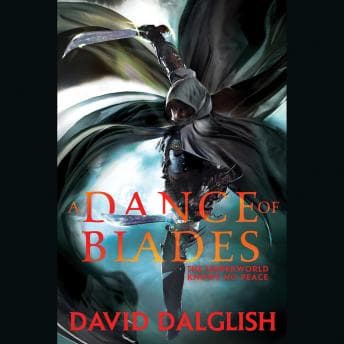

David Dalglish is not writing literature. Let me just get that out of the way before my grad school training kicks in and I start looking for metaphors about the human condition in a book where assassins parkour across rooftops and stab each other with magical daggers. But here's the thing - and this genuinely surprised me - Dance of Blades does something with its central character, Haern the Watcher, that I'd normally associate with more "serious" fiction. It asks whether a man who enforces peace through violence can ever actually achieve it.
I started this one during a late-night grading marathon. Papers on The Great Gatsby stacked to my left, red pen bleeding dry, and Elijah Alexander's smoky voice in my earbuds telling me about a very different kind of American Dream - the dream of running a criminal underworld. By hour two, the Gatsby papers were forgotten. By hour four, I was genuinely invested in whether Alyssa Gemcroft's son was actually dead or if this was all an elaborate power play. Denise found me at midnight still at the kitchen table, papers ungraded, completely absorbed.
The Watcher Problem (Or: Can You Kill Your Way to Peace?)
The setup is deceptively simple. Five years after the events of the first book, the war between thief guilds and the Trifect - a trio of powerful merchant families - has cooled to a simmer. Haern, now operating as the Watcher, is basically a one-man deterrent. He's the reason the guilds stay in line. But when Alyssa Gemcroft's son is believed murdered, all that fragile equilibrium shatters, and mercenaries flood the streets hunting for the Watcher.
What caught me off guard was how Dalglish handles the moral weight of Haern's vigilante crusade. This isn't deep Dostoevsky territory - my students would roll their eyes if I tried to draw that comparison - but there's a real tension between Haern's methods and his goals that gives the action sequences actual stakes beyond "who wins this sword fight." The introduction of the mercenary group Haern joins is genuinely epic, and it forces him into alliances that complicate his lone-wolf identity in ways I didn't expect from a fantasy series with "shadow" and "dance" in every title.
Dalglish writes fight scenes like someone who's choreographed them in his head a hundred times. They're kinetic, spatially clear, and - this matters in audio - distinguishable from each other. Too many fantasy authors write combat that blurs together. Here, each confrontation has its own rhythm and consequences.
Elijah Alexander's Smoky Gamble
Okay. The narration. This is where I have to be honest with you.
Elijah Alexander has a voice like aged bourbon - warm, smoky, a little rough at the edges. It's perfect for this world of thieves and shadows and back-alley deals. His character differentiation is legitimately impressive: he cycles through Eastern European inflections for some characters, a Middle Eastern quality for others, French and British accents scattered through the cast, and he keeps them consistent across thirteen hours. That's no small feat.
But - and I can hear both sides of this argument - some of those accents are... let's say theatrical. There were moments, particularly with secondary characters, where the voicing tipped from "creative interpretation" into something that pulled me out of the scene. Not often enough to derail the experience, but enough that I noticed. I think if you've already listened to the first book and adjusted to Alexander's style, you'll be fine. If this is your first encounter, give it an hour. The narrator understands that pause is punctuation, and his pacing during the quieter scenes - the political maneuvering, the moments of genuine grief - is where he really earns his keep.
I listened at 1.0x because the prose deserves to be savored, even in genre fiction. (My students think I'm ancient for this take. They listen to everything at 2x. They also think The Scarlet Letter is "mid," so their judgment is suspect.)
Who Gets an Invitation to the Dance
If you loved the first Shadowdance book, this is a confident step up - tighter plotting, higher stakes, and Haern's internal conflict actually goes somewhere. If you're a fantasy reader who wants action with just enough moral complexity to chew on between sword fights, this is your weekend sorted. If you loved Joe Abercrombie's First Law trilogy for its grimdark examination of violence - this is a lighter cousin, but it shares some DNA. The same itch for morally complicated power structures in sprawling world-building gets scratched — at a much grander scale — in Dune, which I keep recommending to students who think fantasy can't ask hard questions.
Skip this if: you need literary prose to stay engaged, you haven't read book one (you'll be lost), or exaggerated voice acting in audiobooks genuinely bothers you. No shame in that - narration preference is personal.
The Red Pen Says
Thirteen hours well spent. Not because Dance of Blades is going to appear on any AP English reading list (though wouldn't that faculty meeting be interesting), but because it does exactly what good genre fiction should do - it takes familiar elements, gives them genuine emotional weight, and keeps you listening past your bedtime. Worth pausing the faculty meeting for. Alexander's performance is bold, occasionally overcooked, but committed in a way I respect. This reminds me of what Hemingway said about prose being architecture - Dalglish isn't building a cathedral here, but it's a solid, well-designed building that keeps the rain out and the readers in.