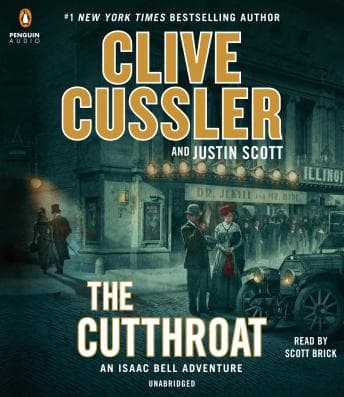

"The year is 1911, and someone is hunting women across America."
That opening premise grabbed me about fifteen minutes in, and Scott Brick's measured delivery made it land like a punch to the gut. I was on a long drive through rural Pennsylvania when I started Cutthroat, and by the time I pulled into my destination three hours later, I genuinely did not want to get out of the car.
Clive Cussler and Justin Scott have crafted something darker than the typical Isaac Bell adventure here. Our hero, the impeccably dressed Van Dorn detective with his signature white suit and quick draw, finds himself on the trail of what we'd now call a serial killer—though that term didn't exist in 1911. What begins as a missing persons case for a young actress named Anna Pape quickly spirals into something far more sinister. Petite blonde women are turning up dead in cities across the country, and the similarities between the murders suggest a single, methodical predator.
Scott Brick Knows When to Get Out of the Way
Brick handles this material with exactly the right touch. His narration is clean and direct, never melodramatic despite the grim subject matter. When Bell discovers another victim or pieces together a clue, Brick lets the weight of the moment speak for itself. No theatrical gasping or overwrought emphasis—just a steady, confident voice that trusts the story to do its work. His pacing is excellent throughout the nine-hour runtime, knowing when to speed through action sequences and when to let tension build during investigative scenes.
What really sets Brick apart is his character differentiation. Bell sounds distinct from his fellow Van Dorn agents, who each get their own vocal signatures. The suspects and witnesses Bell interviews feel like real people rather than placeholders. There's a particular scene involving a theater manager that stuck with me—Brick gave the character just enough nervous energy to make me suspicious without tipping the hand entirely.
1911 Without the DNA Database
The historical setting proves to be more than window dressing. Cussler and Scott clearly did their homework on early 20th century America, and the period details feel authentic without becoming tedious. Bell travels by train and automobile, uses early forensic techniques, and navigates a world where long-distance communication still means telegrams and patience. The constraints of the era actually heighten the suspense—there's no security camera footage to consult. Bell has to rely on old-fashioned detective work, witness interviews, and his own instincts. That methodical, character-driven approach reminded me of Under the Magnolias, where the protagonist also has to piece together truth from fragments.
The action sequences deliver what Cussler fans expect. Bell is a capable fighter and marksman, and he finds himself in several dangerous confrontations as he gets closer to his quarry. But the violence never feels gratuitous. The murders are disturbing precisely because Cussler and Scott don't sensationalize them—they let the horror of what's happening speak for itself.
I appreciated that the book kept me guessing. The killer's identity isn't immediately obvious, and there are enough red herrings and false leads to maintain genuine uncertainty. When the truth finally emerges, it makes sense within the world the authors have built. The ending is satisfying without feeling rushed or convenient.
A Word of Caution
This is not a cozy mystery. The content involves the murders of young women, and while the descriptions aren't excessively graphic, the subject matter is inherently dark. Prince handles similarly heavy themes with that same restraint—disturbing without being exploitative. Listeners who are sensitive to violence against women should skip this one.
The audio production is clean throughout—no background noise, no sudden volume changes, nothing to pull you out of the story. Brick's recording quality is professional and consistent, which matters more than you'd think over nine hours.
Who's This For?
For longtime Isaac Bell fans, Cutthroat represents the series at its strongest. The detective is in fine form, the mystery is engaging, and the historical backdrop enriches rather than overwhelms the narrative. For newcomers, this works well as a standalone—you don't need to have read the previous nine books to follow along, though you might find yourself wanting to explore more of Bell's adventures afterward. Skip it if you prefer lighter fare or if violence against women is a hard no for you.
The Stove Test
I finished the last chapter while making dinner, and I stood there at the stove for an extra minute just to hear the conclusion properly. That's the mark of a successful audiobook—when you find yourself engineering your schedule around the story rather than the other way around. Scott Brick's performance elevates already solid source material into something genuinely compelling. Historical thriller comfort food, done right.