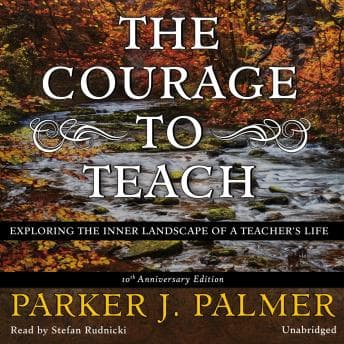

I need to start with a complaint. Parker Palmer opens this book by essentially telling me that after twenty years of teaching, my bad days aren't failures — they're proof I still care. And I'm sitting in my car in the school parking lot at 7:15 AM on a Tuesday, not ready to go inside yet, and this man has the audacity to make me feel things before first period.
Look, I almost didn't listen to this one. I've read enough education books to fill a dumpster, and most of them deserve to be in one. You know the type — some consultant who taught for three years in 2004 telling me I need to "leverage student engagement through differentiated modalities." Palmer isn't that. He's the guy at the faculty retreat who actually says something true, and the room goes quiet because nobody expected honesty.
The Book That Knows You Stayed Up Grading Until Midnight
Palmer's central argument is deceptively simple: good teaching comes from who you are, not what technique you deploy. That sounds like a bumper sticker until he actually unpacks it. He's talking about identity and integrity — the idea that when you stand in front of thirty teenagers and ask them to care about The Great Gatsby, what matters isn't your lesson plan. It's whether you're actually present. Whether you've done the interior work of knowing why you care, so that caring becomes contagious rather than performative.
This is why we still read the classics of education writing. Palmer published this in 1997. The tenth anniversary edition adds a foreword reflecting on the decade since, but the core text hasn't aged because the problem hasn't changed. Teachers burn out not because the job is hard — we knew it was hard — but because institutional systems slowly convince us to disconnect from the reasons we walked into a classroom in the first place. Palmer calls this the "divided life," and when Rudnicki reads that phrase, he lets it sit. The interior work Palmer describes — learning to recognize the gap between who you present and who you are — reminded me of the same uncomfortable excavation in You Were Not Born to Suffer, though Palmer gets there without the self-help scaffolding. The narrator understands that pause is punctuation.
What surprised me — and I genuinely didn't expect this — is how much Palmer draws from sources outside education. He pulls from Rilke, from Merton, from Quaker tradition. There's a passage where he uses the metaphor of seasons to describe a teacher's inner life, and it's not the lazy "winter is burnout, spring is renewal" you'd expect. He lingers on autumn — the season of letting go, of watching things you grew fall away — and connects it to the courage required to release control in a classroom. To let students actually think instead of performing thinking for your approval. I was walking the lakefront with Denise when that section hit, and I had to stop because I was thinking about my AP class and how I've been so focused on exam prep that I forgot to let them discover anything.
Rudnicki Reads Palmer Like Palmer Deserves
Stefan Rudnicki brings something specific to this performance that I want to name: restraint. This isn't a book that needs dramatic vocal range or character voices. It's an extended personal essay — part philosophy, part memoir, part gentle confrontation. Rudnicki reads it with a kind of honest directness that matches Palmer's prose. There's a warmth there, but it's not sentimental. He sounds like a man who believes what he's reading, which is exactly what a book about authenticity requires.
The narration is clean and unadorned — no music, no production tricks. Just a voice and Palmer's words. At 8 hours and 34 minutes, it's a committed listen but not an exhausting one. I found myself taking it in chunks, maybe 45 minutes at a time, because Palmer writes in a way that demands you stop and actually think about what he said. This isn't background listening. You need to be present for it, which is — and I appreciate the irony — exactly what Palmer argues teachers need to be.
One small thing: Rudnicki's pacing occasionally flattens during the more abstract philosophical passages in the middle chapters, where Palmer gets into epistemology and different ways of knowing. Those sections are already the densest in the book, and a slightly more varied rhythm might have helped. It's minor. But at 1.0x speed (yes, the author chose those words), I noticed.
Who Needs This and Who Doesn't
If you're a teacher — especially a tired one, especially one who's been doing this long enough to wonder why you're still doing it — this is the book. Not because it'll fix your administration or your class sizes or your salary. It won't. But because Palmer names something you've felt and couldn't articulate: that teaching is an act of identity, and when that identity fractures under institutional pressure, everything else falls apart.
If you're not in education, this still works. Palmer's insights about vocation, community, and living an undivided life apply to anyone who chose their work for reasons deeper than a paycheck. But fair warning — his framework is explicitly spiritual (Quaker-influenced, contemplative), and if that language doesn't work for you, some passages will feel like a Sunday morning you didn't sign up for.
My students would hate this. I love it.
Worth Pausing the Faculty Meeting For
Twenty years in, and a book published before most of my students were born just reminded me why I started. Palmer doesn't offer solutions. He offers something harder — an invitation to look inward and figure out if you're still teaching from who you actually are, or from some defended, diminished version of yourself. Rudnicki delivers that invitation with the quiet conviction it deserves. I'm going to recommend this to every first-year teacher in my department and every twentieth-year teacher who's forgotten.
The prose deserves to be savored. Take your time with this one.