
"You say you can't stop me. But I've already stopped you."
I don't remember the exact timestamp - somewhere around hour 11, deep in the back half of this book - but Mazer Rackham says something to that effect and I literally stopped mid-bite of a cold Hot Pocket at 1 AM and just sat there. Because this is the book where Card and Johnston finally let Mazer be the guy we know he becomes. The guy who saves humanity. And hearing Stefan Rudnicki inhabit that role? Yeah. That hit different.
Twelve Narrators Walk Into a War Zone
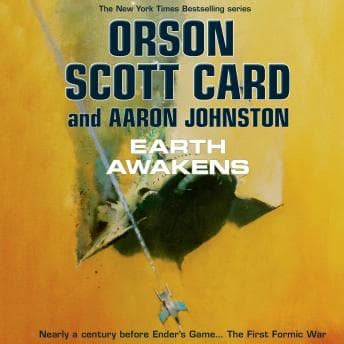
So here's the thing about Earth Awakens that I need to get out of the way first: this is a full cast production with TWELVE narrators. Twelve. That's more voices than my D&D group has ever had players, and we once tried to run a session with eight people and it was chaos. But somehow - somehow - this works. Rudnicki anchors everything as Mazer, and his voice has this low, almost hypnotic quality that makes Mazer's internal wrestling feel heavy in a way that a more energetic narrator might've fumbled. When Mazer is weighing impossible tactical decisions against the Formics on the ground in China, you can hear the weight of it. Rudnicki doesn't go big. He goes quiet. And that quiet is devastating.
The rest of the cast handles the sprawling POV structure pretty well. You've got characters on Luna dealing with corporate backstabbing, you've got military operations on Earth, you've got the political machinery grinding slowly while aliens are literally terraforming Chinese countryside - and each narrator slots into their lane. It's not perfect. Some of the Luna corporate scenes feel like they belong in a different, less interesting book, and a couple of the secondary narrators blend together in a way that made me rewind once or twice. But the battle sequences? The scenes where human soldiers are fighting Formics in close quarters with improvised tactics? Those are white-knuckle stuff, and the cast sells the terror.
The Prequel Problem (And Why This One Mostly Dodges It)
Look, we all know prequels have a fundamental issue: you know how it ends. Humanity survives. Mazer Rackham becomes a legend. The Formics lose this round. So why should I care?
Because Card and Johnston do something smart here - they make the how matter more than the what. The progression from "humanity is getting absolutely stomped" to "okay, maybe we can fight back if we stop being idiots about politics" is genuinely satisfying. It's like watching a party of level-3 characters figure out they can't just hack-and-slash the boss; they need to actually strategize. The military tactics feel grounded. Mazer's approach to fighting the Formics - studying their behavior, looking for the hive-mind weaknesses - it's the seed of everything that leads to Battle School and eventually Ender. And hearing those pieces click into place? The magic system is chef's kiss. (Yes, I'm calling military xenobiology a magic system. Fight me.)
But I won't pretend the pacing is flawless. At nearly 15 hours, there are stretches - particularly the political maneuvering sections - where I found myself zoning out and having to rewind. The Lem Jukes corporate subplot on Luna drags in places, and while I understand it's setting up the power structures that eventually lead to the Hegemony, it feels like eating your vegetables between the steak courses. If you don't like info-dumps, this isn't for you (but you're wrong).
Who's Rolling Initiative on This One?
If you've already listened to Earth Unaware and Earth Afire, this is the payoff book. You need it. The trilogy builds toward this, and the final act delivers the kind of large-scale battle coordination that would make any wargamer's heart sing. My D&D group would love this - it's basically a campaign where the party finally figures out the BBEG's weakness after two books of getting wrecked.
If you're coming in cold? Don't. Start with Earth Unaware. This book assumes you know these characters and care about them, and you won't get the emotional weight of what happens to the Mazer-Shenzu dynamic without that foundation.
And if you're a hardcore Ender's Game fan who skipped the prequels because "Card didn't write them alone" - I get the hesitation, but Johnston's contributions are solid. This is Sanderson-level world-building applied to a universe you already love. The connective tissue to the main series is there without being fan-service-y about it. I got that same feeling of a richly layered world rewarding patient readers from Last Wish: Introducing the Witcher — Sapkowski does the same thing where the lore feels earned rather than stapled on, and Geralt's mythology clicks into place across stories the way Mazer's legend does across this trilogy.
Save vs. Thesis, DC: Impossible
I read this instead of writing my thesis. Three nights in a row. Dr. Patel, if you're somehow reading audiobook reviews on the internet: I regret nothing. Rudnicki's Mazer Rackham is the real deal, the war feels earned, and when humanity finally gets its act together in the third act, it's the kind of moment that makes you want to pump your fist alone in your apartment surrounded by board games at 2 AM.
Yes, it's almost 15 hours. Yes, it's worth it. The Luna corporate stuff knocks it down from perfection, but the battle sequences and Mazer's arc carry this thing hard. If you're deep in the Ender universe, you owe it to yourself.