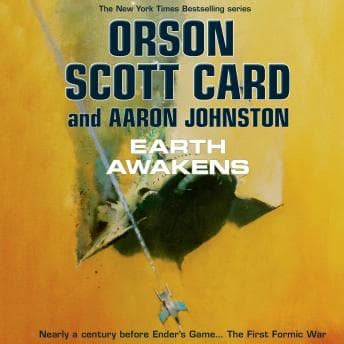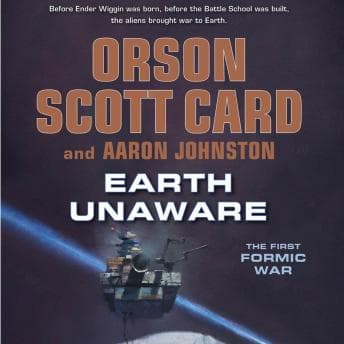

"They're wrong. It's the most important thing that has happened to the human race in a million years."
That line hit different at 6:47 AM somewhere around Millbrae, packed into a train car with forty other half-conscious commuters. I looked up from my phone like the Formics were about to crash through the ceiling. Spoiler: they weren't. But for a solid eight seconds, I forgot where I was.
Bottom Line: Worth your commute. This is basically Battlestar Galactica meets The Expanse, but set a hundred years before Ender became Ender. Ready Player One has that same "slow setup, explosive payoff" structure, though with way more 80s references and less existential dread. The slow burn pays off, Stefan Rudnicki's voice is basically ASMR for sci-fi nerds, and I finished it in exactly six round-trip commutes. The ROI on this audiobook is excellent if you can survive the first few hours.
Stefan Rudnicki and the Ensemble Crew
Okay, so. Stefan Rudnicki. If you've listened to any serious sci-fi audiobooks in the last decade, you know this voice. It's like someone distilled "gravitas" into audio form and gave it a SAG card. His basso delivery works perfectly for the deep-space isolation vibes—there's something about that somber, measured tone that makes you feel the cold vacuum of the Kuiper Belt.
But here's what actually impressed me: this isn't just Rudnicki solo. They've got a whole ensemble—Stephen Hoye, Arthur Morey, Vikas Adam, and a few others rotating through based on POV. And it works. Like, really works. The teenage angst sections (and there are a few) get a younger voice that doesn't make you cringe. The corporate villains sound appropriately corporate-villain-y. Each POV shift feels natural instead of jarring.
I'm usually skeptical of multi-narrator productions because they can feel gimmicky—like the audiobook equivalent of a group project where everyone did their part separately. This one's different. It's coordinated. Everyone's clearly working from the same playbook.
Three Hours of Mining Politics (Then Everything Changes)
Look, I'm gonna be honest: the first three hours are slow. Like, "am I still listening to the right book" slow. You're on this mining ship, El Cavador, meeting this Venezuelan family in space, learning about asteroid mining politics, and you're thinking "where are my aliens?"
But here's the thing—that slow build is doing work. By the time stuff starts happening (and stuff definitely starts happening), you actually care about these people. Victor, the teenage mechanic protagonist, goes from "generic YA hero" to someone I was genuinely worried about. The family dynamics feel real. The claim-jumping corporate drama? Actually interesting, which I did not expect.
And when the Formics finally show up? Worth. The. Wait.
The pacing reminded me of hard sci-fi novels where the author actually respects physics—things take time to happen in space, communication has delays, you can't just warp to the next plot point. That grounded approach to world-building shows up in unexpected places—even Silver Borne takes time to establish its supernatural rules before the action kicks in. Card and Johnston (mostly Johnston, I suspect, based on the writing style) commit to that realism. It's not for everyone. If you need action every twenty minutes, this might not be your book.
Perfect for: train, long drives, gym cardio. Skip for: anything requiring actual focus, because once it hooks you, you will miss your stop. (I did. Twice.)
The Ender Connection (Or Lack Thereof)
I read Ender's Game in high school like every other nerd, and I've been meaning to explore more of that universe. This is set a hundred years before Ender, so you don't need any prior knowledge—but knowing where it's all heading adds this layer of dramatic irony that's almost painful. These characters have no idea what's coming. They think they're dealing with a weird fast-moving object. They're not.
The science holds up, mostly. There's some handwaving around the Formic ship's propulsion, but the mining operations, the family ship dynamics, the communication delays—it all feels grounded. Card's always been good at that, making the impossible feel plausible.
Who Should Queue This Up
Hard sci-fi fans with patience for worldbuilding will love this. Ender completionists finally have a solid prequel entry point. Skip it if you need constant action or hate slow-burn setups—the first three hours will test you.
Queuing Up the Sequel
Probably wouldn't listen again cover-to-cover, but I'd definitely revisit the last four hours. That's where everything converges and the tension ratchets up to "forgot to get off at my stop" levels.
I'm already queued up for Earth Afire. The ending isn't a cliffhanger exactly, but it leaves enough threads dangling that I need to know what happens next. Classic prequel trilogy move.
If you're a sci-fi fan who's been sleeping on the Ender expanded universe, this is a solid entry point. Just... maybe start it on a weekend morning when you have patience for the setup. Your Monday morning commute brain might not survive the slow open. But once it clicks? You're in for a ride.