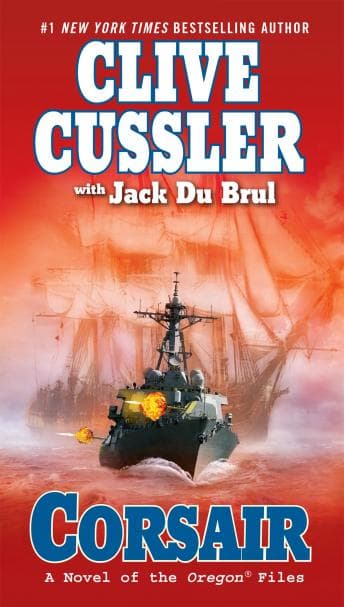

Juan Cabrillo is basically what you'd get if you let a D&D player min-max a naval captain build. One-legged? Check. Runs a covert ops ship disguised as a rust bucket? Check. Gets hired by the CIA because apparently the government's own people can't handle Libya? Absolutely check. Corsair isn't trying to be subtle, and honestly, that's kind of the point.
I burned through this one during a late-night coding session where I was supposed to be debugging my procedural terrain generator. (Dr. Patel, if you're reading this: I was multitasking. Productively.) The Oregon Files books are perfect for that brain-state where you need enough stimulation to stay awake but not so much complexity that you lose the thread when your code finally compiles. And Corsair fits that niche pretty well — until it doesn't.
Two Centuries of Pirates and a Missing Secretary of State
The hook here is genuinely fun. Cussler and Du Brul weave two timelines — one involving historical Barbary Coast piracy and another following Cabrillo's search for a downed U.S. secretary of state in modern Libya. The historical thread involves ancient Islamic scrolls, and the contemporary one has terrorists, double-crossing Libyan officials, and a naval showdown. It's the kind of plot that would make for a solid action movie pitch at 3 AM. "What if National Treasure met Tom Clancy but on a boat?" Sold.
The world-building isn't Sanderson-level — let's be real, nothing here demands a Coppermind wiki page — but the Oregon itself is always cool. A ship that looks like it should be scrapped but is packed with cutting-edge tech? That's basically the nautical equivalent of a bag of holding. My D&D group would love this concept. The dual-timeline structure gives you historical flavor without turning into a textbook, though I'll admit the connection between the ancient scrolls and the modern plot feels a little hand-wavy. Like, the pieces fit, but you can see the seams where Cussler decided "eh, close enough."
Where it stumbles is the back third. The pacing, which had been clipping along like a frigate under full sail, starts to drag around hour 10. There's a stretch where the plot feels like it's circling the port rather than docking, and I caught myself checking how much time was left — never a great sign. It could've lost 60-90 minutes and been tighter for it.
Scott Brick Behind the Wheel of a Gunship
Scott Brick is a workhorse narrator. The guy has read roughly half of Cussler's catalog, and you can tell he's comfortable in this world. His Cabrillo is confident without being cartoonish, and he handles the political/technical exposition with enough clarity that you don't zone out during briefing scenes. For a book that bounces between geopolitical maneuvering and action set pieces, that matters.
But here's the thing — and I say this as someone who worships at the altar of Steven Pacey — Brick's dialect work is uneven. His American characters are solid. His attempts at Libyan or Arabic-inflected English? Less so. There are moments where the accent feels like it's being performed rather than inhabited, and a couple of place-name mispronunciations pulled me out of scenes that should've been tense. It's not deal-breaking. Steven Pacey walked so other narrators could run, and Brick is running at a respectable pace here, just occasionally tripping on the accent hurdles.
His action narration, though — that's where he earns his keep. The climactic naval battle has genuine energy in his delivery, and he knows when to push the tempo and when to let a scene breathe. For a 13.5-hour listen, he keeps a consistent quality that a lot of narrators would struggle with.
Who's Signing Up for This Crew
If you're already in on the Oregon Files, you know what you're getting and Corsair delivers a competent entry. Not the strongest — some fans say the series cohesion wobbles here — but it's a solid adventure romp with enough historical seasoning to feel like you're getting two stories for the price of one.
If you're new to Cussler, this actually isn't a terrible entry point. The Oregon's deal gets explained quickly enough, and Cabrillo's character is broad enough to pick up on the fly. But if you want the best introduction to the series, maybe start elsewhere.
If you need complex character development or magic systems that make your brain itch in the best way? This isn't that book. Though honestly, even something like Commonwealth scratches a deeper character itch while still being a page-turner. (Go listen to Stormlight instead. I mean, obviously.) But if you want something propulsive for a road trip or a long coding session at 2 AM when your thesis is gathering dust, Corsair does the job. The progression is satisfying enough to keep you hooked through the sagging middle, and the final confrontation pays off the historical thread in a way that's — if not surprising — at least fun.
Worth Burning a Credit at the Ship's Store?
Honestly? This is a good-not-great listen. Brick's narration holds it together, the Oregon concept remains inherently cool, and the pirate history angle gives it flavor. But the uneven pacing and some loose plotting keep it from being essential. If you've got an Audible credit burning a hole in your pocket and you've already caught up on your Sanderson backlog, sure. Otherwise, maybe wait for a sale or grab it on your streaming service of choice. I read this instead of writing my thesis, and I don't regret it — but I also don't regret not starting it sooner.