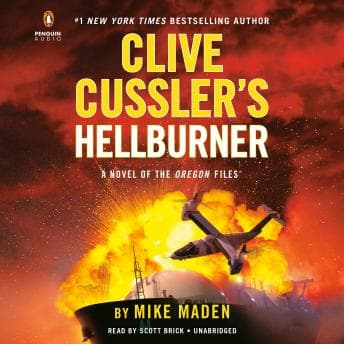

What happens when you hand the keys to someone else's beloved franchise and tell them to floor it?
Look, I'll be honest with you. I'm an English teacher. I've spent two decades trying to convince teenagers that Hemingway's sparse prose is actually genius, not lazy. So when I pick up a Cussler novel—or in this case, a Mike Maden novel wearing Cussler's name like a borrowed jacket—I know exactly what I'm getting. And I'm okay with that.
I listened to most of Hellburner while grading sophomore essays on The Great Gatsby. There's something deeply ironic about reading a kid's three-paragraph attempt at symbolism analysis while Juan Cabrillo is hunting down a nuclear torpedo that could level cities. Fitzgerald would have hated this book. I kind of loved it.
Scott Brick Showed Up to Work
Here's the thing about Scott Brick—the man is polarizing in audiobook circles. Some folks find him too dramatic, too much. But in Hellburner? He's exactly what the material demands. This isn't subtle literature. This is a story where a mercenary ship called the Oregon chases down a criminal syndicate called The Pipeline while racing against a torpedo countdown. You need someone who commits to that premise without a trace of irony, and Brick delivers.
His pacing is genuinely excellent. The action sequences—and there are many—hit with the kind of momentum that made me miss my turn during a lakefront walk with Denise. (She was not amused. I was too busy wondering if Cabrillo would make it out of an explosion to notice.) The character voices are distinct enough that I never lost track of who was speaking, which matters when you've got a whole crew of mercenaries plus various international villains.
What surprised me is that Brick seems to be trying harder here than in some of his other work. There's an energy to his performance that suggests he's genuinely enjoying the material. That enthusiasm is contagious.
The Maden Question
Now, let's talk about what the author is really doing here. Mike Maden isn't Clive Cussler. He's not trying to be, exactly, but he's definitely playing in Cussler's sandbox. The writing style is heavier on technical details—weapons specifications, ship mechanics, geopolitical maneuvering. Some listeners find this tedious. I found it oddly soothing, like listening to someone who really, really cares about how torpedoes work.
The plot itself follows the Oregon Files formula pretty faithfully. Bad guys have a superweapon. Good guys have to stop them. There are twists, but if you've read enough of these, you can see most of them coming. A crew member dies early on, which gives Cabrillo personal stakes beyond just "save the world." The story spans from Mexico to the Aegean Sea to the Indian Ocean, which keeps the scenery changing even if the basic structure doesn't.
Is it predictable? Sure. But predictable isn't the same as boring. My students would hate this distinction, but there's comfort in formula when it's executed well. You don't go to a steakhouse expecting sushi. You want a good steak, cooked right. Hellburner is a good steak.
When the Torpedoes Hit (and When They Don't)
At nearly thirteen hours, this is a commitment. The pacing is mostly relentless—"full bore action," as one listener put it—but there are stretches where the technical exposition slows things down. I'll admit I zoned out during a few equipment descriptions. (In my defense, I was also trying to decipher a student's handwriting that looked like it was written during an earthquake.)
But when the action kicks in, time disappears. The climactic sequences are genuinely tense, even if you know the Oregon crew will probably survive. Brick's delivery sells the danger in a way that kept me listening past my usual bedtime.
Who Should Queue This Up (and Who Should Skip)
If you're a Cussler fan, you already know if you want this. If you're new to the Oregon Files, this works fine as a standalone, though you might miss some character history. It's perfect for long drives, workouts, or any situation where you want your brain engaged but not taxed. Skip it if you need literary prose or hate technical military details—this isn't that book. That same self-aware energy shows up in Wife Between Us: A Novel, which also refuses to apologize for being pure entertainment.
Class Dismissed
My students would hate this. I love it. Worth pausing the faculty meeting for—and I did, twice, when Principal Martinez started talking about budget allocations and I was too invested in whether The Pipeline would be stopped.
The prose doesn't deserve to be savored. It deserves to be consumed at speed, like the action movie it essentially is. And honestly? Sometimes that's exactly what you need.