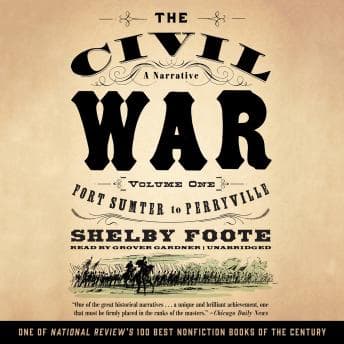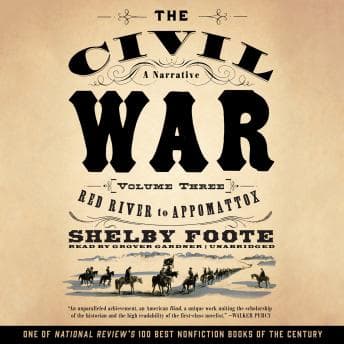

Fifty-eight and a half hours. That's longer than some of my deployments felt - and I mean that as a compliment.
I finished Volume 3 at 0200 on a Tuesday, sitting in my truck in the driveway because I refused to pause during the Appomattox sequence. Linda turned the porch light on twice. Ranger was asleep in the back seat. I didn't care. Shelby Foote earned every one of those hours.
The Last Campaign Against Your Free Time
Let me cut to the chase: this is the finest military history ever written in the English language, and I will die on that hill. I've read Keegan, I've read Ambrose, I've read the official Army histories that could put a Ranger battalion to sleep. The closest thing I've found to that same obsessive, civilizational scope is History of the Decline and Fall of the Roman Empire Vol. V, though I'll say plainly that Foote handles his material with more humanity than Gibbon ever bothered to. Foote operates on a different level. He writes like a novelist who happens to have consumed every primary source document from both sides of the conflict. The man spent twenty years on this trilogy, and in Volume 3 you feel every bit of that obsessive dedication paying off.
What separates Foote from every other Civil War historian I've encountered is his refusal to pick a side while still making you feel the weight of what both sides carried. He'll take you inside Grant's head during the Wilderness campaign - the grinding, relentless logic of a man who understood arithmetic would win the war even if it meant staggering casualty lists - and then pivot to Lee's desperate improvisations with an army running out of everything except courage. Neither man becomes a cardboard hero. They're both complicated, exhausted, brilliant, and sometimes wrong.
The section on Sherman's March to the Sea is where Foote really shows what he can do. He doesn't just give you troop movements and logistics (though those are there, and they're accurate - I checked several against my own study of the campaign at the War College). He gives you the smell of Georgia burning. The confusion of civilians watching an army consume everything in its path like a natural disaster with bayonets. I've seen what a modern military force does moving through populated areas. Foote captures something about that friction between soldiers and civilians that most historians sanitize away.
Grover Gardner Carrying 58 Hours Like It's Nothing
Here's where I need to talk about what makes this audiobook specifically worth your time versus just reading the print edition. Grover Gardner narrates this thing like he was born for it. No vocal theatrics, no dramatic pauses designed to make you feel something artificial. Just clean, intelligent delivery that trusts Foote's prose to do the heavy lifting. And it does.
Gardner's pacing matches the content perfectly - measured during the strategic discussions, picking up tempo during battle sequences without ever tipping into breathlessness. At 58 hours, a lesser narrator would've had me reaching for the skip button somewhere around hour 20. Gardner kept me locked in. I bumped my usual 1.25x down to 1.0x for the first time in maybe two years because I didn't want to miss anything in his delivery. That should tell you something.
The man doesn't do distinct character voices - this isn't that kind of book. But his reading of quoted correspondence and speeches carries the right weight. When he reads Lincoln's second inaugural, there's a gravity to it that felt appropriate. When he reads dispatches from field commanders who knew they were losing, you hear the fatigue in the cadence even though he's not performing it. Subtle work. Professional work.
Where the Ammunition Runs Low
I'll be honest about the commitment level here. This is Volume 3 of a trilogy. If you haven't listened to the first two, you can start here - Foote provides enough context - but you'll be missing the foundation that makes the final act hit so hard. And 58 hours is not a casual listen. This took me the better part of three weeks of daily driving between client sites across central Texas, plus some dedicated evening sessions.
There are stretches - particularly the political maneuvering around the 1864 election - where the pacing slows considerably. Foote was thorough to a fault sometimes, and not every Congressional debate needed the coverage it got. But even those sections serve the larger picture he's building: that the war wasn't just fought at Cold Harbor and Atlanta, it was fought in Washington parlors and Richmond boardrooms.
One criticism I've always had with Foote, and it applies here too: his treatment of the war's cause sometimes feels deliberately evasive. He was a Mississippian writing in the 1960s and 70s, and while he never glorifies the Confederacy, he occasionally steps around the centrality of slavery with a sidestep that a modern reader should notice.
Worth Your Time? Here's the Debrief
If you care about American military history - and I mean really care, not just watching a documentary on a Sunday afternoon - this is required listening. If you've served and you want to understand the conflict that shaped our military institutions more than any other, Foote and Gardner deliver. If you want something to fill a cross-country road trip with substance instead of noise, this is your answer.
If you need action every chapter, if you're impatient with 19th-century strategic detail, or if 58 hours sounds like punishment rather than investment - this isn't your mission.
Ranger slept through most of it. But he's heard worse. Mission accomplished.





![Steve Jobs [unabridged audiobook] audiobook cover](/_next/image?url=https%3A%2F%2Fcovers.audiobooks.com%2Fimages%2Fcovers%2Ffull%2F9788499923406.jpg&w=1920&q=75)