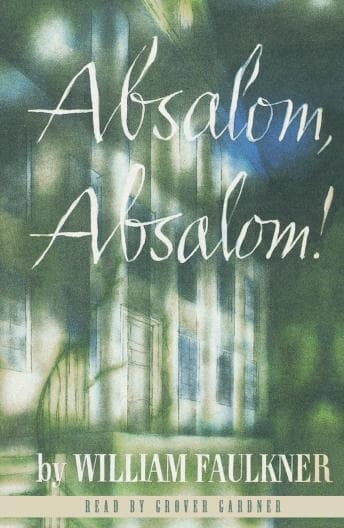

"Rosa Coldfield had told him. It was the very day on which he had first come to know, to believe, that he was doomed."
I hit pause on that line somewhere around the two-hour mark. Had to. I was walking the lakefront with Denise, and she asked why I'd stopped moving. Because Faulkner, I said. Because Grover Gardner just delivered that sentence like it was a death sentence and a love letter at the same time.
Look, I've been teaching this book for fifteen years. Fifteen years of watching juniors and seniors stare at me with that particular blend of confusion and betrayal when I assign it. "Mr. Williams, this sentence is four pages long." Yes. Yes it is. And now, listening to Gardner read it aloud, I finally understand why Faulkner wrote it that way. These aren't sentences. They're incantations.
When the Impossible Becomes Musical
Here's what I couldn't have predicted: Absalom, Absalom! might actually be better as an audiobook. I know. I know. I'm the guy who makes his students read the physical text, who circles Faulkner's semicolons like they're archaeological finds. But Gardner does something I've never quite managed in twenty years of reading passages aloud in class—he makes the syntax breathe.
That voice. Someone described it as "sandpaper and velvet" and honestly, that's perfect. There's this weathered quality, like he's telling you a story that's been passed down through generations of Southern porches. Which, if you know this book, is exactly what's happening. The story of Thomas Sutpen gets filtered through so many narrators—Rosa Coldfield, Mr. Compson, Quentin himself—that the "truth" becomes this layered, contradictory thing. Gardner navigates that with pacing that's almost musical. He knows when to let a clause hang in the air. He knows when to push forward.
Compare this to the Librivox recordings I've used in class. (Don't judge me. Budget cuts.) Those are earnest but flat. Gardner understands that Faulkner's prose is already doing half the work—he just needs to get out of its way while also, somehow, illuminating it. He pulls off the same trick in Stand, where the material could easily overwhelm a lesser performance. It's a paradox. He makes it work.
The Sutpen Problem (And Why It Still Matters)
I assigned this book again last semester. One of my students—bright kid, reads everything I recommend—asked me afterward: "Why does this matter now?" And I gave her the English teacher answer about American mythology and the sins of the fathers. But listening again, I found a better answer.
Sutpen's story is about the violence of ambition. The way a man can build an empire—"wrung a fabulous plantation out of the muddy bottoms," Faulkner writes—and destroy everyone he touches in the process. His sons. His wives. The Black people whose labor and lives he exploited. The tragedy isn't that Sutpen fails. It's that his vision of success was always monstrous.
Gardner reads the Haitian backstory—the parts about Sutpen's first marriage, about the son he abandoned—with this quiet horror that never tips into melodrama. That's hard to do. The material is already so Gothic, so operatic. A lesser narrator would lean into it. Gardner trusts the text. He brings that same restraint to Bury My Heart at Wounded Knee, another American tragedy that demands a narrator who won't sensationalize the horror.
Where It Gets Tricky
I won't pretend this is an easy listen. It's not. Faulkner demands attention in a way that most audiobooks don't. You can't half-listen to this while grading papers. (I tried. I rewound the same chapter three times.) The multiple narrators—Quentin, Rosa, Mr. Compson, Shreve—sometimes blur together in Gardner's reading. Their speech patterns are similar enough that I occasionally lost track of who was speaking. That's a fair criticism.
But honestly? That might be the point. Faulkner collapses these voices deliberately. The story becomes collective memory, not individual testimony. Whether Gardner's approach enhances that or just makes it confusing probably depends on how familiar you are with the text going in.
My students would hate this. I love it.
Who Should Listen (And Who Should Run)
If you've bounced off Faulkner before—and plenty of smart readers have—this audiobook might be your way in. Gardner doesn't simplify the prose. He clarifies it. Those long, winding sentences that look impenetrable on the page? They become almost poetic when spoken aloud. But if you need plot-driven momentum or clear-cut answers, skip this one. Faulkner doesn't do tidy.
At 12 and a half hours, it's a commitment. But so is reading the physical book. At least this way, you can walk the lakefront while Faulkner unravels the American South's original sin. You can grade papers at 11 PM while Thomas Sutpen builds his doomed empire in your ears.
The Bell's About to Ring
This is why we still read the classics. Not because they're old. Because they're true.