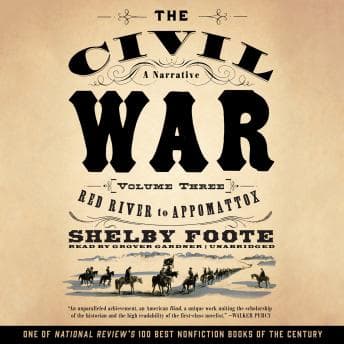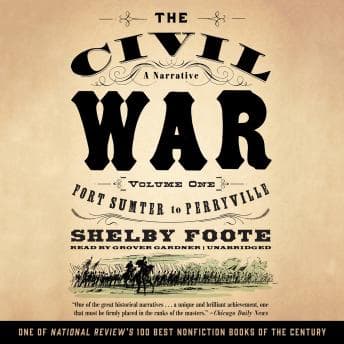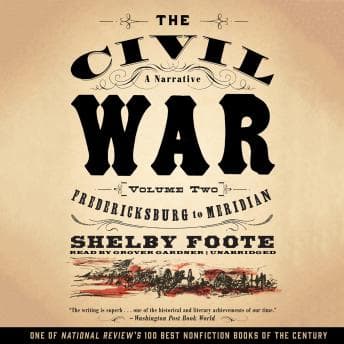

Fifty-three hours. That's longer than most deployments feel, and I mean that as a compliment.
I started this monster during a three-day consulting gig in Houston - four hours of windshield time each way, plus hotel nights where I couldn't sleep because the AC unit sounded like a Humvee idling outside my window. By the time I got home, I was barely a third through it. Ranger gave me a look when I kept listening through his evening walk. He's heard a lot of audiobooks, but this one tested even his patience.
Foote Writes War Like Someone Who Understands Mud
Let me cut to the chase: Shelby Foote does something almost nobody else manages in Civil War history. He writes about generals and politicians and grand strategy, but he never loses the ground-level reality of what war actually is - confusion, bad decisions made under impossible pressure, and men dying because someone read a map wrong. His treatment of Stonewall Jackson's flank attack at Chancellorsville is a perfect example. You feel the chaos of Confederate troops crashing through Union positions at dusk, the friendly fire that wounds Jackson himself, the absolute fog-of-war nightmare that turns a brilliant tactical move into a tragedy. I've seen that scenario play out in real life - the best plan in the world falls apart the moment someone can't tell friend from foe in low light.
What sets Foote apart from your standard Civil War history is that he treats both sides as composed of actual human beings. Grant's Vicksburg campaign isn't just a series of arrows on a map - it's months of failed approaches, political pressure from Washington, soldiers eating hardtack in swamps, and one commander who simply refused to quit. Foote gives you the Confederate perspective with equal weight, which some readers won't like, but as someone who's studied opposing forces professionally for decades, understanding the enemy's logic is the whole game. You can't analyze a battlefield if you only look at one side.
The author clearly did their homework. Twenty years of research, and you feel every bit of it. That kind of scholarly commitment to primary sources reminds me of what Gibbon attempted across a lifetime of work in History of the Decline and Fall of the Roman Empire Vol. IV - though Foote has the advantage of writing about a war he could still find living witnesses to. Foote pulls from letters, dispatches, diaries - the primary sources that make you trust what you're hearing. When he describes a commander's reasoning, it's not speculation. It's documented.
Gardner's Narration: The Steady Hand Problem
Here's where it gets complicated. Grover Gardner has an authoritative voice - the kind of voice you'd want briefing you before an operation. Clear, measured, confident. Shelby Foote himself praised the performance, and the man wrote the book, so that carries weight.
But - and this is a real but - across fifty-three hours, Gardner's steady, controlled delivery starts to flatten out. The passages about Jackson's wounding at Chancellorsville deserve a shift in intensity that doesn't quite arrive. Battle scenes and congressional debates get roughly the same tonal treatment. It's like having a briefing officer who's excellent at conveying information but doesn't raise his voice when the building's on fire.
I didn't hate it. At 1.25x speed, the pacing actually improved - Gardner's deliberate cadence tightened up nicely, and the prose moved the way Foote probably intended. But if you're coming from audiobooks with dynamic, emotionally engaged narration, this will feel like a long march on flat terrain. Functional. Professional. Just not electric.
Who Should Strap In (And Who Should Walk Away)
Worth your time? Here's the debrief. If you're serious about Civil War history - not casual-interest serious, but willing-to-commit-your-entire-month serious - this is essential. Foote's narrative approach makes dense military history accessible without dumbing it down. He respects the material and respects the reader.
If you want something you can half-listen to during a workout or while cooking dinner? Wrong book. This demands focused attention. I missed critical details twice because I was navigating Austin traffic and had to rewind. The operational details of Vicksburg alone require the kind of concentration I used to reserve for route clearance briefings.
Skip this if bad narration is a dealbreaker for you - not because Gardner is bad, but because opinions genuinely split on whether his style serves or undermines Foote's writing. And definitely skip if you're not ready for the time commitment. Fifty-three hours is no joke.
Mission Debrief
This is the real deal - a legitimate historical work that treats the Civil War with the seriousness and scope it demands. Gardner's narration is the one variable that keeps it from being a perfect listen. The content itself? Foote earned every one of those Guggenheim fellowships. I finished it, I'm better informed for it, and I'm already eyeing Volume 3.
Ranger slept through most of it, but he's not much of a history guy.







![Steve Jobs [unabridged audiobook] audiobook cover](/_next/image?url=https%3A%2F%2Fcovers.audiobooks.com%2Fimages%2Fcovers%2Ffull%2F9788499923406.jpg&w=1920&q=75)