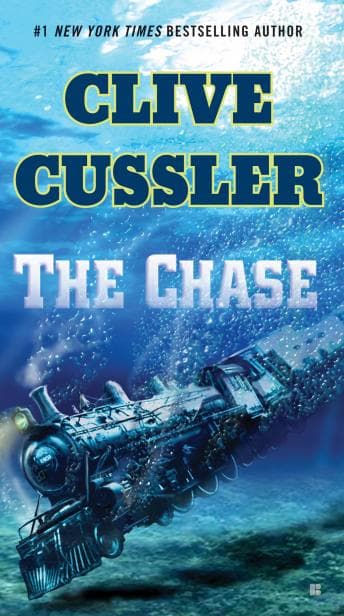

"You can run, but you can't hide. Not from Isaac Bell."
Okay so that's not an exact quote but it's basically the vibe of the entire twelve and a half hours I just spent with this book instead of working on my procedural generation thesis. (Dr. Patel, if you're reading this — I was doing research on narrative pacing in sequential media. Definitely that.)
I picked this up on a whim because I needed something different from my usual Sanderson-Cosmere-LitRPG rotation, and honestly? A turn-of-the-century detective chasing a bank-robbing serial killer across early 1900s America sounded like the kind of thing my D&D group would cook up if we ever ran a Call of Cthulhu one-shot set during the Gold Rush era. Minus the eldritch horror. Mostly.
Isaac Bell Is Basically a Lawful Good Paladin and I'm Here For It
So here's the deal with The Chase — it's a standalone Cussler novel, which means you don't need seventeen books of backstory to jump in. Isaac Bell is a Van Alen detective (think early 1900s FBI but privately funded and way more stylish) hunting a guy called the Butcher Bandit who robs banks and then just... murders everyone present. No witnesses. Cold, calculated, and genuinely unsettling in a way I didn't expect from what I thought would be a popcorn adventure book.
The cat-and-mouse dynamic is the engine here. Bell is smart, methodical, and has that old-school gentleman detective energy — like if Sherlock Holmes lifted weights and owned a derringer. The Butcher Bandit, meanwhile, is operating with a level of disguise and misdirection that kept me guessing for... okay, about the first third. Then I started figuring things out.
And look, that's the elephant in the room. The mystery isn't exactly Agatha Christie. By around hour four, I had a pretty solid read on where things were headed, and I was right. If you're the kind of listener who needs to be genuinely shocked by the reveal, you might be a little deflated. But here's my counterpoint: the train chase sequence in the back half of this book is so ridiculously fun that I don't care that I saw the villain coming. Cussler writes action set pieces the way Sanderson writes magic systems — with obsessive mechanical detail and genuine enthusiasm for the machinery involved. The man clearly loved trains and it shows. Locomotive specs, period-accurate steam engine capabilities, the physics of pursuit on rails — if you don't like info-dumps, this isn't for you (but you're wrong).
Scott Brick Does the Heavy Lifting
Scott Brick is narrating, and the man is an AudioFile Golden Voice for a reason. His delivery here is dramatic in a way that suits the period setting — there's a formality to his read that matches the early 1900s dialogue without sounding like he's performing Shakespeare at a dinner theater. He's got that steady, confident pacing that works great for building tension during the investigation scenes.
That said — and I say this as someone who considers Steven Pacey the GOAT — Brick doesn't do wildly distinct character voices. You're not going to get the Joe Abercrombie treatment where every character sounds like a different person walked up to the mic. It's more of a "slight shifts in register" approach. Bell sounds authoritative, the Bandit gets a colder edge, and the supporting cast blends together a bit. For this kind of book it works fine. You always know who's talking from context. But if you're spoiled on full-cast energy, temper your expectations.
The pacing thing is real though. The first couple hours are setup — establishing Bell, the detective agency, the pattern of robberies — and it moves at the speed of a steam engine building pressure. Which is either a great metaphor or genuinely a little slow depending on your patience. I was listening while debugging a particularly cursed procedural terrain generator at 1 AM, so the slow build actually worked for me. Gave my brain something to chew on between error messages.
Who Rolls Initiative on This One
If you like Cussler, this is apparently one of his best — it launched the whole Isaac Bell series and you can feel the freshness in the concept. If you're a history nerd who gets excited about early 20th century America, the period detail is genuinely fun. My D&D group would love this as campaign inspiration — the Butcher Bandit is basically a perfect recurring villain with a high Deception modifier.
If you need complex magic systems, deep world-building with cosmological implications, or stat blocks — wrong shelf, friend. This is pulp adventure done well. Think of it like a really solid session of a one-shot campaign: not going to change your life, but you'll have a good time and remember the big set pieces.
Skip it if predictable mysteries genuinely bother you. The progression is satisfying in terms of Bell closing the net, but the mystery itself won't stump you.
My Thesis Can Wait Another Twelve Hours
Look, The Chase isn't going to dethrone The Way of Kings in my rotation. But as a palate cleanser between epic fantasy doorstoppers? As something to keep your brain engaged during a late-night coding session or a long drive through rural Georgia where the radio options are country, gospel, or static? It does the job and does it well. Cussler knew how to write a chase scene — literally, the man named the book after it — and Scott Brick delivers it with the kind of steady confidence that keeps you listening past your exit.
Solid popcorn. Good train content. My thesis remains unwritten.