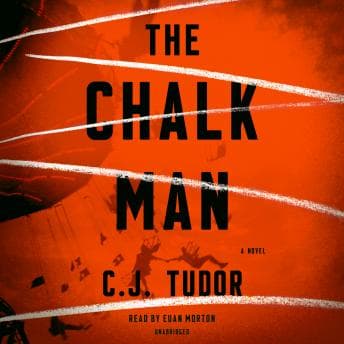

C.J. Tudor's debut is basically what happens when you take the DNA of a Stephen King coming-of-age story, splice it with British small-town dread, and ask: what if the secrets you buried as a twelve-year-old could still kill you at forty-two?
I started this one while making dal makhani on a Sunday evening — one of those elaborate cooking sessions where I'm alone in my apartment, the pressure cooker doing its thing, and I need something to keep my hands busy and my brain occupied. By the time the dal was done, I'd forgotten to add the cream because I was standing at the stove with a wooden spoon in one hand, completely locked into Eddie Adams's narration of the worst summer of his life.
The Dual-Timeline Psychology Trick That Actually Works
Here's the thing about dual-timeline mysteries: they're everywhere now, and most of them fail because the author doesn't understand that a character at twelve and a character at forty-two shouldn't just have different problems — they should have different cognitive frameworks. Tudor gets this. Young Eddie processes trauma through the magical thinking of adolescence: chalk figures are adventure codes, the dead girl in the woods is terrifying but also kind of exciting in the way only a kid who hasn't yet metabolized real horror can find it exciting. King does something similar with his short fiction — the moment childhood wonder curdles into something darker is basically his entire brand, and Just After Sunset: Stories has that same quality of dread seeping into ordinary perception, though Tudor's version is more psychologically precise about why kids and adults experience horror so differently. Adult Eddie? He's drinking too much, living alone, and performing the classic avoidance behavior of someone who never properly integrated a childhood trauma. The protagonist exhibits classic compartmentalization — he's built an entire adult identity around not thinking about 1986.
What makes this character compelling is that Tudor doesn't let Eddie off the hook. He's not a noble damaged hero. He's kind of a mess, and his friendships have calcified into these weird, obligatory relationships where everyone's pretending they don't share a terrible secret. Psychologically, that tracks perfectly. I've read studies on shared traumatic experiences in peer groups and the way silence becomes its own binding agent. Tudor may not cite the literature, but she understands the mechanism.
Euan Morton Knows Exactly What He's Doing
So about this narrator. Euan Morton has this British accent that sits right in the sweet spot between warm and unsettling — silky enough to lull you, precise enough to make you pay attention when something shifts. But the real skill is in how he differentiates the timelines. Young Eddie gets this softer, slightly higher register with genuine vulnerability baked in — you can hear the kid who still trusts the world. Adult Eddie sounds like that same voice after thirty years of scotch and regret. It's not a gimmick. It's a genuine characterological shift, and Morton signals the timeline jumps so clearly through vocal tone alone that you never get lost even when Tudor is bouncing between decades.
I found myself asking: why does this narration work so well when so many dual-timeline audiobooks confuse me? And I think it's because Morton treats the two Eddies as fundamentally different people who happen to share a body. Which is — and my therapist would have thoughts about this character — pretty much how trauma works.
Where the Chalk Lines Smudge
Okay, I can't write this review without addressing the pacing issue. The first couple of hours are slow. Not glacially slow, not offensively slow, but there's a stretch where Tudor is laying groundwork — establishing the friend group dynamics, the town's geography, the family tensions — and it requires patience. I'm someone who analyzes character motivation for a living, so I was engaged throughout because I was cataloguing everyone's behavioral patterns like index cards. But if you're listening for plot momentum? You might find yourself checking the progress bar before hour three.
The other thing — and this is me being the annoying psychologist at the dinner party — is that a couple of the secondary characters feel more like plot devices than people. They exist to hold secrets and deliver reveals at the right moment. Tudor's clearly strongest with Eddie and his immediate family, where the motivations feel layered and earned. Some of the friends are a bit thinner, more functional than psychological.
But those last couple of chapters? This is a fascinating case study in how a strong ending can retroactively improve everything that came before it. Tudor pulls a twist that recontextualizes character behavior you'd taken at face value, and I literally stopped washing dishes to stand in my kitchen and whisper "oh, that's what she was doing." The research actually shows that narrative satisfaction is disproportionately weighted toward endings — and Tudor clearly knows that.
Who Gets the Chalk and Who Gets Lost in the Woods
This is for you if: you loved Stand by Me but wished it had more menace, if you appreciate psychological suspense that treats childhood as something genuinely complex rather than just nostalgic, or if you want a mystery where the whodunit matters less than the why-did-they-become-this.
Skip it if: slow builds make you impatient, if you need all your secondary characters to be fully three-dimensional, or if British small-town settings feel claustrophobic rather than atmospheric to you.
My Clinical Notes
Tudor's debut is imperfect in the way that promising first novels often are — slightly overwritten in places, slightly undercooked in others. But the core psychology is sound, the narrator elevates the material significantly, and that ending will rearrange the furniture in your brain. I went to bed that night thinking about how the stories we tell ourselves about our childhoods are never the whole story. And then I couldn't sleep. So thanks for that, C.J.