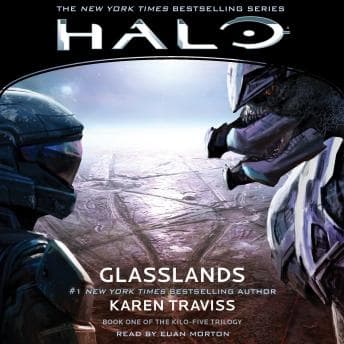

So I was up at 2 AM supposedly debugging a procedural terrain generator for my thesis, and instead I'm fifteen hours deep into a Halo novel, listening to ONI operatives play galactic chess with alien civil wars. Dr. Patel, if you're reading this: I regret nothing. (I regret a little. My commit history is embarrassing.)
Karen Traviss Brought Her Star Wars Energy and It Shows
Look, if you know Traviss from her Republic Commando books, you know exactly what you're getting here: military fiction that cares way more about the people wearing the armor than the armor itself. Glasslands is not a Master Chief shooting gallery. It's a political thriller wearing a Halo skin, and honestly? That's exactly what the universe needed after Halo 3 wrapped things up with a neat little bow. This book rips that bow off and goes, "Cool, now here's the messy geopolitical fallout."
The Kilo-Five squad is basically an ONI black ops team tasked with destabilizing the Sangheili — our former enemies who just became our allies, mind you — because humanity's intelligence apparatus doesn't do "trust." It's morally gray in a way that most tie-in fiction doesn't dare to be. Traviss spends real time making you uncomfortable with what the "good guys" are doing. Naomi-010, the Spartan on the team, is wrestling with the fact that she was kidnapped as a child and turned into a weapon, and her father is out there on the insurrectionist colony Venezia, nursing thirty years of grief. That thread alone hits harder than most standalone sci-fi premises.
Then there's the Halsey subplot. Dr. Catherine Halsey trapped in a Forerunner slipspace bubble with Mendez and the surviving Spartans from the Onyx catastrophe — Traviss takes the woman who was basically lionized in earlier Halo fiction and puts her on trial. Not literally, but through every other character's eyes. The book has a pretty clear opinion about a scientist who kidnapped children for super-soldier experiments, and if you're a Halsey apologist... you're going to have a rough time. That willingness to indict a powerful institution through the eyes of the people it ground up reminded me of something Orwell does in 1984 — the horror isn't the villain monologuing, it's everyone quietly deciding the system was worth it. I actually love this, because it's the kind of moral reckoning that franchise fiction almost never commits to. But I get why it's divisive. Some fans wanted their hero scientist left on a pedestal.
The pacing, though — and I'll be honest — it's deliberate. Like, "I checked how many hours were left" deliberate in a couple of the middle sections. There's a lot of political maneuvering, a lot of characters thinking through implications rather than shooting things. If you don't like info-dumps, this isn't for you (but you're wrong). The world-building around Sangheili post-war society, the way their keeps function, the theological collapse after discovering the Prophets lied to them — this is Sanderson-level world-building applied to a franchise universe. My D&D group would love this as campaign setting material.
Euan Morton's Slow Burn Into Your Brain
Here's the thing about Morton's narration: it took me a solid two hours to settle in. His delivery has this theatrical precision that initially felt a little stiff against the military dialogue. I kept comparing him to what I imagined these characters sounding like from the games, and that's an unfair fight for any narrator.
But somewhere around the third or fourth chapter, something clicked. His voice for the Sangheili characters — the Elites — is genuinely impressive. He captures this alien formality, this weight of a warrior culture in crisis, without going full cartoon alien. And his female character work is notably strong. Vaz and Naomi and Halsey all sound like distinct people with distinct temperaments, which shouldn't be remarkable but absolutely is in single-narrator sci-fi audiobooks.
The one consistent issue: distinguishing character thoughts from spoken dialogue. There were moments where I genuinely couldn't tell if a character was thinking something or saying it out loud, and in a book with this much internal moral debate, that matters. I had to rewind a handful of times. Not a dealbreaker, but if you're listening while doing anything else — cooking, driving, pretending to work on your thesis — you might lose the thread.
Steven Pacey walked so other narrators could run, and Morton isn't quite at that level, but he earns his keep. By the back half of the book, I wasn't thinking about the narration at all, which is honestly the best compliment I can give.
Who's Deploying With Kilo-Five (And Who Should Stay Home)
If you're a Halo fan who played the games and wants to understand what happened between Halo 3 and Halo 4, this is essential reading. Full stop. If you've never touched Halo, you're going to be lost — the book assumes you know who the Covenant are, what happened on Reach, why Spartans exist. It doesn't hold your hand, and I respect that, but newcomers will struggle.
If you want military sci-fi that's actually interested in the ethics of empire and espionage, this delivers. If you want nonstop action, you'll be waiting a while. The progression is satisfying, but it's the slow-cook kind, not the microwave kind.
Yes, it's 15 hours. Yes, it's worth it — if you're the right listener.
Roll for Intelligence, Not Dexterity
I read this instead of writing my thesis, and I'd do it again. Glasslands is a franchise novel that punches above its weight class. It's messy and political and morally uncomfortable in ways that most game tie-ins wouldn't dream of attempting. The narration takes some warming up, but Morton settles into something genuinely immersive. It's not perfect — the pacing sags, the thought-vs-dialogue issue is real, and Traviss's Halsey agenda might rub you wrong — but it's the kind of ambitious military sci-fi that treats its universe like it actually matters. And for a Halo book? That's saying something.