
The "Chosen One" Hangover
It's 2:00 AM. My procedural dungeon generation algorithm just spawned a room with no doors for the forty-seventh time, and my advisor, Dr. Patel, sent an email with the subject line "Quick Check-in" (it will not be quick). But I'm not fixing the code. I'm staring at a loading bar and listening to Paul Atreides realize that being the Messiah actually sucks.
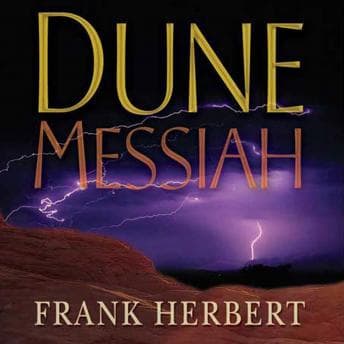
Look, we need to talk about Dune Messiah.
If the first Dune was the epic D&D campaign where the party rolls nat 20s, overthrows the evil emperor, and rides sandworms into the sunset, Messiah is the awkward session six months later where the DM forces you to deal with tax policy, religious schisms, and the fact that your "Chaotic Good" rogue actually killed a few billion people.
It's a vibe shift. A massive one.
The Narrator Hydra Problem
Let's address the elephant in the recording booth first: the casting. This production throws everything at the wall—Simon Vance, Scott Brick, Katherine Kellgren, Euan Morton.
On paper? This is an Avengers-level lineup. Simon Vance is practically the patron saint of fantasy narration (seriously, the man could read a EULA and make it sound like ancient prophecy). And when Vance is driving the bus, it's chef's kiss. He brings this gravitas that makes the dense, philosophical info-dumps feel like sacred scripture.
But here's the thing—and this might be a hot take—the handoffs can be jarring.
It's not a full-cast audio drama where everyone plays a specific role all the time. It's this hybrid style where sometimes the narrator switches based on chapter POV, and sometimes it feels… arbitrary? Like when my D&D group rotates DMs mid-campaign. Scott Brick brings the drama—he's got that breathy, emotional weight that screams "THIS IS IMPORTANT"—which works for the internal angst of the Atreides family. But then you switch back to Vance or over to Kellgren, and the tone shifts gears without using the clutch.
(Katherine Kellgren, by the way? Absolute marvel with the accents. She creates distinct sonic textures that help separate the factions, which is super helpful because, let's be real, Herbert's plotting gets dense.)
Some people hate this multi-headed narrator hydra. I don't hate it, but it definitely pulled me out of the immersion a few times. You get used to it, but the first hour is an adjustment period.
Deconstructing the Power Fantasy
I listen to audiobooks to escape my thesis, right? Usually, that means progression fantasy or space operas where things explode. Dune Messiah is… not that. It's 9 hours of Frank Herbert looking at the camera and saying, "You thought Paul was the good guy? That's cute."
It's shorter than the first book—way shorter—which is actually a blessing. The pacing is weirdly claustrophobic. There's no big desert journey here; it's mostly people in rooms whispering about conspiracies.
But honestly? It's fascinating.
If you're a lore nerd like me, seeing the consequences of Paul's Jihad is satisfying in a grim, train-wreck sort of way. The narration really leans into the tragedy of it. Euan Morton and the rest of the crew do a solid job conveying the weariness of these characters. Paul isn't the plucky hero anymore; he's a tired god trapped by his own prescience. The audio performance captures that sense of inevitable doom perfectly. It feels heavy.
Who Should (and Shouldn't) Listen
Skip this if you wanted more sandworm battles and triumphant desert conquests—you'll be disappointed. But if you finished Dune wondering what happens when the "hero" actually has to govern, and you can handle 9 hours of political scheming over action sequences, this is essential listening.
The Verdict
Is it as "fun" as the first book? No. Absolutely not.
But if you listened to Dune and stopped there, you missed the punchline of the joke. Iron Gold pulls a similar move—taking a triumphant series and forcing you to reckon with what "victory" actually costs. You have to listen to Messiah to understand what Herbert was actually doing.
The production values are high—clean audio, professional delivery—even if the multiple narrators fight for dominance sometimes. It's a necessary bridge. You need to cross it to get to Children of Dune (which gets wild again).
So, yeah. I listened to this instead of fixing my thesis. Do I regret it? No. Paul Atreides has bigger problems than my graduation timeline. And at least my code isn't trying to breed a Kwisatz Haderach. Yet.