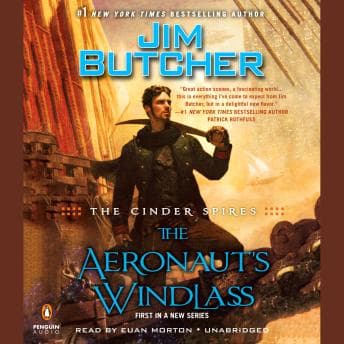

Look, I went into this one skeptical. I'm a Dresden Files guy through and through, and every time Butcher announces a new series I'm like "but what about Harry?" (Don't @ me, I know he's still writing Dresden.) So when my D&D group kept insisting I needed to try the Cinder Spires, I finally caved during a particularly brutal thesis-avoidance session.
Twenty-one hours later, my thesis is still unwritten, but I regret nothing.
The World-Building Is Sanderson-Level Good
Okay, that's a bold claim, I know. But hear me out. Butcher builds this vertical world of Spires—massive habitats where humanity lives because the surface is apparently a nightmare zone—and then layers on airship combat, crystal-powered technology, and a magic system that actually makes sense. The etherealists channel power through their minds but it costs them their sanity in specific, fascinating ways. There's a cat society with its own politics and honor codes. CATS. WITH POLITICS.
The info-dumps are real, I won't lie. Butcher loves his exposition, and if you're the type who skips the appendices in Tolkien, this might test your patience. But honestly? I ate it up. Every detail about how the airships work, how the Spirearch's Guard operates, how the different aristocratic houses scheme against each other—it all clicks together like a well-designed game system. My D&D group would absolutely steal half of this for a campaign setting.
Euan Morton Speaks Cat (And Everything Else)
So here's where I need to gush a little. Euan Morton might be one of the best fantasy narrators I've heard since Steven Pacey, and that's not something I say lightly. The guy does like thirty distinct voices and I never once got confused about who was talking. Captain Grimm has this weary authority, Gwendolyn Lancaster is all aristocratic determination, and the etherealist Folly sounds appropriately otherworldly without being annoying.
But the cats. Oh man, the cats. Rowl and his warrior-poet arrogance, the way Morton captures that feline superiority complex—it's chef's kiss. There's this scene where Rowl explains cat honor to the humans and I was literally laughing on the bus like a weirdo.
Fair warning though: Morton commits to his performance, sometimes a little too hard. When characters whisper, he actually whispers, which meant I kept cranking my volume up and then getting blasted when the action kicked in. His natural pace is also... leisurely. I ended up bumping it to 1.25x speed after the first few chapters, which felt right. Not a dealbreaker, but something to know going in.
The Slow Burn That Paid Off
This is not a fast book. The first third is mostly setup—introducing the ensemble cast, establishing the political situation between Spire Albion and Spire Aurora, getting all the pieces on the board. If you need explosions in chapter one, look elsewhere.
But when the action hits? It HITS. The airship battles are genuinely thrilling, with Morton's pacing keeping the chaos comprehensible. There's a ground assault sequence in the latter half that had me missing my bus stop because I couldn't pause. Butcher knows how to write combat—that Dresden Files experience shows—and the steampunk setting gives him new toys to play with.
The character work sneaks up on you too. I expected to like Grimm (honorable captain, obvious protagonist vibes) but ended up way more invested in Bridget, the young warriorborn who's basically a fantasy supersoldier trying to figure out who she wants to be. Her friendship with Rowl the cat is genuinely touching, in a weird interspecies-buddy-cop kind of way.
Roll for Initiative (Or Don't)
If you love detailed world-building, airship battles, and ensemble casts with distinct personalities—this is your jam. If you've read Butcher before and wanted to see him go full secondary-world fantasy, you'll be happy. If you're into LitRPG-adjacent progression fantasy, the magic system here scratches a similar itch. Though if you want something that leans harder into cozy mystery vibes with a fantasy setting, Murder in an Irish Village might be more your speed—completely different tone, but equally immersive world.
Skip this one if you bounced off Codex Alera for being too slow—it won't convert you. And if you're expecting Dresden's snark and first-person energy, you'll need to recalibrate. This is third-person omniscient, more epic in scope, less personal in tone.
Me? I'm already hunting down book two. My thesis can wait another twenty hours.