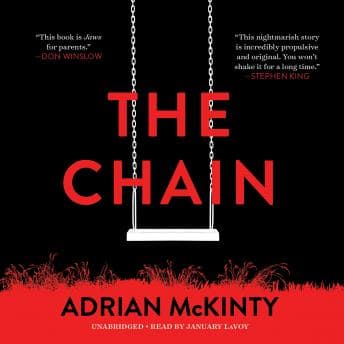

"You are not the first. And you will certainly not be the last."
That line hit me somewhere around hour two, while I was chopping onions for a dal that would take three hours to cook. And I just... stopped. Knife in hand, staring at my cutting board, thinking about how Adrian McKinty had just described the most elegant psychological trap I've encountered in fiction.
Look, I study why people do terrible things. It's literally my job. And The Chain? It's a crash course in coercion psychology disguised as a thriller. The premise is deceptively simple: your child gets kidnapped, and the only way to get them back is to kidnap someone else's child. Pay the ransom, perpetuate the cycle, become both victim and perpetrator in the same breath.
The Psychology of Impossible Choices
What makes this work—and I mean really work, not just "exciting thriller" work—is that McKinty understands something fundamental about human behavior. Parents will do anything for their children. Anything. This isn't speculation; it's documented across cultures, across time periods. The research shows that parental protection instincts can override virtually every other moral consideration we hold.
Rachel Klein, our protagonist, exhibits classic trauma response patterns that feel psychologically authentic. She's a cancer survivor, already primed to understand that life can turn catastrophic without warning. When The Chain contacts her, she doesn't waste time with denial. She moves straight into problem-solving mode—exactly what you'd expect from someone who's already stared down mortality.
But here's where it gets interesting from a behavioral perspective. The Chain isn't just about kidnapping. It's about transforming ordinary people into criminals through incremental commitment. First you pay. Then you plan. Then you execute. Each step makes the next one easier to justify. It's the foot-in-the-door technique weaponized to its most horrifying extreme. (My therapist would have thoughts about this character. Many thoughts.)
January LaVoy Understands Desperation
I couldn't find extensive background on January LaVoy before this listen, but based on this performance? She gets it. The way she voices Rachel's internal calculations—that cold, survival-mode thinking layered over barely contained terror—is spot on. There's a particular quality to how she handles the phone calls with The Chain's operators. Focused. Intense. Like someone trying very hard not to scream.
Rachel isn't a victim who waits to be saved. She's analytical, strategic, and increasingly ruthless. LaVoy captures that evolution without making it feel forced. By the time Rachel starts thinking like a predator instead of prey, you believe it. You might even find yourself nodding along.
(Don't tell my students I said that.)
The pacing here is relentless—and I mean that literally. Almost no breathing room. Which works for the story, but I'll be honest: around hour seven, I needed a break. Not because it was boring, but because the sustained tension was exhausting. That's a compliment, I think? The audiobook equivalent of needing to pause a horror movie to make tea and remember that your apartment is safe.
Where the Moral Philosophy Gets Complicated
McKinty studied philosophy at Oxford, and it shows. The Chain isn't just asking "what would you do to save your child?" It's asking something harder: at what point does self-preservation become complicity? When does understanding your captors' system make you part of it?
There's a moment—I won't spoil it—where Rachel has to make a choice that most thrillers would treat as the climax. McKinty treats it as a stepping stone. Because The Chain doesn't end when you get your child back. It ends when you've successfully victimized someone else. The psychological implications of that are genuinely disturbing.
I found myself asking: why does Rachel really keep going after a certain point? Is it pure maternal instinct, or has she internalized The Chain's logic? McKinty understands human nature well enough to leave that ambiguous.
Who This Works For (And Who It Won't)
Perfect for anyone who wants their thriller to actually make them think. Fans of moral complexity, of protagonists who aren't purely heroic, of systems that corrupt everyone who touches them. Great for commutes—the pacing keeps you alert—but maybe not for bedtime unless you want anxiety dreams about phone calls from unknown numbers.
Skip if you need extensive character development or slower pacing. McKinty is more interested in momentum than introspection. The writing occasionally dips into functional-rather-than-literary territory in the back half, but honestly? I barely noticed. The premise carries so much weight that the prose doesn't need to do heavy lifting.
The production is clean, professional, no audio issues. January LaVoy was named a Golden Voice narrator by AudioFile Magazine, and yeah, I get it now.
Case Closed (For Now)
I've read a lot of thrillers that claim to explore the dark side of human nature. Most of them are just violence dressed up in psychological language. The Chain is different. Works of Edgar Allan Poe, Raven Edition, Volume 2 explores similar darkness, though Poe's characters descend into madness rather than coercion. This is a genuine case study in how ordinary people become capable of extraordinary cruelty—and how quickly it can happen.
I finished it three days ago. I'm still thinking about it.