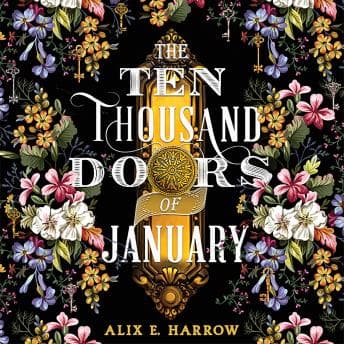

Everyone kept telling me this was a portal fantasy. And I mean, yes, technically. There are doors. They go places. But calling this a portal fantasy is like calling Middlemarch a book about a marriage. You're not wrong, but you're missing the point entirely.
I started this during one of those late-night grading sessions—you know the ones where you're reading the same paragraph about The Great Gatsby for the fifteenth time and your eyes are staging a rebellion. Denise had already gone to bed. I put in my earbuds expecting something light, something to keep me company while I bled red ink onto sophomore essays. What I got instead was a book that made me set down my pen and just... listen.
The Voice in My Head (For Twelve Hours)
January LaVoy. Look, I've heard mixed things about her narration from other listeners—some find her voice grating, apparently—but I genuinely don't understand those people. Her voice has this quality that reminds me of the best kind of professor you had in college. The one who made you actually care about the material because they so clearly cared first.
She reads Harrow's prose like she understands that every comma is a breath, every em-dash a pivot. And Harrow's sentences deserve that treatment. They're these long, winding, gorgeous things that build and build until they punch you right in the chest. LaVoy knows when to let them roll and when to pull back. The character voices—particularly January herself, but also the various people she encounters across worlds—feel distinct without being cartoonish. (Though I'll admit, some of the male voices are a bit theatrical. My students would probably roll their eyes. I thought it worked.)
The pacing does slow in places. There are introspective stretches, descriptive passages where Harrow is clearly in love with her own world-building. Some listeners apparently lost focus during these sections. I didn't. But I also listen at 1.0x because I'm apparently ancient, so take that as you will.
What Harrow Is Really Saying
Here's the thing about this book that the fantasy label doesn't quite capture: it's about stories themselves. About the power of narrative to literally reshape reality. About who gets to tell their own story and who has theirs told for them.
January Scaller is a biracial girl in early 1900s America, raised as a curiosity in a rich man's collection. Harrow doesn't let you forget the weight of that for a second. The fantasy elements—the doors, the other worlds, the magic—they're not escapism. They're resistance. They're January claiming her own narrative in a world that would rather she stay silent and decorative.
This is why we still read the classics, honestly. Wolves of the Calla does this too, though King's approach is messier, more sprawling. The best speculative fiction does what the best literature has always done: it uses the impossible to illuminate the real. Harrow is working in a tradition that goes back to Mary Shelley, to H.G. Wells, to Ursula K. Le Guin. She knows it, too. The book-within-a-book structure, the way the narrative layers fold into each other—it's ambitious. Sometimes it's a little too aware of its own cleverness. But mostly it earns it.
The Gut-Punch Moments
I won't spoil specifics, but there's a letter in this book. You'll know it when you hear it. LaVoy reads it with such restrained devastation that I had to pause grading entirely. Just sat there in my kitchen at midnight, red pen suspended over some kid's thesis statement about the American Dream, trying not to wake Denise with my emotions.
The relationship between January and her father—the way it's revealed in fragments, the way the truth unfolds—this is where Harrow's structural choices really pay off. Little Fires Everywhere uses a similar fragmentary reveal about family secrets, though Ng's realism makes the gut-punch land differently. It's not just clever. It matters.
And the romance, when it comes, feels earned rather than obligatory. It's woven into the larger themes about connection and belonging and the stories we tell to find our way home.
Who's Walking Through This Door?
If you loved The Night Circus or The Starless Sea, this is their spiritual successor. If you want something that feels like a fairy tale but thinks like literary fiction, this is it. My students would hate the pacing—they want their fantasy fast and their payoffs immediate. But the readers among them, the ones who actually finished Wuthering Heights instead of just reading the SparkNotes? They'd understand what Harrow is doing here. If you need constant action and plot momentum, sample first.
Class Dismissed
I listened to the whole thing twice. Once while grading, once while walking the lakefront with Denise. She asked why I kept smiling at the water.
I told her it was about doors.
She didn't ask follow-up questions. Twenty-three years of marriage will do that.