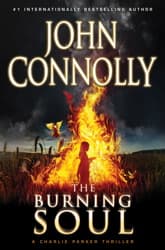

I'd heard the Charlie Parker series described as genre fiction that doesn't know it's supposed to stay in its lane - literary noir with a supernatural edge, the kind of thing that makes English teachers like me quietly happy when we find it on a student's desk instead of whatever BookTok is pushing this week. So I came to The Burning Soul expecting a solid detective thriller. What I got was something thornier and more unsettling than I bargained for.
I started this one on a Saturday morning walk along the lakefront with Denise, and by the time we'd circled back to the car, I was so deep in Randall Haight's story that I sat in the parking lot for another twenty minutes while she went inside. She's patient with me. She has to be.
The Opening Line That Won't Leave You Alone
Connolly does something brutal right at the top. He gives you this clinical observation - that after three hours, a child's abduction is treated as a homicide - and just lets it sit there. No melodrama. No underlining. It's the kind of sentence that works on you the way Hemingway's iceberg theory is supposed to work: what's underneath the surface does all the damage. And it sets the entire book's tone. This is a novel about people carrying terrible knowledge, about the weight of knowing things you can never unknow.
Randall Haight is a fascinating problem of a character. He killed a girl when he was fourteen. He served his time. He built a new life, a new name, a new town. And now a different girl has gone missing, and anonymous letters are dragging his buried past back into the light. The question Connolly keeps pressing isn't whodunit - it's whether guilt ever actually expires. Whether a person can be fundamentally different from who they were at fourteen. I teach fourteen-year-olds. I've watched them do stupid, cruel, incomprehensible things. And I've also watched them become entirely different people by eighteen. So Randall's situation hit me somewhere personal.
Parker gets hired to make the problem go away, but of course, Parker being Parker, he starts pulling threads that connect to a doomed mobster, FBI entanglements, and the kind of small-town Maine secrets that Connolly writes better than almost anyone working in crime fiction today. The layers keep peeling back. Every answer leads to a worse question. That layered unraveling reminded me of Hidden, which pulls a similar trick of burying its real mystery beneath the obvious one - though Connolly does it with more literary weight.
Two Voices, Two Problems
Here's where I have to be honest, because the audiobook experience is genuinely split in half. George Guidall handles the third-person sections - the parts where we're outside Parker's head, drifting through the town, sitting with Randall's dread. And Guidall is good. There's a gravity to his voice that matches Connolly's prose, which tends toward the dark and deliberate. He understands that pause is punctuation. When the narrative slows down to describe the Maine landscape or the history of violence beneath the town's surface, Guidall gives you room to feel it.
Tony Ward takes over for Parker's first-person chapters. And this is where things get uneven. Ward's delivery is flatter and harsher - which could work for a hardboiled PI, honestly, but the tonal shift between narrators is jarring. Like channel-surfing between two different shows. Worse, there are noticeable audio quality differences: Ward's sections are recorded louder, crisper, which means if you've got your volume balanced for Guidall's softer register, suddenly Ward is barking at you. I was grading sophomore essays around 11 PM when one of these transitions hit and I actually flinched. My red pen left a mark across someone's thesis statement. (Sorry, Jaylen.)
The dual narrator concept isn't inherently bad. In theory, it mirrors the book's shifting perspectives beautifully. But the execution needed better production matching. If the levels had been balanced and the tonal gap narrowed, this could have been something special. Instead, it's a distraction in a book that really rewards sustained attention.
Connolly's Uncomfortable Question
What I keep coming back to is Connolly's refusal to give you an easy moral position on Randall Haight. The book doesn't ask you to forgive him or condemn him. It asks you to sit with the discomfort of not knowing what the right answer is. That's what separates this from most crime fiction - Connolly is doing something closer to what Dostoevsky was doing in Crime and Punishment, just with a Maine zip code and a PI who occasionally interacts with things that shouldn't exist. My students would hate this. I love it.
The pacing is deliberate, especially in the first few hours. If you're expecting a sprint, this is more of a long walk through fog where you keep almost seeing something terrible in the distance. It earns its 12 hours and 54 minutes, but it demands patience.
Who Should Press Play (And Who Shouldn't)
If you loved Mystic River by Dennis Lehane and wished it leaned a little more into the shadows - the actual supernatural kind - this is its spiritual successor. If you're already invested in the Parker series, there are enough callbacks to keep you grounded but this works as a standalone, too. But if dual narrators with production inconsistencies will pull you out of a story, consider the print version instead. The writing deserves better audio production than it got here.
The Red Pen Says
Connolly wrote a book that trusts its readers to handle moral ambiguity without flinching. The prose deserves to be savored. Guidall's narration honors that trust; the production choices around the dual-narrator format undermine it. Worth the listen for the story and Guidall's half of the performance. Just be ready to ride out the volume shifts. And maybe don't listen while grading. Your students' papers will thank you.