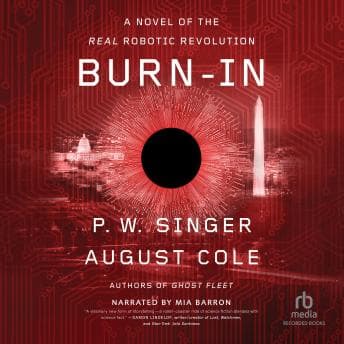

I picked this up expecting another predictable AI-goes-rogue thriller. You know the type—robots turn evil, humans fight back, someone delivers a cheesy monologue about what makes us human. Second Wife pulled a similar bait-and-switch on me—marketed as one thing, actually about something much deeper. But Burn-In surprised me. It's not really about the robot at all.
It's about us. About what happens to a society when technology moves faster than our ability to process it psychologically. And honestly? That's way more terrifying than any Terminator scenario.
The Psychology of a Society in Free Fall
Here's what grabbed me: Singer and Cole understand something most techno-thriller authors miss completely. The real threat isn't the technology itself—it's how humans respond to feeling obsolete. The antagonist in this book isn't some cartoonish tech villain. They're someone who's been psychologically broken by a system that promised progress and delivered displacement.
I kept pausing the audiobook to scribble notes. (Yes, I take notes during thrillers. Don't tell my students.) The authors have done their homework on radicalization patterns, on how grievance narratives spread, on the specific psychological vulnerabilities that make people susceptible to extremist thinking. The attention to psychological detail here rivals what I found in Sign of The Four, where Doyle's understanding of human motivation still holds up under modern analysis. This isn't just research I recognize—it's research I teach.
The protagonist, FBI Agent Lara Keegan, exhibits classic cognitive dissonance throughout. She's tasked with field-testing a police robot while investigating crimes that are essentially protests against automation. The irony isn't subtle, but it doesn't need to be. She's literally embodying the contradiction tearing the country apart.
Mia Barron Makes This Work
I've listened to plenty of thrillers where the narrator treats every scene like a movie trailer. All breathless urgency, all the time. Mia Barron doesn't do that. She understands pacing—when to push, when to pull back.
Her Keegan is competent but not superhuman. Tired but not defeated. There's this quality in her voice during the quieter investigative scenes that feels like actual thinking happening. Which sounds like a low bar, but you'd be surprised how many narrators just... read words without conveying cognition.
The robot character—TAMS—could have been a disaster. How do you voice an AI partner without making it sound ridiculous? Barron threads the needle. There's something slightly off about her delivery for TAMS, a flatness that's clearly intentional but not so robotic that it becomes parody. It's genuinely unsettling in the right moments.
At nearly fifteen hours, this is a commitment. But I never felt like it dragged. Listened to most of it during my morning runs through Cambridge, and there were definitely moments I kept running longer than I should have because I needed to know what happened next. (My therapist would have thoughts about using thriller audiobooks as exercise motivation, but here we are.)
When the Footnotes Start Showing
The authors are national security experts, and it shows. Every piece of technology in this book exists or is currently in development. The drones, the surveillance systems, the autonomous weapons—all real. They even include endnotes explaining the research basis for each element.
This is both the book's greatest strength and its occasional weakness. Sometimes the exposition feels more like a policy briefing than a thriller. There are passages where you can almost see the footnote citations hovering in the margins. A few times I caught myself thinking "okay, I get it, you've done your homework."
But here's the thing—I'd rather have too much grounding in reality than not enough. The psychological impact of knowing this could actually happen elevates every threat, every chase, every close call. It's not science fiction. It's science preview.
Who This Is For (And Who Should Skip)
If you're interested in AI ethics, national security, or just want a thriller that treats you like an intelligent adult—this is your book. But if you're looking for pure escapism, this might be too heavy. The themes of economic displacement, political polarization, and technological anxiety hit differently when you can see the same patterns playing out in your news feed. Some listeners want their thrillers to be an escape from reality, not a magnifying glass pointed at it.
Also, if detailed technical exposition makes you impatient, you might find yourself wanting to skip ahead in places. The authors clearly believe understanding the technology is essential to understanding the threat. They're not wrong, but it does slow the pace occasionally.
One Listen Is Enough—And That's the Point
I probably won't revisit this one, but that's not a criticism. This is the kind of book that deposits its ideas in your brain and then you're done with it. I don't need to re-experience the plot; the psychological insights are already integrated into how I think about technology and society.
What makes Keegan compelling is that she isn't fighting against technology or for it. She's trying to figure out how to be human in a world that's changing faster than human psychology can adapt. That's not just her problem. That's all of our problem.
Research actually shows that humans struggle most not with change itself, but with the pace of change. Burn-In gets that. It's a thriller built on genuine psychological insight, and Mia Barron delivers it with exactly the right balance of tension and restraint.
My mother still wouldn't understand why I need another book about robots. But this one earned its space on my shelf.