
When's the last time you actually knew your neighbor's name? Not just the guy you nod at while grabbing the mail - I mean really knew them. Knew their kids, their dog, what they did for a living?
I was up at 0300 - old habits die hard - sitting on the back porch with Ranger while this one played through my earbuds. Couldn't sleep. And honestly, Putnam's thesis about the slow disintegration of American community felt like the right companion for staring into the dark and wondering what happened to the country I spent 25 years defending.
The Intelligence Brief You Didn't Know You Needed
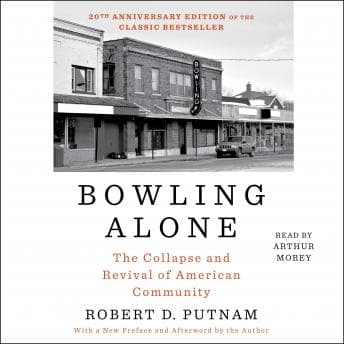
Let me cut to the chase: Robert Putnam's Bowling Alone is one of the most important books about America that most people haven't actually read. The core argument is deceptively simple - Americans stopped joining things. Bowling leagues, Elks lodges, PTAs, church committees, civic organizations. Not just one or two of these, but all of them, across the board, starting somewhere around the late 1960s and accelerating ever since.
But Putnam doesn't just make the claim and walk away. This is a Harvard professor who has spent decades gathering data, and the audiobook's 21-hour runtime reflects that. He walks you through the numbers on political participation, religious involvement, workplace connections, informal social ties, volunteering, philanthropy - and then connects the decline in all of these to measurable outcomes in education, crime, health, and democratic functioning. The social capital framework he builds isn't just theory. I've seen this scenario play out in real life, in neighborhoods where nobody talks to each other and then wonders why crime spikes. In units where cohesion breaks down and people start making bad decisions. Community isn't just nice to have. It's load-bearing infrastructure.
The 20th anniversary edition adds a chapter on social media and the internet, which is where things get interesting and a little frustrating. Putnam acknowledges the potential for digital connection but - correctly, I think - argues that online engagement is mostly a poor substitute for the real thing. The problem is the new material feels a bit bolted on rather than fully integrated into the original framework. It reads like an update memo stapled to an existing operations order.
Where the Audio Drops Below the Noise Floor
Here's where I have to be honest: Arthur Morey's narration is competent but not dynamic. His delivery is steady, measured, academic - which fits the material. But the audio production has a real problem. The recording sits in this lower-mid-range frequency band that gets absolutely swallowed by ambient noise. I tried listening during a drive to a client meeting in San Antonio and had to give up somewhere around hour three. The narrator's voice just blended into the road noise like camouflage. Not ideal for a 21-hour commitment.
This is a book you need to listen to in a quiet room, with decent headphones, at a time when you can actually focus. At 1.25x speed it's still over 16 hours - roughly the length of a C-17 flight to the sandbox, so I know what that kind of time commitment feels like. And honestly, some of the middle chapters where Putnam is working through statistical evidence sector by sector (here's what happened with unions, here's what happened with professional associations, here's what happened with card games) can feel like reading an after-action report that could've been an email. The data is important, but the pacing is genuinely slow in spots.
Morey doesn't bring much variation to break up those stretches. No dramatic shifts in tone, no emphasis that makes the key findings pop. For a book that's essentially a 21-hour lecture, you need a narrator who can make statistics feel urgent. Morey makes them feel... present. That's about it.
Why It Still Matters More Than Most Books on Your List
But here's the thing - and I keep coming back to this while Ranger snores at my feet - the core argument hasn't just aged well. It's aged into prophecy. Putnam wrote the original in 2000, before smartphones, before Facebook, before the complete atomization of American public life. Everything he predicted about what happens when social bonds erode? We're living in it. The polarization, the loneliness epidemic, the collapse of institutional trust. He saw it coming by looking at bowling league membership rolls and church attendance records. I kept thinking about how different forces exploit exactly that collapse - United States of Trump gets at some of the same fractures, though from a much narrower and less rigorous angle. The author clearly did their homework - decades of it.
The book is dense. It's academic. It's not a thriller, and nothing explodes. Linda would probably say it's exactly the kind of thing I'd hate. But some books matter not because they're exciting but because they're right.
Who Needs This Intel and Who Should Pass
If you care about why America feels the way it does right now - fractured, angry, lonely - this is required reading. Policy wonks, veterans wondering what they came home to, anyone in community leadership. Worth your time? Here's the debrief: yes, but budget for the slog and listen at home, not on the road. If you need tight pacing and polished production, wait for someone to re-record this with better audio engineering. As it stands, the content earns the credit even if the production barely scrapes by.
Mission accomplished - but just barely on the audio side.







![Steve Jobs [unabridged audiobook] audiobook cover](/_next/image?url=https%3A%2F%2Fcovers.audiobooks.com%2Fimages%2Fcovers%2Ffull%2F9788499923406.jpg&w=1920&q=75)