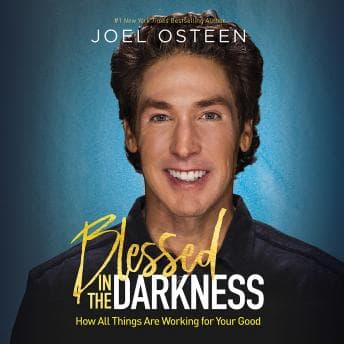

"God has a purpose for every dark season you go through."
That line hit somewhere around hour two, and I was standing in my kitchen, stirring a pot of dal that absolutely did not need that much stirring. I'd picked up Joel Osteen's Blessed in the Darkness on a whim — not my usual genre, not even close — but I'd been in one of those weeks where nothing in my research was clicking, my committee feedback was brutal, and I figured: okay, universe, let's see what the positivity preacher has to say about suffering.
Here's my honest assessment: as a psychology researcher, I have... thoughts.
The Cognitive Reframing Engine That Never Stops
Let me give Osteen credit where it's due. The central thesis — that dark periods are not punishments but preparation — is actually well-supported by psychological literature. Post-traumatic growth is a real, documented phenomenon. Viktor Frankl built an entire school of psychotherapy around the idea that meaning can be extracted from suffering. So the framework here isn't wrong.
But the execution? The research actually shows that premature positive reframing can be harmful — it's called toxic positivity in clinical literature, and Osteen dances dangerously close to it throughout this book. He uses biblical examples like Paul's "thorn in the flesh" and the three Hebrew teenagers who refused to bow to the King of Babylon as case studies in faithful endurance. And those are genuinely powerful stories. I found myself asking: why does Osteen keep circling back to the same narrative structure — suffering, then blessing, then bigger blessing — without ever sitting with the suffering itself?
Because that's what happens here. Every dark moment gets resolved into a neat theological bow within paragraphs. Psychologically, this doesn't track with how most people actually process grief, loss, or prolonged hardship. The human mind needs space for ambiguity. For sitting in the not-knowing. Osteen's model skips that step entirely, and it shows.
Joel Narrating Joel — The Comfort and the Cost
Here's the thing about author-narrated books: they either feel intimate or they feel like a sermon. This one feels like a sermon. And I don't mean that entirely as criticism.
Osteen's Texan drawl has a warmth to it — a kind of pastoral cadence that genuinely does soothe. He's an expert communicator; decades of megachurch preaching will do that. The pacing is steady, the tone is encouraging, and there's a consistency to his delivery that some listeners will find deeply comforting.
But — and this is a significant but — that same consistency becomes monotone over seven and a half hours. There's no dramatic variation. No shifts in energy when he moves from a personal anecdote to a scriptural passage to a practical application. It all hits the same emotional register. By hour five, I'd bumped the speed to 1.25x just to give my brain something different to process, and honestly it improved the experience. The content didn't suffer at all; the pacing just tightened up.
Some listeners have described his tone as paternalistic, and I can see it. There's a "trust me, I know" quality to the delivery that works if you're already bought into Osteen's worldview but might grate if you're not. My therapist would have thoughts about this character — the perpetually optimistic authority figure who never quite acknowledges the full weight of what you're carrying before telling you it'll all work out.
Who This Is Actually For (And Who Should Quietly Back Away)
I want to be fair here, because this book clearly serves a specific audience well. If you're someone of faith going through a difficult season and you need someone to remind you — repeatedly, gently, with scripture — that this isn't the end of your story, Blessed in the Darkness will do that for you. It's devotional listening. It's the audio equivalent of a warm hand on your shoulder.
But if you're looking for psychological depth about why suffering transforms us, how the brain actually processes adversity, or any engagement with the genuine theological problem of evil — this isn't that book. The positive-thinking framework is relentless and unexamined. There's no room for doubt, and I think that's a missed opportunity, because doubt is where the most interesting faith lives.
This is a fascinating case study in the limits of positivity-based frameworks. Osteen understands human nature — or at least, he understands a version of it. The version that wants reassurance. The version that needs to hear "it's going to be okay" on repeat. And there's nothing wrong with needing that sometimes. I needed it on a Tuesday in my kitchen, burning dal.
But the mind has patterns, and one of the deepest is this: we don't grow from being told everything will be fine. We grow from being allowed to sit with the possibility that it won't be — and choosing to keep going anyway.
My Prescription Pad Says...
Listen to this if you need comfort, not complexity. At 1.25x speed. And maybe pair it with something that lets you feel the full weight of what you're going through, too. The darkness deserves more than a quick reframe. I Am Number 8 sits in that same devotional-comfort space, though it at least leans into the feeling of being unseen before rushing toward the reassurance — which my psychologist brain appreciated more than I expected.