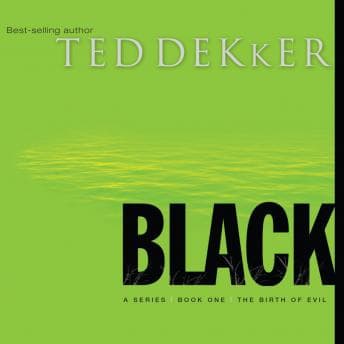

What happens when you die twice and the world still needs saving?
That's the question Ted Dekker drops in your lap with Black, and honestly, it's the kind of premise that would make my AP Lit students roll their eyes before secretly getting hooked. I listened to most of this during my morning walks along the lakefront with Denise, and I'll admit—there were moments I stopped walking entirely. Just stood there like a weirdo near the pier, staring at the water while Rob Lamont's baritone pulled me between two realities.
The Dual-World Gambit
Look, here's the thing about parallel reality narratives—they're incredibly hard to pull off. You're asking readers (or listeners, in our case) to invest in two separate worlds, two sets of stakes, two versions of the same character. Most authors fumble it. Dekker doesn't.
Thomas Hunter exists in our world—modern, terrorist threats, biological weapons—and also in a fantastical realm that operates by entirely different rules. When he sleeps in one world, he wakes in the other. Die in one? Well. That's where it gets complicated.
This reminds me of what C.S. Lewis did with the Narnia chronicles, actually—that sense of slipping between realities, where time moves differently and the rules you thought you knew become suggestions. City of God plays with similar metaphysical territory, though Augustine's wrestling with eternal versus earthly cities feels less frantic. But Dekker cranks the urgency way higher. This isn't children discovering a wardrobe. This is a man racing against a virus that could end humanity while simultaneously fighting for survival in a world of forests and evil that feels almost... biblical.
(Don't tell my students I compared anything to Narnia. They already think I'm ancient.)
Rob Lamont Gets It
I've listened to enough audiobooks to know when a narrator understands their assignment versus when they're just reading words. Lamont gets it. His baritone carries this weight—there's an urgency that builds as the story progresses, and his timing is exquisite. When Thomas moves between realities, Lamont shifts with him. Not dramatically, not with cartoon voices, but with subtle changes in pace and tension that make both worlds feel equally real.
One listener quote I found described him as creating "a sense of desperate urgency that leaves the listener breathless." That's accurate. There were moments during faculty meetings—okay, fine, Principal Martinez, I was definitely not listening to your budget presentation—where I had to actively control my breathing because Lamont had me so wound up.
Now. I did find that some listeners preferred reading the book instead. And I get it—narration is deeply personal. What works for me might not work for you. If you're someone who needs a lot of vocal variation, multiple distinct character voices, that kind of theatrical performance—maybe sample first. But if you appreciate a narrator who trusts the material enough to let it breathe while still maintaining tension? Lamont delivers.
The Christian Element (Let's Talk About It)
Dekker writes Christian fiction, and Black doesn't hide from that. The good versus evil framework here isn't subtle—it's cosmic, it's intentional, and it's woven into the fantasy world in ways that feel organic rather than preachy.
I teach literature. I've watched students dismiss books for less. But here's what I'd tell them: this is allegory done well. Dekker isn't hitting you over the head with a message. He's telling a story about evil and rescue, betrayal and love—universal themes dressed in fantasy clothing. If you loved The Chronicles of Narnia or even The Lord of the Rings, this is their spiritual successor in thriller form. Tattooist of Auschwitz sits in a different category entirely—that one's about real evil, not allegorical forests—but both books understand how to make moral stakes feel visceral.
My students would probably hate the nearly thirteen-hour runtime. I loved it. Worth every minute of pretending to grade papers.
Who's This For (And Who Should Skip)
If you want allegory with teeth—good versus evil that actually feels dangerous—and you've got patience for a dual-world structure, this one's for you. Commuters, late-night graders, anyone who likes their fantasy with thriller pacing. Skip it if overt Christian themes aren't your thing, or if you need your narrators doing full theatrical voice work.
Class Dismissed
Here's my honest take: Black is the first book in the Circle trilogy, and based on what I heard, I understand why listeners say they "couldn't put them down." The ending left me wanting more—not in a frustrating cliffhanger way, but in that satisfying way where you know the author has more story to tell and you trust them to tell it well.
The production is clean, the pacing keeps you engaged through nearly thirteen hours, and the dual-world narrative actually works. That's rare.
If you're a commuter, this is perfect. If you're someone who listens while doing mindless tasks—grading papers at 11PM, hypothetically—even better. The story is complex enough to reward attention but propulsive enough that you won't lose the thread if you zone out for a minute.
Just maybe don't listen during faculty meetings. Or do. I won't judge.