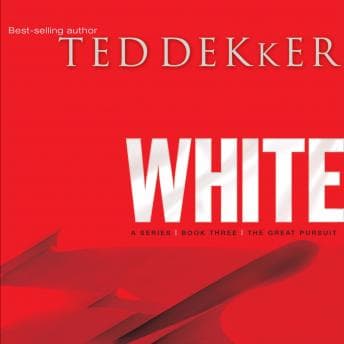
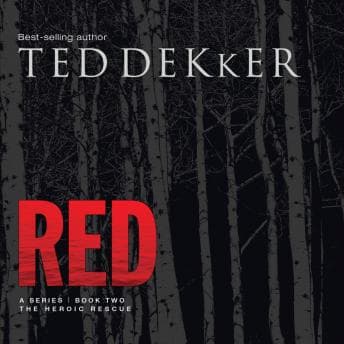
"Only Thomas Hunter can stop it, and he has been killed. Twice."
That line from the opening description is basically the pitch that got me to commit fifty-two hours of my life to Ted Dekker's Complete Circle Series. Fifty-two hours. That's longer than it takes me to grade a full set of junior research papers, and honestly, this was more emotionally exhausting.
I started this during spring break - Denise and I drove down to visit her sister in St. Louis, and I had the whole backseat-of-my-own-mind thing going while she drove and sang along to Motown. By the time we hit I-55 south of Bloomington, Thomas Hunter had already died twice and I was hooked in a way I hadn't expected from something shelved under Religion & Spirituality.
Two Worlds, One Very Tired English Teacher
Here's what Dekker does that's genuinely interesting: he builds a dual-reality structure where Thomas Hunter exists in our contemporary world - dealing with a bioterrorist virus threat - and simultaneously in a future/alternate world where good and evil are literal, visible forces. Fall asleep in one world, wake up in the other. The question of which world is "real" drives the first two books, Black and Red, with real momentum.
And I want to be fair to Dekker here. The man can plot. The virus storyline in our world has genuine thriller mechanics - there's a ticking clock, government incompetence, scientists scrambling. The other world, with its Colored Forests and the entity called Elyon and the bat-creature Teeleh, operates on allegory so thick you could spread it on toast. This is C.S. Lewis by way of Tom Clancy, and I mean that with about 60% admiration and 40% bewilderment. That same earnest allegory-meets-narrative-drive combination is what drew me to Redeeming Love, which pulls off a similar trick of transplanting scripture into genre fiction with more emotional precision than I expected.
The Christian allegory isn't subtle. It's not trying to be. By White, the third book, Dekker has essentially rewritten the Passion narrative with Thomas Hunter's people as the faithful remnant and the Horde as - well, you get it. My students would recognize the symbolism in about three minutes. But there's something earnest about the ambition that I respect even when the execution gets heavy-handed. This reminds me of what Hemingway said about writing - "All you have to do is write one true sentence." Dekker writes plenty of true sentences. He also writes some that made me wince.
Green, the final book (or "Book Zero" as Dekker calls it, because it loops back to the beginning), is where things get philosophically wild. The circular structure - where the ending feeds into Black's opening - is genuinely clever. It's the kind of structural ambition you rarely see in genre fiction, let alone Christian genre fiction. Whether it fully works is another question. I spent about twenty minutes after finishing just staring at Lake Michigan trying to figure out if the loop was profound or a cop-out. I'm still not sure.
The Narration Problem That Won't Go Away
Okay. Rob Lamont and Tim Gregory. Here's where I have to be honest, and it pains me because I believe great narration is performance art.
The narration across these fifty-two hours is... functional. Sometimes intense - there are stretches in Black where the pacing of the read matches the thriller energy and you're genuinely locked in. But the character differentiation is essentially nonexistent. Thomas Hunter sounds like Rachelle sounds like Mikil sounds like the terrorist Svensson. When you're bouncing between two entire worlds with dozens of characters, that's a real problem.
It reminded me of sitting in a college lecture where the professor is clearly passionate about the material but reads every quote in the same cadence. You can feel the story underneath, but the performance isn't excavating it. The narrator understands that pause is punctuation - except here, they mostly don't pause. The emotional beats in White, which should hit like a freight train given the allegory Dekker is building toward, land with the weight of a faculty memo.
At 1.0x speed - because the author chose those words - I noticed every flat line reading. Every moment where a character's grief or rage or wonder came through as the same steady mid-range tone. Fifty-two hours is a long time to wish someone would just raise their voice.
Who This Is Actually For
If you're a Dekker fan who wants the complete arc in one marathon listen, this delivers the story. The plot will carry you. If you loved Narnia as a kid and want something with that same allegorical DNA but aimed at adults with thriller sensibilities, there's genuine pleasure here. If you're coming to this as literary fiction - no. Come for the ideas and the structure, stay for the pacing in Black and Red, and forgive the narration its limitations.
My students would hate the allegory. They'd say it's too obvious. But I've been teaching long enough to know that sometimes the obvious thing said with enough conviction still matters.
Worth the Fifty-Two Hours?
Honestly? About thirty-five of them, yes. Black is the strongest entry - tight, disorienting, propulsive. Red maintains the energy. White starts to strain under the weight of its own mythology. Green is ambitious and uneven and strangely moving in spots. The narration holds it back from being what it could've been. A full-cast production with distinct voices would've made this something special. What we got is a good story read adequately.
I finished it on the lakefront, walking alone because Denise had book club. The circular ending hit me harder than I expected. Maybe that's the St. Louis road trip talking, or maybe Dekker earned it. Either way - I didn't fall asleep. The only other audiobook that hit me that quietly at the end was A Shepherd Looks at Psalm 23 - different scale entirely, but that same feeling of a familiar idea landing like you'd never actually heard it before. Which is more than my mom can say about my Faulkner episodes.