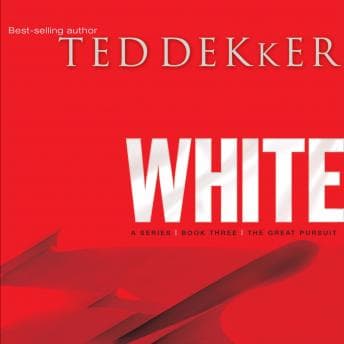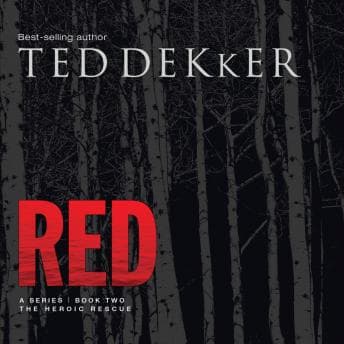

I was three hours deep into a stack of sophomore essays on The Great Gatsby — the ones where every other student calls the green light "a symbol of hope" and leaves it at that — when I realized I needed something to keep me from writing increasingly sarcastic margin notes. So I put on Red, the second book in Ted Dekker's Circle trilogy, and let Rob Lamont's voice carry me through the remaining forty-seven papers.
Here's the thing about Red that I didn't expect: it made me think about C.S. Lewis.
The Dual-World Problem Lewis Would've Loved
Dekker's central conceit — Thomas Hunter living in two parallel realities, one as a warrior general commanding a primitive army, the other as a modern-day guy trying to stop a catastrophic virus — is ambitious in a way that makes the English teacher in me both excited and nervous. It's the kind of structural gamble that either pays off or collapses into narrative whiplash. And honestly? It does a little of both.
The parallel world structure works because Dekker commits to it. When Hunter sleeps in one world, he wakes in the other, and the consequences bleed across. The virus plotline — terrorists engineering global chaos — has the pacing of a thriller you'd grab at an airport, while the fantasy war sequences feel more like something out of a blood-soaked Old Testament retelling. The tension between those two modes is what makes the book interesting. It's also what makes it exhausting.
This reminds me of what Hemingway said about writing — that the dignity of movement of an iceberg is due to only one-eighth of it being above water. Dekker's approach is the opposite. Everything is above water. Every revelation, every spiritual parallel, every moment of allegorical significance gets pushed right to the surface. There's no subtext here. There's just... text. My students would actually appreciate that directness. I found myself wanting more room to breathe, more trust in the reader — or in this case, the listener — to do some of the interpretive work.
Rob Lamont: Minister or Narrator? (The Answer Is Complicated)
Let's talk about the elephant in the room. Rob Lamont's narration has split listeners right down the middle, and I understand why. There's a quality to his delivery that sounds distinctly like — and I'm going to be as specific as I can here — a passionate pastor working through a sermon illustration. He brings genuine urgency. When the virus plot accelerates in the modern-world chapters, Lamont's pacing tightens, his voice drops into this clipped, almost breathless cadence that genuinely kept me alert during hour ten of paper grading. That's not nothing.
But in the fantasy sequences, where Hunter leads his army and the spiritual allegory becomes more overt, Lamont shifts into something more reverent, more measured, and it starts to feel less like fiction and more like a dramatized reading at a Wednesday night Bible study. (No shade to Wednesday night Bible studies — Denise and I went to plenty before we moved to Chicago. But they're a different genre experience.) The transition between the two tonal registers isn't always smooth, and there were moments where I caught myself thinking about the narration rather than the story, which is always a problem.
I didn't find him amateurish, exactly. More... earnest in a way that works for the material's spiritual dimension but occasionally undercuts the thriller tension. He's better at urgency than subtlety. And in a book where the author is already painting in broad strokes, a narrator who also paints in broad strokes means everything comes on pretty strong.
Who This Is Really For (And Who Should Walk Away)
If you loved Black and you're invested in the Circle trilogy, you're going to listen to this regardless of what I say — and you should. On the subject of faith-driven narratives that don't apologize for what they are, I spent some time earlier this year with Every Good Endeavor: Connecting Your Work to God's Work, which operates in a completely different register — nonfiction, quieter, more Lewis than Dekker — but scratches a similar itch if the theological sincerity in Red is what's drawing you in. The dual-world structure deepens, the stakes escalate, and Dekker clearly has a destination in mind. If you're someone who appreciates fiction that wears its Christian allegory openly, the way Lewis did with Narnia or the way Tolkien would argue he didn't with Middle-earth, there's genuine substance here. Dekker isn't subtle, but he's sincere, and sincerity counts for something.
If you're coming to this cold, without having listened to Black, don't start here. You'll be lost within twenty minutes. And if allegorical fiction that occasionally reads like a sermon wrapped in a thriller wrapped in a fantasy novel sounds like three genres too many — this probably isn't your book. I respect what Dekker is doing even when it doesn't land for me. The ambition is real. The execution is uneven.
I finished it at 1:00 AM, papers finally graded, lakefront dark outside the window. And I sat with it for a minute before putting on anything else. That's worth something — even when a book frustrates you, if it makes you sit in silence afterward, the author did something right.
The Assignment: Read or Return?
I'd give this a passing grade. Strong concept, committed worldbuilding, a narrator who matches the book's energy even when that energy veers toward pulpit rather than page-turner. It's not the kind of audiobook I'd recommend to the 47 listeners of my podcast — the prose doesn't quite deserve the savoring treatment. But for fans of Dekker's particular brand of spiritual thriller, it delivers exactly what it promises. Just know what you're signing up for.