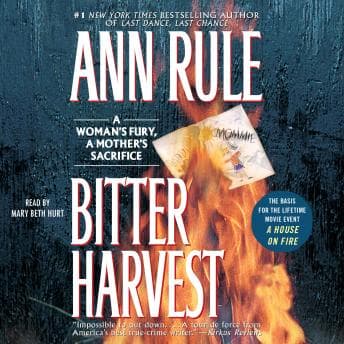

I need to talk about Mary Beth Hurt's narration choices. Because they're... a lot.
Look, I was chopping onions for dal at 10 PM—already emotionally compromised—when Hurt launched into what I can only describe as a community theater interpretation of Debora Green's psychological unraveling. And I found myself asking: why does a narrator feel the need to perform a true crime book like it's Medea at the local playhouse?
This is a fascinating case study in mismatched delivery. Ann Rule's writing doesn't need theatrical embellishment. The facts are horrifying enough. A physician mother. A seemingly perfect Kansas suburb. Two children dead in a fire that wasn't an accident. Rule—a former police officer herself—understood how to build dread through accumulation of detail, not melodrama. Hurt's tendency to lean into dramatic vocal flourishes works against that restraint.
The Psychology of a Prairie Fire
Here's what makes Debora Green compelling as a subject: she exhibits classic narcissistic collapse patterns. The infidelity, the revenge poisoning (yes, poisoning—before the fire), the escalation when her carefully constructed life began crumbling. Rule traces the trajectory with the patience of a forensic investigator, and at under four hours, this abridged version hits the major psychological beats without the exhaustive detail of her longer works.
The arson investigation scenes are genuinely gripping. Rule walks you through how investigators pieced together accelerant patterns, how they moved from "tragic accident" to "unthinkable conclusion." My therapist would have thoughts about this character—specifically about how Debora's medical training gave her both the means and the clinical detachment to attempt murder multiple times before succeeding.
But here's my frustration: Hurt's performance keeps pulling me out of the analysis. When you're trying to understand the psychology of maternal violence—which, let's be honest, challenges every narrative we hold about motherhood—you need space to think. The theatrical delivery fills that space with... performance.
What Rule Understood About Monsters
Ann Rule spent her career studying why ordinary-seeming people commit extraordinary evil. She worked alongside Ted Bundy, for crying out loud, before anyone knew what he was. That background gives her writing a particular quality—she doesn't sensationalize because she doesn't need to. The horror is in the mundane details. The casseroles brought to the grieving family. The husband who suspected something but couldn't quite believe it. The children who trusted their mother.
Psychologically, this tracks in ways that make your stomach turn. Debora Green wasn't a monster in the obvious sense. She was a physician. She volunteered at school functions. She made dinner. And she systematically destroyed her family when they threatened to leave her.
The book works as a case study in how we miss warning signs because they don't match our expectations. We're trained to look for certain patterns—the absent father, the abusive boyfriend, the stranger danger. Not the accomplished mother in the nice neighborhood.
The Abridged Question
At 3 hours and 51 minutes, this is clearly a condensed version. I'm of two minds about that. On one hand, Rule's unabridged works can run 15+ hours, and sometimes you want the essential narrative without every peripheral interview. Clock Strikes Thirteen also benefits from that compact approach—sometimes brevity sharpens the psychological impact rather than diluting it. On the other hand, true crime lives in those details—the neighbor who noticed something off, the colleague who remembers a strange comment. You lose texture in abridgment.
For a commute listen or a cooking session (my onions were very well caramelized by the end), the shorter format works. But if you're genuinely interested in the psychology of this case, you might want the full text.
Who This Is For (And Who Should Read Instead)
If you can tolerate—or even enjoy—theatrical narration, and you want a compact introduction to one of Rule's most disturbing cases, this works. The story itself is undeniably compelling. A mother who poisons her husband with ricin before graduating to arson? Classic escalation patterns that any criminal psychology student would recognize. That same clinical detachment in examining violence shows up in All That Remains, where the horror lies in methodical investigation rather than theatrical presentation.
Skip this if dramatic narration pulls you out of true crime—consider the print version instead, or find a different Rule audiobook with a more restrained narrator. The material deserves to speak for itself.
My Clinical Assessment
Three and a half stars. The case is genuinely horrifying and psychologically rich. Rule's writing demonstrates her decades of expertise in making sense of senseless violence. But Hurt's performance—that listener wasn't wrong about it feeling like a play—keeps this from being the immersive experience it could be. Worth your time if you're interested in the psychology of maternal violence, but maybe wait for a sale. The narration isn't bad enough to skip, but it's not good enough to pay full price for when you could just read the book.