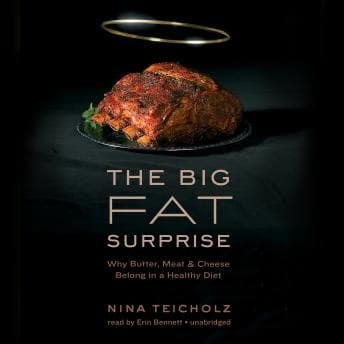

Thirteen hours and twenty-six minutes about dietary fat. I know. I KNOW. But hear me out — I started this at 10 PM on a Tuesday because I couldn't sleep (Jenny had commandeered the bedroom TV for some K-drama marathon), and by 2 AM I was in the kitchen eating cheese straight from the block like a man possessed. That's either the sign of a great book or a mental breakdown. Possibly both.
Sixty Years of Nutritional Malpractice, Narrated Clearly
Bottom line: This book is what happens when an investigative journalist applies actual rigor to the dietary advice your doctor has been parroting since the 1960s. Nina Teicholz spends eight years — eight years — tracing how one man's flawed hypothesis about saturated fat basically became national policy, and how the scientific establishment closed ranks around it like a Fortune 500 company protecting a bad product launch.
The Ancel Keys chapters are where this thing really catches fire. Teicholz lays out how Keys cherry-picked data from his Seven Countries Study, ignoring populations that didn't fit his thesis. She walks you through the politics of the American Heart Association, the USDA dietary guidelines committee, and how food industry money warped everything it touched. I've seen this exact pattern at three different companies — a charismatic leader pushes a thesis, everyone falls in line, and by the time the data says otherwise, careers depend on nobody admitting the mistake.
This is what my parents did instinctively. My mom cooked with sesame oil, pork fat, eggs every morning. Nobody in Koreatown was worried about saturated fat in 1993. Then the low-fat craze hit, and suddenly the grocery store was full of SnackWell's cookies that had more sugar than a candy bar but hey — fat free! Progress.
Where Gary Taubes Built the Foundation, Teicholz Brings the Receipts
If you've read — or listened to — Taubes's Good Calories, Bad Calories, you'll recognize the territory. But here's the difference: Taubes is a physicist-turned-science-writer who builds arguments like proofs. Teicholz is a journalist who builds arguments like cases. She names names. She tracks the money. She interviews the researchers who got blackballed for questioning the orthodoxy. The same forensic-journalism energy shows up in Friday Night Lights, where Bissinger does something structurally similar — follows the money and the myth-making behind an institution everyone agreed not to question, and names the people propping it up. The section on the Women's Health Initiative — a $700 million study that basically proved the low-fat diet doesn't prevent heart disease — and how its results were quietly buried? That's not just science writing. That's institutional autopsy.
Erin Bennett narrates this with a clean, measured delivery that works well for the density of the material. She's not doing character voices or dramatic shifts — this isn't that kind of book — but she handles the transition between narrative storytelling and data-heavy passages without losing you. For a 13-plus hour listen packed with study citations and historical detail, that's harder than it sounds. Bennett keeps the pacing conversational enough that you don't zone out during the Mediterranean diet deep-dive sections, which could easily have become a slog.
My 2.0x speed couldn't save the middle stretch, though. Chapters on trans fats and the vegetable oil industry are important but repetitive — Teicholz makes the same point (industry funded the science, science supported industry products, consumers got screwed) about four times more than necessary. Skip to chapter 5 if you already know the basics of how Crisco conquered America. Thank me later.
The 45 Minutes of Insight Problem — Inverted
Here's what surprised me: this is one of those rare business-adjacent books where the ratio is inverted. There's maybe 2 hours of padding in 13 hours, not 7 hours of padding in 8. Teicholz earned those pages. The historical narrative alone — watching the AHA transform from a small cardiology group into a diet-policy juggernaut funded by Procter & Gamble — reads like a case study I'd assign to clients about regulatory capture.
The weakness? Teicholz occasionally oversells. When she argues that saturated fat is essentially harmless, she's strongest. When she edges toward suggesting it's actively therapeutic, the evidence gets thinner and she doesn't always flag the distinction. Jenny would say I'm being harsh. Jenny is right. But in consulting, we call that "getting ahead of your data," and it matters.
Still — for anyone running a health-related startup, working in food industry, or just tired of being told eggs will kill you every other Tuesday, this is essential listening. It's a masterclass in how institutional consensus can override evidence, and that lesson applies way beyond nutrition.
Who Gets the Most ROI Here
People who think critically about received wisdom. Founders in health tech or food. Anyone whose doctor told them to cut fat and they gained weight anyway. Skip it if you want a diet plan — this isn't a how-to, it's a why-we-got-here. Also skip if you need your science books under 6 hours. This one demands your attention.
The key takeaway is worth the listen. The other 7 hours? Actually, most of them are too.