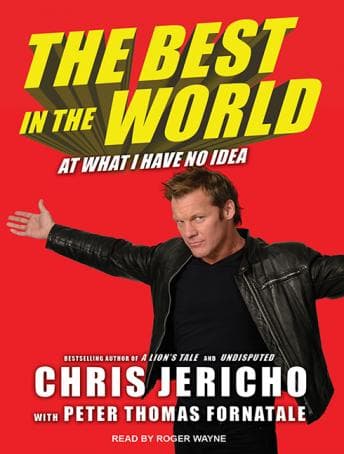

Look, I'll be upfront: I have never cared about professional wrestling. Not once. Not even during the Attitude Era when every kid in my middle school was doing the People's Elbow on the playground. My parents' dry cleaning shop was across the street from a strip mall with a wrestling memorabilia store, and I remember thinking, "Who buys this stuff?" So when a founder I'm advising told me Jericho's books were actually solid business reads disguised as wrestling memoirs, I figured I owed it twelve hours on a red-eye to Dallas.
He was half right.
A Dry Cleaner's Kid Recognizes the Hustle
Here's what caught me off guard: Chris Jericho's career arc from 2007 onward is basically a case study in brand reinvention that I've pitched to clients using far worse examples. The guy watches No Country for Old Men, sees Javier Bardem's Anton Chigurh, and decides to rebuild his entire professional persona around that energy. Cold. Calculated. No catchphrases. That's not wrestling nonsense - that's a pivot strategy executed with more conviction than half the Series B founders in my portfolio. The level of disciplined commitment to a persona reminded me of the ownership mindset in Extreme Ownership - different arena, same refusal to half-ass the mission.
The Vince McMahon relationship stuff is genuinely fascinating from a power dynamics standpoint. Jericho describes this on-again, off-again dynamic with his boss that anyone who's navigated corporate politics will recognize instantly. You're in favor, you're out. You pitch an idea, it gets shot down. You pitch the same idea three months later through someone else, suddenly it's genius. This is what my parents did instinctively - reading the room, knowing when to push, when to wait. Now it has a TED talk. Or in this case, a wrestling memoir.
The celebrity encounters are where the book earns its subtitle. Mickey Rourke challenging Jericho to a real match and then backing out reads like a startup founder announcing a product launch and quietly shelving it. Bob Barker, Ozzy Osbourne, Mike Tyson, Al Sharpton - Jericho collects these interactions like trading cards, and most of them land because he's genuinely funny and self-aware enough to know when the joke is on him.
Roger Wayne Is Not Chris Jericho (And That's a Problem)
Here's where I need to be honest. Roger Wayne does a competent job narrating - his comedic timing is solid, and his pacing keeps the stories moving. But this is a memoir. A deeply personal, voice-driven memoir from a guy whose literal job is talking on a microphone. And they didn't get Jericho to narrate it.
Wayne's from small-town Minnesota, and he reads this like a well-prepared book report rather than a man reliving the craziest decade of his life. There are mispronunciations of wrestling terminology that any fan would catch - the kind of thing that signals the narrator didn't do his homework. If I turned in a client deck where I mispronounced the company's own product names, I'd get fired. Same energy here.
It's not bad narration. It's just... wrong narration. Like hiring a perfectly competent accountant to do your stand-up set. The technical skill is there. The soul isn't.
The Padding Problem
At nearly twelve hours, this book has the classic business-book disease: too much content for the actual insight. Story by Robert McKee lays out exactly why this happens - when you don't know your core narrative spine, you fill the space with everything instead of the right thing. The Icelandic volcano escape story - fleeing through Europe in a broken-down rental shuttle during the 2010 eruption - is genuinely great. It's chaotic, absurd, and you can feel the panic. But for every volcano story, there are two chapters of match-by-match recaps that blur together if you're not already invested in WWE storylines.
I listened at 2.0x. My 2.0x speed couldn't save this one during the match recaps. But the backstage politics? The Vince McMahon mind games? The career reinvention stuff? That I'd slow down for.
Skip to the chapters about his character transformation and the McMahon dynamics. Thank me later.
Who Gets ROI on This Listen
Wrestling fans: obvious yes, though you'll grind your teeth at Wayne's pronunciation slips. Business nerds who appreciate unconventional case studies in personal branding and corporate navigation: surprisingly yes, but be ready to fast-forward through match recaps. People who want a celebrity memoir that's actually funny rather than ghostwritten-generic: cautious yes.
People who need Jericho's actual voice to sell the stories: go find his podcast instead.
Bottom Line on the P&L
Bottom line: there's a sharp, funny, surprisingly strategic book in here that's about 7 hours long trapped inside a 12-hour audiobook. The reinvention arc is legitimately instructive. The celebrity stories are entertaining. But the wrong narrator and the match-recap padding knock this from a strong recommendation to a "catch it on sale" situation. Jenny would say I'm being harsh. Jenny is right. But Jenny also doesn't sit through twelve-hour audiobooks about wrestling on a Tuesday night flight to Texas.