
I was jammed into the quiet car on the Caltrain—standing room only, of course—staring at a billboard for some AI productivity tool that promised to "optimize my workflow," wondering if my obsession with efficiency was actually making me successful or just making me... tired. That's when I hit play on this.
Usually, business books are my 1.75x speed fodder. You know the type: one good idea stretched over 300 pages, narrated by someone who sounds like they're reading a terms of service agreement. But honestly? I slowed this one down to 1.5x.
Not Another LinkedIn Sermon
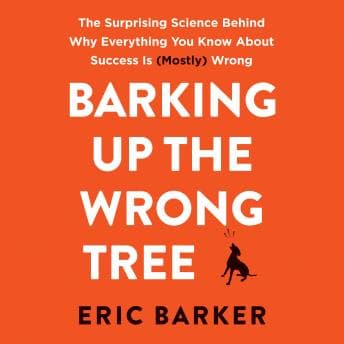
First off, Roger Wayne. I hadn't listened to him before, but the guy brings it. Most self-help narrators have this soothing, "I have my life together and you don't" tone that makes me want to throw my phone at the train window. Wayne also narrated The Subtle Art of Not Giving a F*ck, and he brings that same caffeinated energy here. He just sounds enthusiastic. Like your friend who had three espressos and really needs to tell you about this cool study he read.
He handles the transitions between the heavy data and the weird anecdotes—pirates, serial killers, Navy SEALs—without missing a beat. Keeps the momentum high. If you're listening while trying to stay awake on a commute or during a repetitive gym set, he's got your back. He nailed the conversational vibe Barker was going for.
The Valedictorian Trap (Ouch)
Okay, so the content. As someone who definitely cared about grades way too much (don't look at my transcript), the section on why valedictorians rarely become millionaires hit a little close to home.
Barker basically argues that following the rules makes you great at school, but "meh" at life. Life rewards the outliers. The obsessive weirdos. The people who are bad at everything except the one thing that matters.
It's validating, in a way. Data-driven permission to stop trying to be well-rounded. Being Mortal gave me a similar kind of permission—to stop optimizing for the wrong metrics entirely. In software terms: stop trying to be a full-stack developer if you're a backend genius. Just optimize the backend.
And the science actually holds up. He's not just throwing platitudes around; he's citing studies. It feels like debugging the "success algorithm" we've all been fed since kindergarten.
The Grit vs. Quitting Paradox
The part that stuck with me—and actually made me pause the audio to take a note—was the tension between persistence and knowing when to walk away. We're told to never give up, right? But Barker points out that strategic quitting is actually super important. You have to know when a system is failing and kill the process.
It's not perfect. Sometimes the advice feels a bit contradictory (be nice! but also, jerks win sometimes!), but that's honestly more realistic than most books in this genre. Life is messy. Distributed systems are messy. Success is messy.
Who's This For?
If you're a recovering perfectionist, a rule-follower wondering why the rule-breakers keep winning, or just someone tired of success advice that sounds like it was generated by a motivational poster algorithm—queue this up. Skip it if you want a simple, actionable framework. Barker's more interested in showing you the contradictions than resolving them.
Commit to Main
This isn't a blog post padded out to book length. The ROI on the 9 hours is high. I finished it in about four commutes and actually retained enough to annoy Kevin with "did you know?" facts all weekend.