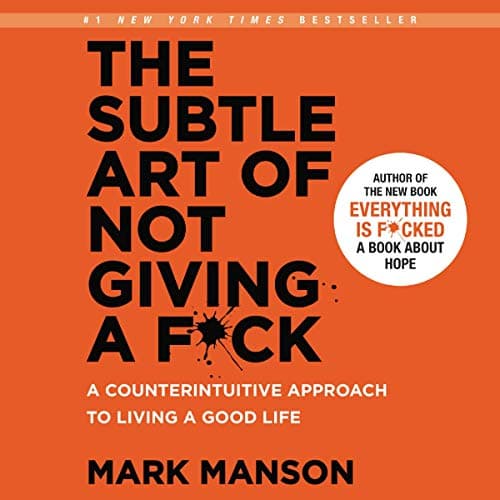

I started this on a gray Cambridge morning while chopping onions for an overly ambitious dal I absolutely did not need to make on a Tuesday. And within ten minutes Mark Manson was basically yelling, in thesis form, that most of us are emotionally unserious about suffering. Which - rude. Also not wrong.
What annoyed me first, and then won me over, is that this book is built like a contrarian TED Talk that went to therapy. It keeps poking at the American obsession with feeling good, optimizing harder, manifesting your best life, and all the other glossy nonsense that tends to collapse the minute actual grief or failure walks into the room. The research actually shows that avoidance makes distress stickier, and Manson's central argument lives in that neighborhood: you do not fix life by erasing pain; you fix it by choosing which pain is worth tolerating.
That is a much more psychologically honest premise than a lot of self-help gives us.
When the book stops performing and starts making sense
The protagonist here - yes, I analyze nonfiction books like they have protagonists, don't judge me - exhibits classic anti-guru behavior. Manson wants to be the guy who says the unsayable. Sometimes that works beautifully. Sometimes you can feel him leaning a little too hard on the "look how blunt I am" persona. Psychologically, this doesn't always track as depth. Occasionally it's branding.
Still, the core ideas land because they are less rebellious than they first sound. Accept your limitations. Stop treating discomfort like an emergency. Pick values that can survive reality instead of values built on applause. Take responsibility for your choices without pretending you control everything. Rising Strong covers remarkably similar ground with a warmer hand and Brené Brown's research backing it up, which is worth knowing if Manson's delivery ever makes you want to throw something. None of this is revolutionary if you've spent time around CBT, existential psychology, or frankly any emotionally mature adult over forty. But Manson packages it with enough irreverence and concrete examples that the medicine goes down easier.
And that matters. Self-help often fails because it confuses inspiration with behavior change. This one, for all its bro-ish profanity, understands that humans are meaning-making creatures with limited bandwidth. There are only so many things we can care about before the whole system overheats. A fascinating case study in cognitive triage, really.
I found myself asking: why does this book work for so many people when its advice is, stripped down, fairly old? Because the tone gives readers permission to stop performing wellness. That's the real service it provides.
Roger Wayne, the chaos moderator
Roger Wayne's narration is a huge part of why the audiobook clicks. He doesn't read this like a serene life coach floating above human mess. He sounds like someone grabbing you by the collar, then cracking a joke so you don't bolt. That "intense self-help seminar" description from listeners feels exactly right.
Most notably: the Disappointment Panda bit. Wayne gives that character voice such weird, committed energy that it becomes the kind of audio moment you remember later while unloading groceries. It could have been unbearable. Instead it's just absurd enough to work, and it highlights one of the book's better instincts - using humor to smuggle in ego punctures.
His timing is good with Manson's poop jokes and casual profanity too. There's a down-to-earth quality in the delivery that keeps the text from becoming insufferably self-satisfied. Wayne moderates the author's bombast without flattening it. That's harder than it sounds.
But. Yes, there is a but.
At times he pushes too hard, especially when the writing itself is already doing capital-M Most. If you're sensitive to narrators who sound slightly too pleased with the material's swagger, you'll notice it. I did. Not enough to ruin the listen, but enough that I occasionally wanted five percent less "listen up, champ" energy.
Also, this is only 5 hours and 17 minutes, and I still think 1.25x is the sweet spot. Not because it's dull - it isn't - but because the rhetorical point of this book is very clear, very early. The later chapters deepen it some, yet there are stretches where the anecdotes and circling emphasis feel like blog-to-book inflation. Some of the 2-3 star complaints about filler are not wrong. They are just less bothered by the shtick than I was.
Who Should Listen (And Who Should Skip)
If you like your self-help gentle, affirming, and free of F-bombs, absolutely do not start here. My therapist would have thoughts about giving this to someone in acute emotional fragility. The book's whole method is confrontation softened by humor, and if that style hits you as contemptuous rather than clarifying, you're going to hate every minute.
But if you've rolled your eyes at overly polished personal growth books that promise confidence, abundance, and a color-coded morning routine, this will probably feel like relief. Especially if you appreciate conversational logic over spiritual branding. Manson is strongest when he talks about choosing better values instead of chasing better feelings. That's where the book stops being a gimmick and becomes useful.
Best in audio, I think, for focused listening rather than half-paying attention while answering emails. The ideas are simple, but the tone is doing a lot of the persuasive work, and Roger Wayne's performance is the delivery system. Clean production, no distracting effects, no nonsense. Just one guy talking directly into your conscience with a smirk.
I wouldn't call it profound. I would call it clarifying. And honestly, that may be more useful.
Prognosis
This audiobook understands something many self-help titles don't: people don't need endless positivity; they need a better relationship with frustration, failure, and limitation. Manson grasps human nature often enough to be worth your time, even when the persona gets a bit performative. Roger Wayne makes it lively, especially in bits like Disappointment Panda, though he occasionally over-seasons the attitude.
So. Not enlightenment. Not a life manual. Just a smart, funny corrective for people exhausted by motivational fluff.
Which, depending on your current level of annoyance with the self-improvement industry, might be exactly the right prescription.