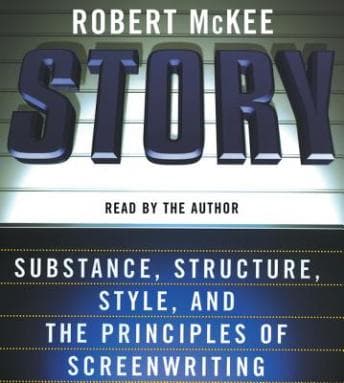

Robert McKee is the professor you wish you'd had in graduate school - the one who makes you feel simultaneously brilliant and completely inadequate.
I finished this at 11 PM while grading a stack of sophomore essays on The Great Gatsby, and I'll be honest: McKee made me question every piece of writing advice I've given my students for twenty years. Not because he's wrong about what I teach. Because he articulates why it works in ways I've never managed to explain.
The Lecture Hall in Your Earbuds
Here's the thing about McKee narrating his own work - it sounds exactly like what it is: a man who has delivered this material to thousands of paying seminar attendees and knows precisely where to pause, where to emphasize, where to let the silence do the heavy lifting. His analysis of Casablanca's structure isn't just informative; it's performed with the timing of someone who's watched audiences lean forward at specific revelations for decades.
But that polish cuts both ways. There's a loftiness to his delivery that occasionally made me roll my eyes. He speaks with the certainty of a man who has never been interrupted by a sixteen-year-old asking "but why does it matter?" And look - I get it. He's earned that authority. His students have won Oscars. Mine have won perfect attendance certificates. Different leagues.
The audio quality is... not great. I had to crank my volume higher than usual, and some words got swallowed in what sounds like an older recording. Not a dealbreaker, but noticeable. Worth mentioning if you're listening in a noisy environment.
Form, Not Formula (And Why That Distinction Matters)
This is where McKee earns his reputation. His central argument - that great storytelling follows principles, not templates - is something I try to explain to my AP Lit students every semester. He does it better in six hours than I've managed in six years.
The scene analysis sections are genuinely excellent. When he breaks down Chinatown beat by beat, you start seeing the architecture beneath the story. It's like those moments when a student suddenly understands that Fitzgerald wasn't just describing a green light - they were witnessing structure become meaning.
What I appreciated most: McKee doesn't talk down to you, but he also doesn't assume you've internalized three-act structure from the womb. He builds his arguments. If you loved Aristotle's Poetics (and I mean actually loved it, not just survived it in a survey course), this is its spiritual successor for the screen age. Fresh Off the Boat works with similar structural principles, though Huang's applying them to memoir instead of fiction—same bones, different flesh.
The Catch - And There's Always a Catch
This audiobook apparently differs from the updated print edition in significant ways. If you're the type who reads along - and for a craft book like this, that's not unreasonable - you'll find discrepancies that could drive you slightly mad. I listened without the text and was fine, but it's worth knowing.
Also: this is not background listening material. I tried it during a faculty meeting once (sorry, Principal Martinez, I was definitely not paying attention to the budget presentation) and had to rewind constantly. McKee demands focus. His ideas build on each other, and if you zone out for ten minutes, you'll miss the foundation for his next point.
My students would probably hate this. Too dense, too theoretical, too much "old guy telling you what's wrong with modern movies." I loved it. But then, I'm the guy who listens to Middlemarch for fun.
Who Should Listen (And Who Should Skip)
If you're serious about understanding why stories work - whether you're writing screenplays, novels, or just want to be the person at book club who notices things - this is essential. Listen at 1.0x. Let McKee's examples sink in.
But if you want quick tips or a motivational writing pep talk, skip this. McKee isn't here to make you feel good about your current manuscript. He's here to make you better, which sometimes means making you uncomfortable first.
Worth Pausing the Faculty Meeting For
I've taught story structure for two decades using intuition and borrowed wisdom. McKee gave me the vocabulary and framework I was missing. The audio issues are annoying, and yes, he can sound like he's delivering commandments from Mount Hollywood. But the content? The content is why we still study craft.
Just don't try to listen while doing anything else. This one requires your full attention - and honestly, it's earned the right to demand it.