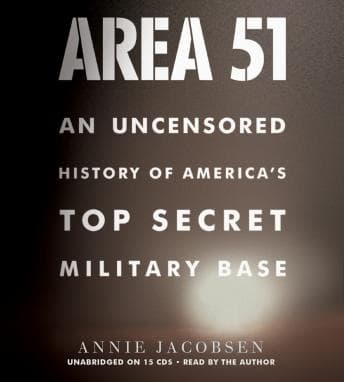

"The atomic bomb was the most secret project in history. Until Area 51."
That line hit me somewhere around hour three, and I had to pause my jog to just... process. Look, I picked up Annie Jacobsen's deep dive into America's most mythologized military base expecting the usual UFO speculation dressed up in serious clothing. What I got instead was a psychological case study in institutional secrecy—and honestly, that's way more fascinating than little green men.
The Psychology of Secrets
Here's what grabbed me: Jacobsen interviewed nineteen men, aged 75 to 92, who spent their careers doing things they couldn't tell their wives, their children, their therapists. Sustained secrecy creates specific psychological patterns—compartmentalization, identity fragmentation, sometimes profound isolation. You hear it in these testimonies. These weren't conspiracy theorists or attention-seekers. They were engineers and pilots who'd carried classified knowledge for decades, finally unburdening themselves before death. That kind of psychological weight—carrying a secret identity your whole life—reminded me of the compartmentalization I saw in Short and Tragic Life of Robert Peace, where someone lives split between two incompatible worlds.
The protagonist here—if we can call the collective consciousness of Area 51 that—exhibits classic institutional narcissism. The base believed it was so special, so essential, that normal rules of disclosure didn't apply. And maybe they were right? The U-2 spy plane, the A-12 Oxcart, stealth technology—all developed there. But the secrecy bred a kind of organizational pathology that Jacobsen traces carefully.
What makes this character study compelling is how the men themselves rationalize their silence. One describes missing his daughter's wedding for a test flight he couldn't explain. Another talks about lying to his wife for thirty years about where he worked. The cognitive dissonance required to maintain that—my therapist would have thoughts about these men.
Where the Narrative Fractures
Okay, so here's my issue. The book jumps around chronologically in ways that sometimes feel disorganized—we're in the 1950s testing nuclear weapons, then suddenly it's the War on Terror, then back to the Cold War. I get that classified history doesn't unfold neatly, but my brain wanted more linear structure.
And that ending. Jacobsen includes a controversial claim about Roswell that... look, I won't spoil it, but it's a pretty wild assertion based on a single source. She presents it as one man's testimony, not established fact, but it feels tonally jarring after sixteen hours of careful documentation. It's the kind of thing that makes you question the whole edifice, which is frustrating because the rest is so meticulously sourced.
The writing style is straightforward—some would say dry, others would say eighth-grade level. I found it accessible, which isn't a criticism. Dense military history doesn't need baroque prose. But if you're expecting lyrical nonfiction, adjust expectations.
Jacobsen Behind the Mic
Here's where I have to be honest: Jacobsen narrates her own book, and she's not a professional voice actor. Her delivery is clear but flat—little emotional variation, minimal differentiation between narrative and dialogue. When she's quoting a test pilot describing a near-death experience at Mach 3, it sounds pretty much like when she's describing bureaucratic memos.
This bothered me less than I expected, actually. There's something authentic about hearing an author read their own investigative work. She knows where the emphasis should be, even if she can't quite deliver it theatrically. But I'll say this: at 16 hours, the monotone accumulates. I found myself speeding up to 1.25x around hour eight, which helped with engagement.
The production quality is clean—no technical issues, no weird editing artifacts. Just... steady. Relentless. Like the Nevada desert itself.
Who Should Queue This Up (And Who Should Skip)
Listeners expecting a UFO tell-all will be disappointed. (And honestly, that's the point—Jacobsen is debunking as much as revealing.) But if you're into Cold War history, aviation technology, or the psychology of institutional secrecy, this is genuinely fascinating. Skip it if you need dynamic narration or can't tolerate a controversial final chapter that may undermine your trust in the whole project.
I found myself asking: why do we need secrets this big? What does it do to a democracy when entire histories are classified? Jacobsen doesn't answer these questions explicitly, but they hover over every chapter. The men who built stealth technology couldn't even tell their families they'd changed the world. That's a psychological burden I keep thinking about.
The book works best for long-form listening—commutes, road trips, household chores that don't require focus. It's not the kind of audiobook that demands your full attention every second, which is both a weakness and a strength. I got through it over two weeks of morning runs, and the pacing suited that rhythm.
The Classified File on My Desk
Psychologically, this doesn't quite track as pure history—it's also a meditation on what secrets cost the people who keep them. And that's the angle that kept me listening even when the narration dragged.