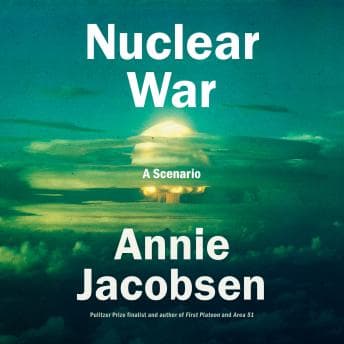

Couldn't sleep last Tuesday. Three in the morning, Ranger snoring at the foot of the bed, Linda dead to the world. So I figured I'd knock out a few chapters of Annie Jacobsen's Nuclear War: A Scenario. Bad call. Spectacularly bad call. By 5 AM I was wide awake, staring at the ceiling, running mental calculations about blast radii and wondering if Austin is far enough from any strategic target to matter. (It's not, by the way.)
Let me cut to the chase: this book will ruin your week. And you should listen to it anyway.
The Countdown Clock That Never Stops
Jacobsen structures the entire book around a single hypothetical scenario — a nuclear missile launched at the United States — and then walks you through the response minute by minute, sometimes second by second. The decision chain from detection to presidential notification to launch authorization happens in roughly six minutes. Six. I spent 25 years in the Army, three combat deployments, and the compressed decision timeline she lays out still made my stomach drop. There's a section where she details the sequence inside the Pentagon — the specific protocols, the physical movements of people through corridors, the communications chains — and it felt less like reading journalism and more like reading an operations order that someone forgot to classify.
The author clearly did their homework. Jacobsen interviewed former SecDefs, STRATCOM commanders, nuclear weapons engineers, the people who actually sat in the chairs and would've had to make these calls. She names names. She cites specific weapons systems, yields, and effects with the kind of precision that tells me she wasn't just Googling this stuff. When she describes the thermal effects at various distances from ground zero — what happens to human tissue, to infrastructure, to the atmosphere — it's clinical and devastating.
Here's what surprised me: the book isn't really about the bombs. It's about the systems. The bureaucratic, technological, human systems that exist to manage the unmanageable. And how those systems — designed during the Cold War, patched and updated but never fundamentally rethought — create their own kind of inevitability. The escalation logic she walks through is the scariest part. Not the warheads. The logic.
Jacobsen Behind the Mic — A Mixed Debrief
So here's where it gets complicated. Jacobsen narrates her own book, and I have genuinely mixed feelings about it. On one hand, she knows this material cold. When she's laying out the technical details or recounting what her interview subjects told her, there's an authority to her voice that a hired narrator probably couldn't replicate. You can hear when she's personally disturbed by what she's reporting.
On the other hand — and I say this with respect — the pacing is slow. I bumped it to 1.25x almost immediately, and even then certain passages dragged. She has this breathless quality, like every single sentence is the most important thing she's ever said. For the first few hours, it works. It builds tension. By hour seven or eight, it's exhausting. Your brain stops registering urgency when everything is urgent. I caught a couple of mispronunciations on military terminology that pulled me out of the moment — small things, but when you've spent your career in that world, they snag like a burr. Marcus Aurelius ran into a similar problem in Meditations on First Philosophy — circling the same hard truths so many times that the repetition itself becomes the point, though I'll admit it wore on me there too.
The repetition is the real issue. She circles back to the timeline — "it is now twenty-six minutes since launch" — so frequently that I started feeling like I was stuck in a loop. I get the structural purpose. She wants you to feel the compression of time. But there's a line between effective repetition and the listener checking their phone to see how much time is left in the chapter.
Who Needs This in Their Ears
If you care about national security, defense policy, or just understanding the actual mechanics of how nuclear deterrence works (and fails), this is essential. Period. The research is exceptional, the scenario is plausible — I've seen briefings that track with her analysis — and the implications are the kind of thing every voting citizen should grapple with. If you served, especially in any capacity adjacent to strategic operations, this will hit different.
If you need fast-paced thriller energy, this isn't that. It's journalism. Meticulous, relentless journalism structured like a thriller. Big difference. And if slow narration drives you nuts, commit to 1.25x or 1.5x from the jump.
Don't listen to this before bed. Trust me on that one.
Mission Debrief
Worth your time? Here's the debrief: the content is a solid 4.5. The narration knocks it down a peg. But the substance — the actual intelligence Jacobsen has gathered and synthesized — is too important and too well-researched to skip because the delivery isn't perfect. I finished it three days ago and I'm still thinking about the six-minute decision window. Ranger slept through the whole thing, but I guarantee he'd agree: this one matters.







![Steve Jobs [unabridged audiobook] audiobook cover](/_next/image?url=https%3A%2F%2Fcovers.audiobooks.com%2Fimages%2Fcovers%2Ffull%2F9788499923406.jpg&w=1920&q=75)