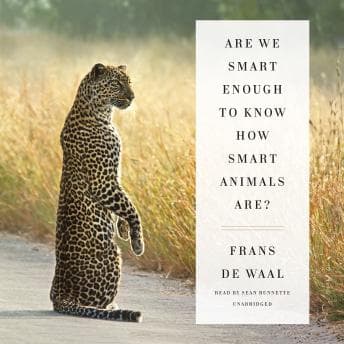

So here's the thing everyone says about this book: it's dry. And yeah, I get it. Sean Runnette reads like he's presenting findings at an academic conference at 4PM on a Friday. But I'd been up since 2AM debugging a cascading failure in our message queue (the kind where you fix one thing and three others break), and by the time I collapsed onto the 6:47 Caltrain with my headphones in, his measured, scholarly tone was actually... kind of perfect? Like a really smart professor who doesn't need to perform excitement because the material is already wild enough.
Let me back up. TL;DR: Worth your commute, but conditionally. This is basically a 10-hour argument that we've been measuring animal intelligence wrong — like benchmarking a GPU on CPU tasks and calling it slow.
The Umwelt Problem (Or: Stop Testing Fish on Tree-Climbing)
De Waal's central thesis hit me like a well-written error message — obvious once you see it, but you can't unsee it after. We've spent decades designing intelligence tests for animals that are basically rigged for human cognition, then acting surprised when animals "fail." His term for this is borrowed from biology: Umwelt, the perceptual world unique to each species. A bat navigating by echolocation isn't doing a worse version of seeing — it's doing something fundamentally different.
The specific examples are what make this sticky. There's Ayumu, a young chimpanzee at Kyoto University who can glance at a screen of randomly placed numbers, have them masked after 210 milliseconds, and then tap their locations in perfect numerical order. Humans can't do this. Not "most humans" — basically no humans. De Waal uses this to dismantle the cognitive ladder we've built with ourselves comfortably at the top. And the honey badgers who escape captivity by building tools from mud and sticks, or the octopuses carrying coconut shells around as portable shelters — these aren't cute anecdotes, they're data points in a pretty devastating case against human cognitive exceptionalism.
What I really appreciated is how de Waal goes after behaviorism — the old school "animals are just stimulus-response machines" framework — with the energy of someone who's been fighting this battle for decades. He traces the history of how we got so wrong about animal minds, from Descartes' "animals are automata" nonsense through Skinner's pigeons, and shows how researchers who dared suggest animals had inner lives got professionally punished for it. It's a science history book wrapped in a cognitive science book, and both layers work.
Runnette: The Narrator You'll Either Vibe With or Won't
Okay, let's talk about Sean Runnette. He's an Earphones Award winner. He's narrated a ton of audiobooks. And his delivery here is... fine. Just fine. It's clear, it's professional, and it has all the emotional range of a well-written README. No vocal fireworks, no character voices (not that there are characters to voice, really — this is nonfiction). He reads de Waal's prose the way you'd want a colleague to present technical findings: accurately, without injecting unnecessary drama.
But — and this is the part where I split from the "it's too dry" crowd — this is a 10.5-hour science book. If Runnette had been doing a performance, hamming up the chimpanzee anecdotes and getting breathless about octopus tool use, it would've felt patronizing. The material is inherently fascinating. You don't need a narrator to tell you that a chimp with better working memory than any human is mind-blowing. You just need someone to get out of the way and let the science land. I had a similar experience with Intention Experiment — another science-adjacent book where a low-key narrator ended up being the right call, even if my first instinct was to want more energy injected into it.
That said, I bumped it to 1.5x around hour 3 because at default speed some of the more academic sections (particularly the history of ethology) started to feel like wading through a lengthy code review. At 1.5x, Runnette sounds like a slightly caffeinated professor, which is the sweet spot.
Where It Drags (Because It Does)
I finished this in about 5 commutes, and I'll be honest — commutes 3 and 4 were where I felt it. The book gets repetitive in its middle third. De Waal makes his central point (we underestimate animal cognition, our tests are biased, the cognitive ladder is wrong) early and well, then keeps making it. And making it. With different animals, sure, but the argument structure starts feeling like a for-loop that could've broken earlier. Could some of this have been a blog post? No — there's genuinely 7 hours of excellent material here. But there's maybe 2-3 hours of reinforcement that a tighter edit would've caught.
The science actually holds up, though. De Waal is careful about distinguishing anecdote from controlled experiment, and he's refreshingly honest about the limitations of specific studies.
Who Gets the Most ROI
Perfect for: commute, roadtrip. Skip for: bedtime (you'll zone out during the academic history sections and lose the thread). If you're the kind of person who listens to optimization podcasts and thinks about systems design — which, hi, that's me — this book reframes intelligence as a distributed system with wildly different architectures rather than a single benchmark. That metaphor alone is worth the listen.
If you need your narrator to perform enthusiasm, this isn't your audiobook. If you want a smart person laying out evidence and letting you draw your own conclusions at 6AM while half the train is drooling on their laptops — the ROI on this audiobook is solid.





![Steve Jobs [unabridged audiobook] audiobook cover](/_next/image?url=https%3A%2F%2Fcovers.audiobooks.com%2Fimages%2Fcovers%2Ffull%2F9788499923406.jpg&w=1920&q=75)