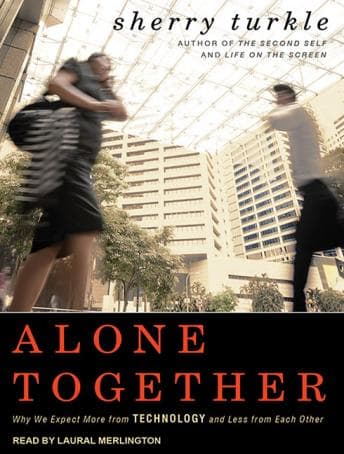

Everyone told me this would be life-changing. Every "must-read for tech workers" list. Every ex-coworker who left FAANG to become a life coach. So I went in expecting to feel attacked, like someone was going to point at my four Slack workspaces and my inability to make a phone call without rehearsing it first and say, "See? You're broken."
That's... not quite what happened.
The Robot Part Nobody Talks About
So here's the thing most people don't mention about Alone Together: roughly the first half isn't about social media at all. It's about robots. Specifically, it's about MIT experiments where kids and elderly people interact with robotic companions - Tamagotchis, Furbies, AIBO, and eventually more sophisticated social robots like Paro (the baby seal). Turkle spent years watching children debate whether their Furbies were "alive" and recording nursing home residents forming genuine emotional bonds with machines that couldn't love them back.
And this section is where Merlington really earns her paycheck. When she's voicing the children's remarks - these wild, excited observations about their robot "friends" - versus the quieter, more resigned tones of elderly people who know the robot isn't real but still prefer it to loneliness, you feel the contrast in your chest. It's not flashy voice acting. It's calibrated. She has this matter-of-fact quality that lets Turkle's research land without melodrama, which is exactly right because the material is already plenty unsettling on its own.
I started this book thinking the social media half would hit hardest. I was wrong. The robot half kept me up past midnight on a Tuesday, which is saying something because I had a 6AM train.
Where It Shows Its Age (And Where It Doesn't)
Let's be honest: this book dropped in 2011. Pre-TikTok. Pre-Instagram-stories. The social media examples reference Facebook and texting habits that feel almost quaint now. If you're looking for analysis of doomscrolling or parasocial relationships with streamers, you won't find it here.
But - and this is the interesting part - Turkle's core framework still holds up way better than it should. Her argument isn't "phones bad." It's more subtle than that. She's tracking a specific psychological shift: we're designing technologies that let us have the illusion of connection without the risk of real intimacy. We text instead of call. We prefer asynchronous communication because we can curate ourselves. We'd rather have a robot that simulates caring than deal with a human who might actually need something from us.
If you've read Cal Newport's Digital Minimalism, this is basically the prequel - the academic research that underpins Newport's prescriptions, except Turkle is more interested in asking questions than giving you a productivity framework. Which makes it simultaneously more intellectually honest and more frustrating if you're the kind of person (hi, me) who wants actionable takeaways. I hit that same wall of wanting a prescription that never comes when I read Intention Experiment — lots of fascinating research, zero commute-friendly to-do list.
Compared to something like Newport or even Adam Alter's Irresistible, Turkle moves slower and digs deeper into individual case studies. She'll spend twenty minutes on one teenager's relationship with their phone. If you're used to the pace of a typical business audiobook, this will feel like switching from a sprint to a long hike.
The 14-Hour Elephant in the Room
Okay. 14 hours and 48 minutes. For a nonfiction book about technology and loneliness. That is... a lot. And I'll be straight with you: there are stretches in the social media section where Turkle makes the same point through three or four different interviews when one would've been sufficient. I bumped to 1.5x for most of it and honestly could've gone 1.75x during some of the repetitive case studies.
Merlington's pacing is deliberate by design - she's matching Turkle's academic tone, and it works for the philosophical passages. But on a packed Caltrain at 6AM? There were mornings I drifted and had to skip back. This is not a half-asleep-friendly listen. It demands your brain.
The ROI on this audiobook is high if you're in tech and want to actually think about what you're building, but the time investment is real. Could've been 9 hours and hit harder.
Who Gets Value, Who Doesn't
Perfect for: anyone building consumer products who should probably feel a little guilty about engagement metrics. Also weirdly perfect if you have kids and are trying to figure out your own screen time philosophy - Turkle's observations about children and robots will rewire how you think about that Alexa in your living room.
Skip for: anyone wanting a quick, actionable guide. This is research and reflection, not a how-to. And if dated social media references will annoy you, be warned.
The Commit Message
TL;DR: Worth your commute if you can give it real attention. Turkle saw the loneliness epidemic coming a decade early, and the robot research alone is worth the first seven hours. The social media analysis shows its age but the underlying thesis - that we're trading messy human connection for controllable digital approximations - hits different when you're reading it on a train full of people staring at their phones. Including me.



![Steve Jobs [unabridged audiobook] audiobook cover](/_next/image?url=https%3A%2F%2Fcovers.audiobooks.com%2Fimages%2Fcovers%2Ffull%2F9788499923406.jpg&w=1920&q=75)