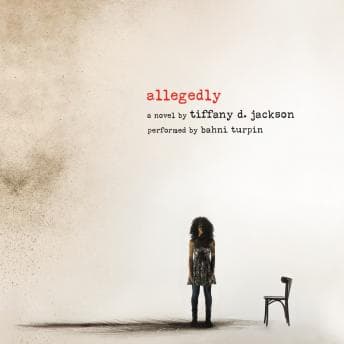

"Mary B. Addison killed a baby. Allegedly."
I heard that opening during school drop-off and sat in the parking lot for an extra ten minutes because I couldn't make myself press pause. Which, if you know my mornings, is basically a miracle.
Okay. So. I need to be upfront about something: this is not my usual lane. I am a comfort-read person. I have a whole system. But my sister kept sending me voice memos about this book and I finally caved, and now I have Feelings.
The Part Where I Realized This Was Not Going To Be Cozy
Allegedly is the story of Mary - a sixteen-year-old living in a group home, pregnant, trying to hold her life together while carrying a conviction for killing a baby when she was nine. Nine. The whole book is built around this question of what actually happened, and Tiffany D. Jackson does something I didn't expect: she makes you genuinely unsure what to believe about Mary for almost the entire 10+ hours.
Here's the specific thing that wrecked me. Bahni Turpin narrates Mary in this way where she sounds simultaneously like a sharp, calculating adult and then suddenly, terrifyingly, like a little kid who didn't understand what was happening to her. The same voice. The shift is subtle enough that you catch it mid-sentence and your stomach drops. That's not a trick you can do with just "good emotional delivery" - that's something else entirely. That's Turpin understanding that Mary's whole tragedy is that she was nine, and the jury forgot that.
I listened to a chunk of this during Sophie's nap (she actually slept, rare miracle, I should've bought a lottery ticket) and I made the mistake of getting too comfortable on the couch. Because then the scene where Mary starts describing her mother - her Momma, specifically, the way she says it - hit me and I was very much not comfortable anymore. The Momma character is one of the most quietly horrifying portraits of a certain kind of maternal abuse I've encountered in fiction. She's religious, she's charming to outsiders, and she is a monster. Turpin plays her with this sweetness that makes your skin crawl.
What Survived 47 Pauses (And What Didn't)
Here's my honest assessment as someone who listens in 25-minute chunks and frequently loses her place: this book is not easy to pause. Not because it's confusing - the plot is actually pretty clean once you're in it - but because Jackson writes in these short, punchy chapters that keep ending on a question you need answered. I kept going "just one more" like it was Netflix at 11pm.
The pacing is fast. Almost aggressively fast for the weight of the subject matter. Which is both a feature and, occasionally, a bug. Some of the group home dynamics and secondary characters felt a little thin to me - like they existed to move Mary's story forward rather than be their own people. At 10 hours 38 minutes, there was probably room to breathe more.
And the ending. I'm not going to spoil it. But I will say: I understand why some readers feel blindsided. I felt blindsided. I sat with it for two days. And then I decided I respected what Jackson did, even though it's not the ending I wanted. It's not a happy ending. It's not even a clean ending. It's the kind of ending that's trying to say something true about systems that fail Black girls, and it does say that thing, but it will not leave you feeling warm.
I cried in my car in the garage. Not the good kind. The kind where you're just sitting there going "that's not fair" to no one.
So Who's This Actually For
Not for you if you need your audiobook to survive a bad week without making it worse. This is not a comfort read. I made that mistake once with Emergency too — thought it would be easy listening and ended up standing in my kitchen completely frozen with a wet spatula in my hand. It is not background-friendly. It requires you to actually be present, which is a big ask for those of us who listen while unloading the dishwasher.
But if you have some emotional bandwidth saved up, and you want a book that treats its teenage protagonist like she's a full human being with a complicated interior life - not a cautionary tale, not a symbol, an actual person - then yes. Bahni Turpin alone is worth the time. The way she holds Mary's uncertainty, that specific quality of a person who's been told a story about themselves for so long they're not sure anymore what's true - that performance is the reason this book works as audio specifically.
Not groundbreaking for the genre. But the execution is sharp, Turpin is extraordinary, and I'm still thinking about Mary two weeks later. That's not nothing.