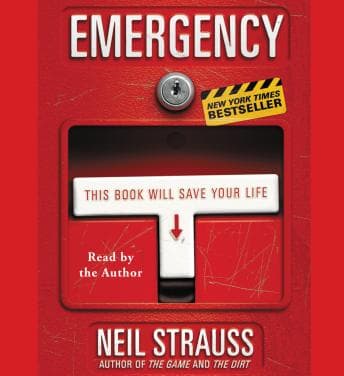

I was stress-cooking at 11 PM—one of those elaborate biryanis that takes three hours and feeds eight people I won't invite over—when Neil Strauss started explaining how to gut a goat. My mother would be horrified. Not by the goat thing, actually. She'd be horrified that I was listening to a book about becoming a doomsday prepper instead of calling her back.
But here's the thing about Emergency: it's not really a survivalist manual. It's a case study in anxiety. And as someone who studies why people do the things they do, I found myself completely absorbed.
Why Smart People Build Bunkers
Strauss exhibits classic catastrophic thinking patterns—the kind I see in my research subjects who've experienced loss of control. Post-9/11, post-Katrina, post-financial-collapse, he looks at the world and sees systems that could fail at any moment. So what does he do? He spends three years learning to fly planes, shoot guns, obtain a second citizenship, and yes, butcher animals.
What makes this character compelling—and I do mean character, because Strauss is performing a version of himself here—is his self-awareness. He knows he's being paranoid. He knows the billionaire gun nuts and survivalist superheroes he meets are often unhinged. He documents his own crippling doubts alongside his tactical training. The research actually shows that this kind of meta-cognition (knowing you're anxious while still being anxious) is incredibly common in high-functioning people who've lost faith in institutions.
Strauss doesn't just teach you survival skills. He's asking: why does anyone really want to go off the grid? Is it preparedness or is it escape? Is it self-reliance or is it fear dressed up as competence?
My therapist would have thoughts about this character.
When Your Ego Writes Checks Your Voice Can't Cash
Here's where I have to be honest. Strauss reading his own work is... a choice. His nasally, monotone delivery sounds like he's perpetually getting over a cold. For six hours. The dramatic pauses are well-timed—he clearly understands where emphasis belongs—but the actual vocal execution is flat. When he tries to vary his tone, you can hear him forcing it. It's like watching someone who's read about acting try to perform.
One listener put it bluntly: "He should have left it to the pros." Harsh but not entirely wrong. The wit that made The Game such a cultural moment is present in the writing, but it gets muffled by the delivery. That same performative self-awareness—the narrator as both subject and observer—shows up in Noble Art of Seducing Women, though with far less introspection about what drives the behavior. Strauss's humor needs energy, and energy is exactly what's missing here.
That said—and this is the conflicting part—hearing the author tell his own story does add authenticity. When he describes learning to track animals or meeting shady offshore lawyers, there's an intimacy that a professional narrator might have polished away. It's imperfect in a way that feels honest.
I just wish "honest" didn't also mean "occasionally boring."
A Fascinating Case Study In Pre-2020 Anxiety
Listening to this now is strange. Strauss wrote Emergency in 2009, convinced that civilization was one disaster away from collapse. Then we all lived through 2020 and discovered he was... not entirely wrong? The pandemic, the supply chain chaos, the runs on toilet paper—suddenly his paranoid fantasies about self-sufficiency didn't seem so paranoid.
Psychologically, this doesn't track as pure survival manual. It tracks as memoir. Strauss is processing his own helplessness by becoming hyper-competent. Classic compensation behavior. He can't control the world, so he'll control his ability to survive it. The fact that he's self-deprecating about this journey makes it palatable rather than preachy. The psychology of control-seeking in relationships gets a much deeper treatment in Wired for Love, which examines how our attachment patterns drive compensatory behaviors—though in intimate contexts rather than apocalyptic ones.
But here's what I found myself asking: does any of this actually work? He learns to start fires, purify water, obtain emergency documents. Useful skills, sure. But the deeper question—how do you live with uncertainty?—never quite gets answered. He ends the book more capable but not necessarily less anxious. Which, honestly, tracks with what the research shows about control-seeking behavior. More skills rarely equal more peace.
Who This Is (And Isn't) For
If you're interested in the psychology of preparedness culture—the why behind the bunkers and bug-out bags—this is genuinely illuminating. Strauss interviews fascinating people: cult leaders, government skeptics, ordinary citizens who've decided the social contract is void. It's immersive journalism with a self-help veneer.
If you want an actual survival guide, look elsewhere. The practical tips are scattered and often outdated (this was pre-smartphone ubiquity). And if you can't tolerate monotone narration, consider the print version. Seriously. The audiobook requires active listening—this is not background material. I had to rewind multiple times because his flat delivery let my attention drift.
Priya's Diagnosis
Strauss is a skilled writer who shouldn't narrate his own work. The material is compelling, the self-awareness is refreshing, and the cultural snapshot of late-2000s anxiety feels weirdly prescient now. But the audio experience is compromised by a voice that doesn't match the energy of the prose.
Worth experiencing. Maybe not worth a full credit. Wait for a sale, or find it at your library. Your attention span will thank you.