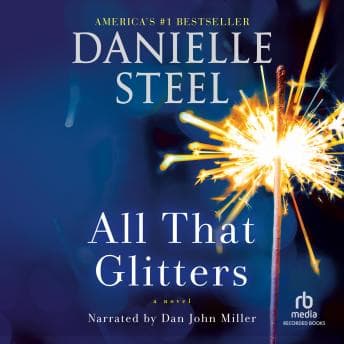

Can a book with every advantage in the world still somehow squander it all? Because that's the question I kept asking myself during All That Glitters - and I'm not sure Danielle Steel meant for it to be meta.
I was grading a stack of sophomore essays on The Great Gatsby last Tuesday night - yes, the irony of that title pairing is almost too perfect - when I put this on. Denise had gone to bed. The apartment was quiet. And for about the first hour, I thought: okay, this might actually work. A young woman loses her parents in a terrorist attack, inherits wealth and beauty and connections, and has to figure out who she is without the people who defined her world. That's a premise with real potential. Fitzgerald would've done something devastating with it.
Steel does not.
The Cliff Notes Version of a Life
Here's the thing about All That Glitters that kept nagging at me as a teacher of literature: it reads like a summary of a novel rather than the novel itself. Coco graduates from Columbia. Coco gets a magazine job. Coco dates a charismatic man. Coco learns a lesson. Coco dates another charismatic man. Coco learns another lesson. It's structured like a Wikipedia biography of a fictional person - events are reported to you rather than lived through. The writing assumes you can't hold a thought for more than a paragraph, constantly circling back to remind you that Coco's parents died (yes, we remember, it happened in chapter one), that Coco is beautiful (noted, several times), that Coco is determined (okay, got it).
This is what I tell my students about showing versus telling, and I wish I could assign this book as an example of what happens when you choose telling every single time. The grief after her parents' death? We're told she's devastated. The excitement of her career? We're told she's dazzled. The romantic relationships? Each man is described as fascinating or charismatic, but I couldn't tell you a single distinguishing habit or contradiction that made any of them feel real. Compare this to, say, how Edith Wharton builds a love interest - through the smallest gestures, the things left unsaid. Here, everything is said. Repeatedly.
Dan John Miller Does What He Can
Dan John Miller narrates this in a straightforward, professional manner, and honestly? The performance is fine. Clean, clear, steady pacing. But there's not much for him to work with. The narrator understands that pause is punctuation - and Miller places his pauses well - but when the prose itself has the emotional texture of a status update, even a skilled reader can only do so much. He doesn't phone it in, which I respect. He gives Coco a kind of earnest warmth. But the secondary characters blur together because the text doesn't differentiate them enough for any narrator to create real distinction. It's like watching a good actor perform in a school play where everyone has the same three lines.
At eight hours and change, this is a quick listen. I'll give it that. It doesn't overstay its welcome the way some of Steel's longer books might.
What Hemingway Would've Cut
This reminds me of what Hemingway said about prose being architecture, not interior decoration. All That Glitters is all decoration - surface-level descriptions of wealth, beauty, glamour, European travel, prestigious jobs - without the architecture underneath. The title promises a meditation on the difference between surface glitter and real substance, and the description says as much explicitly. But the book never earns that theme because it's too busy cataloguing Coco's apartments and career moves to sit with any moment long enough for it to mean something.
My students would probably finish this faster than anything I've assigned them all year. And they'd retain about the same amount.
I don't want to be cruel. Steel has sold nearly a billion books, and she clearly knows her audience. If you want pleasant, frictionless storytelling where a sympathetic protagonist faces adversity and comes out fine - truly, genuinely fine, with no lasting scars or complicated feelings - this delivers exactly that. It's comfort food. But I teach kids every day that books can be comfort AND substance, and I kept wishing this one would choose to be both. It Starts with Us manages that balance better than most in this genre - Colleen Hoover gets criticized in my department too, but at least her characters bleed a little.
Who This Is Actually For
If you're a dedicated Steel fan, you already know whether you want this. You probably already have it. And that's perfectly valid - she writes a specific kind of book and she writes it consistently. If you're looking for contemporary literary fiction about grief, identity, or reinvention with real emotional weight? Skip this and pick up A Little Life by Hanya Yanagihara or even The Vanishing Half by Brit Bennett. If you loved The Great Gatsby for its glittering surface hiding hollow interiors, well - this book has the glittering surface part down.
The Grade I'd Give It
I've read enough freshman essays to recognize competent writing that doesn't take risks. This is a solid C+. Technically proficient. Hits all the expected beats. But it never surprised me, never challenged me, never made me stop grading papers to actually listen. And that's what separates a book you finish from a book you remember.