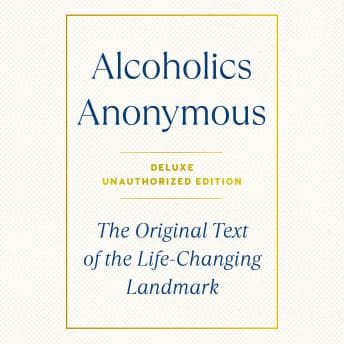

How do you review a book that's literally saved lives? Not in the vague LinkedIn-post way people say "this book changed my life" about some productivity hack. I mean a book where people credit it with keeping them alive past forty.
I listened to the Big Book at 1.5x - and yes, I dialed it back from my usual 2.0x. Not because Mitch Horowitz is slow, but because this text earned the extra half-second per sentence. I was up late reorganizing my home office (Jenny's been on me about the cable situation behind my desk for months), and honestly? The quiet house at midnight is probably the right setting for this one.
The Original 1939 Text Hits Different Than You'd Expect
Here's what surprised me: this is fundamentally a business book. Not officially, but structurally. Bill W. wrote a step-by-step operational manual for human beings who've lost the ability to operate. The Twelve Steps aren't spiritual poetry - they're process documentation. My parents wouldn't have called it that, but the underlying logic? Identify the problem. Admit you can't solve it alone. Build a system. Work the system daily. Follow up. This is what my parents did instinctively. Now it has a TED talk.
The 1939 language is formal in a way that modern self-help authors have completely abandoned. No "hacks." No "5 Morning Rituals." Bill W. writes with the careful precision of someone who knows that if he gets the instructions wrong, people will die. That weight is present in every chapter. When he describes the alcoholic's pattern of self-deception - convincing themselves that this time, just one drink will be fine - I couldn't help mapping it onto every founder I've coached who keeps doubling down on a failing strategy because "this pivot will be different."
The personal stories in the second half are where the 12-hour runtime earns its keep. These aren't polished case studies. They're raw, sometimes rambling accounts from people in the 1930s who were genuinely bewildered by their own behavior. One guy describes losing his medical practice, his family, everything - and the calm, matter-of-fact tone of the writing makes it land harder than any dramatic narration could.
Horowitz Reads It Like He Trusts the Material
Mitch Horowitz does something smart here: he doesn't perform. He reads. There's a difference. His voice is steady, warm without being syrupy, and he treats the text with the kind of respect you give a document that's earned its authority. No dramatic pauses before the Twelve Steps like he's revealing plot twists. No vocal gymnastics during the personal testimonies. He reads it straight, and the material does the work.
One thing worth flagging: Audible's chapter markers are off by one (chapter 7 is actually chapter 6, etc.), which is genuinely annoying if you're trying to navigate to specific sections. For a book people often return to repeatedly, that's a production oversight that shouldn't exist. Not Horowitz's fault, but it dinged my experience.
The bonus inclusion of the 1941 Saturday Evening Post article by Jack Alexander is a nice touch. It's essentially the piece of journalism that turned AA from a small fellowship into a national movement. Hearing it narrated after the main text gives you a sense of the cultural moment - America in the early '40s, desperate for solutions, willing to try something that sounded borderline religious because the alternative was watching people drink themselves to death.
Who This Is Actually For (And It's Not Just Who You Think)
Obvious audience: anyone in recovery, anyone thinking about recovery, anyone who loves someone in recovery. But here's my take as a consultant who reads organizational behavior for a living - this book is quietly one of the most influential management frameworks ever published. The sponsor system is mentorship. The group meetings are accountability structures. The emphasis on service is stakeholder alignment. Every peer-support program, every twelve-step variant, every corporate wellness initiative with "accountability partners" traces back to this book. The parenting lens in How to Raise Successful People actually borrows from this same structural DNA - accountability, daily systems, showing up - even if it never acknowledges the lineage.
If you're in self-help or business leadership, you should know the source code. This is it.
Who should skip? If you need modern pacing and a breezy tone, this will feel like reading legal documents. The 1939 prose is deliberate and sometimes repetitive. At nearly 12 hours, there are stretches where I felt the density. But cutting it would be like editing the Constitution for readability - you'd lose the thing that makes it work.
Bottom Line on the Balance Sheet
Bottom line: This isn't a book you "enjoy." It's a book you respect. Horowitz delivers it clean, the original text holds up remarkably well after 85 years, and the chapter-numbering issue is annoying but survivable. I've seen flashier self-help books come and go every quarter. This one's still here, still working, still saving lives. My parents would've appreciated the no-nonsense approach - no promises of easy fixes, just a system and the willingness to show up every day. That's the only productivity hack that's ever actually worked.