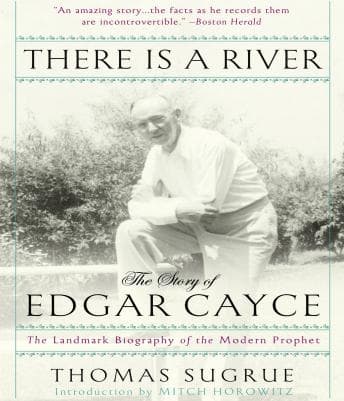

So here's the thing people don't tell you about Edgar Cayce: the man was basically a walking contradiction, and Thomas Sugrue knew it. I came into this audiobook expecting a hagiography — the kind of uncritical spiritual biography where every miracle is presented with breathless reverence and zero interrogation. And look, there are moments where Sugrue's proximity to his subject shows. But what surprised me, genuinely surprised me while I was chopping onions for a dal that took way longer than it should've, was how much psychological complexity Sugrue actually captures in a man who could've easily been flattened into a saint or a fraud.
The Psychology of a Man Who Couldn't Explain Himself
What makes Cayce compelling as a character — and I'm treating him as one, sorry not sorry — is the disconnect between his conscious self and whatever was happening during those trance states. Sugrue documents this tension with real care. Cayce was a devout Christian Sunday school teacher from rural Kentucky who kept producing readings that referenced reincarnation, a concept fundamentally at odds with his own stated beliefs. I found myself asking: why does a man continue doing something that terrifies and confuses him for decades? The protagonist exhibits classic cognitive dissonance, and Sugrue captures it without trying to resolve it neatly. That's rare in spiritual biography. That willingness to sit with unresolved tension is something I also appreciated in Anxious for Nothing, though from a completely different theological angle.
The early chapters covering Cayce's childhood — the strange episodes, the learning difficulties, the moment he reportedly absorbed an entire spelling textbook by sleeping on it — read almost like a clinical case history. Sugrue was a journalist, not a psychologist, but his instinct to document rather than editorialize (at least in these sections) gives the material a weight that pure advocacy wouldn't. By the time you reach the adult Cayce performing medical readings for strangers, you've been given enough biographical context to understand why this man couldn't just walk away from something he barely understood.
The research actually shows that people who develop identities around unusual experiences often feel trapped by community expectations. Cayce's story is a fascinating case study in exactly that — a man whose gift (or delusion, depending on your framework) became the thing everyone around him needed, leaving him no psychological exit.
Fourteen Hours With Mitch Horowitz
At 14 and a half hours, this is a commitment. And here's where I have to be honest about the narration split. Mitch Horowitz clearly has deep affection for this material — he wrote the new introduction and his emotional investment comes through in sections describing Cayce's struggles, particularly the periods where Cayce questioned whether his abilities were demonic. There's a warmth there that works.
But. Sustained warmth over 14 hours can start to feel like a single temperature. The book has stretches — particularly the middle sections cataloguing reading after reading — where the narration needed more variation to keep the material from blurring together. I wouldn't call it bad narration. I'd call it narration that loves its subject so much it forgets to modulate. My therapist would have thoughts about that kind of attachment.
I listened to most of this at 1.25x during my morning jogs through Cambridge, and at that speed the pacing felt right. At normal speed, I think those middle chapters would've tested my patience.
What Sugrue Gets Right (And What He Can't See)
The book was published in 1942, while Cayce was still alive, and that proximity is both its greatest asset and its blind spot. Sugrue had access nobody else had — years of personal observation, conversations, documentation. But he was also a believer, and by the final third of the book, the journalistic distance thins. The claims get bigger, the skeptical framework gets quieter. Psychologically, this doesn't track with how a trained journalist would normally operate, which tells you something about the effect Cayce had on the people around him.
And that's actually the most interesting thing about the book from a narrative psychology perspective. It's not just a biography of Cayce. It's an unintentional autobiography of Sugrue's conversion from skeptic to advocate, playing out in the shifting tone of the prose itself. The author who writes Chapter 3 is not the same person who writes Chapter 20. Whether that makes the book more or less trustworthy depends entirely on what you're looking for.
If you want a critical examination of psychic claims, this isn't it. If you want to understand why millions of people found (and still find) Cayce's story meaningful, this is the primary text. And if you're like me and you want to understand why people believe what they believe — the actual psychological machinery of faith and meaning-making — there's genuinely good material here, even if Sugrue wouldn't have described it that way.
Who Gets Something From This (And Who Won't)
Listeners already interested in Cayce, New Age history, or spiritual biography will find this essential — it's the original, the source document. If you're a skeptic who gets irritated by unexamined claims, the back half will frustrate you, but the first half is worth your time as a character study alone. If you need fast pacing and tight editing, 14 hours of early 20th-century biography will feel long.
The Case File, Closed
I walked away from this one thinking less about whether Edgar Cayce was "real" and more about why a man who was genuinely distressed by his own abilities never stopped. That question — the psychology of compulsive service, of identity built around something you can't control or explain — is worth sitting with. Sugrue gave us the raw material, even if he didn't know that's what he was doing.