![A Court of Wings and Ruin (1 of 3) [Dramatized Adaptation] audiobook cover](/_next/image?url=https%3A%2F%2Fm.media-amazon.com%2Fimages%2FI%2F51TsSCZLoZL._SL1200_.jpg&w=1920&q=75)

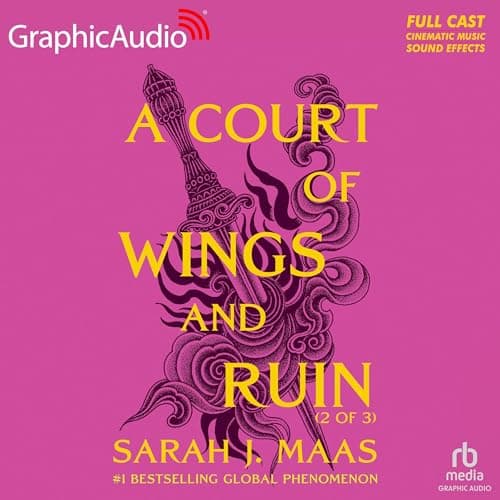
GraphicAudio's dramatized adaptation of A Court of Wings and Ruin is the closest thing to an accessibility-first fantasy production I've encountered this year.
I was at my desk late, prepping caption sync notes for a publisher client, hearing aids in, when Feyre's return to the Spring Court hit me sideways. Not the plot — I've read Maas before — but the production design. The sound effects layered under dialogue, the score swelling during tension shifts, the way each cast member occupies a distinct sonic space. As a hard-of-hearing listener, this hit different. I could track who was speaking without straining, without rewinding, without guessing. That almost never happens with full-cast audiobooks.
When Eleven Voices Actually Mean Something
Here's where dramatized adaptations usually fall apart for me: too many voices bleeding together, no clear spatial separation, and I'm lost by minute ten. This production dodges that. Amanda Forstrom's Feyre carries a controlled tension — not breathless YA energy, but someone actively performing deception at the Spring Court and letting you hear the calculation underneath. Anthony Palmini's Tamlin sits in a lower register that contrasts sharply enough from Gabriel Michael's Rhysand that even on a noisy subway platform, I never confused the two. That's not a small thing. That's accessibility done right.
The ensemble is large — twenty-three performers listed — but the dramatized format means you're not relying on one narrator doing vocal gymnastics. Each character gets a dedicated voice actor, and the production treats that seriously. Nora Achrati and Natalie Van Sistine handle supporting roles with enough specificity that the political maneuvering scenes between High Lords don't collapse into a wall of similar-sounding voices. Firekeeper's Daughter pulled off something similar with its ensemble cast — distinct enough that I never lost the thread even when the political tension ran hot.
The Sound Design Is Doing Real Work
This isn't background music slapped onto narration. The sound effects — doors, wind, the ambient hum of different courts — function almost like audio captions. They orient you spatially. When Feyre moves between the Spring Court and the Night Court, the sonic environment shifts before any dialogue confirms it. For someone like me who processes audio through layers of hardware and interpretation, those environmental cues are gold. They're the difference between following a story and being inside one.
The score during the war buildup scenes doesn't overpower the dialogue either. Clarity over speed — always. I've listened to dramatized productions where the music drowns the vocals and my hearing aids just give up trying to separate the channels. Here, the mix keeps voices front and center. Someone on the production team understood that dramatic doesn't mean loud.
What You're Trading For This Format
At 6 hours 11 minutes, this is part one of three. You're getting roughly the first third of the novel, and it ends accordingly — mid-arc, threads unresolved, Feyre's political game still in motion. If you need closure in a single listen, this will frustrate you. The pacing within this chunk is solid though. Feyre's deception at the Spring Court moves with purpose, and the ensemble format means scenes don't drag the way single-narrator versions sometimes do when one voice has to carry every conversation.
But I'll be honest — the dramatized format means you lose internal monologue depth. Maas writes Feyre's inner calculations extensively, and some of that gets compressed or externalized through dialogue. If you're coming from the standard audiobook and you live for Feyre's interiority, this adaptation trades that for theatrical immersion. Whether that's a win depends entirely on what you want from the experience.
The emotional layers come through even without the internal narration, though. The scene where Feyre navigates trust with the other High Lords — the vocal tension between performers, the slight pauses where score fills the silence — this cast actually performs, not just reads. You feel the political stakes in the delivery, not just the words.
Who Should Listen (And Who Should Skip)
Hard-of-hearing listeners, anyone who struggles with single-narrator character differentiation, people who want fantasy that sounds like it was designed to be heard rather than just recorded — this is the version to reach for. Skip it if you need Feyre's full internal monologue or if buying a story in thirds drives you up a wall.
My Sync Notes
I went in skeptical. Full-cast fantasy adaptations are either brilliant or a mess, and the margin between is razor thin. This one lands. The production quality respects listeners who need clarity — clean vocal separation, purposeful sound design, a mix that doesn't sacrifice dialogue for atmosphere.
Just know you're buying a third of a book. Plan accordingly.