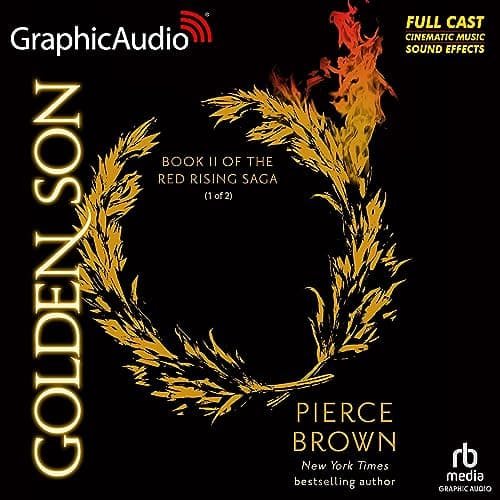

Look, I have a legitimate complaint. You cannot — cannot — release a dramatized adaptation of Golden Son and split it into two parts and then just leave me hanging like that. I was three hours deep, sitting in the grad lab at 1 AM pretending to debug my procedural terrain generator, and the Graphic Audio production had me so locked in that I forgot to save my code for probably forty minutes. Dr. Patel, if you're reading this: the thesis is fine. Everything is fine.
It is not fine. I need Part 2 immediately.
The Society Sounds Like a Real Place Now
So here's what Graphic Audio does with Golden Son that the standard Tim Gerard Reynolds narration — great as it is — simply can't: they give the Color hierarchy an actual sonic identity. When Stewart Crank's Darrow is navigating Gold politics, you hear the hum of grav-boots on marble, the ambient thrum of ship engines during fleet sequences, swelling orchestral cues that hit like a John Williams score during the space battles. It's not subtle. It's maximalist. And for a book where Pierce Brown is already writing at like 110% intensity, the production matches that energy perfectly.
The full cast is where this gets interesting though. Jon Vertullo's Sevro is feral in exactly the right way — he plays him with this raspy, barely-contained chaos that makes every Howler scene pop. Jenna Sharpe as Mustang brings this measured intelligence that contrasts hard against the machismo of the other Golds. And Andrew James Spooner as the Jackal? Cold. Like, unnervingly calm-cold. The kind of voice where you instinctively lean back from your headphones. Ian Russell gives Nero au Augustus this deep patrician authority that makes you understand why people follow him even when he's clearly monstrous.
The cast differentiation matters because Golden Son is juggling way more political players than Red Rising did. Brown's second book drops the Hunger Games arena structure and goes full space opera political thriller, and with a dozen-plus named characters scheming at once, having distinct actors means you're never confused about who's talking. The dense political layering reminded me of Empire of Gold, which does similarly exhausting — I mean that affectionately — work juggling factions and loyalties across a sprawling cast. My D&D group would love this — it basically plays like a really well-produced actual play podcast, except everyone's competent and the DM is actively trying to TPK the party.
Where the Dramatization Helps (and Where It's Almost Too Much)
The sound design during the Iron Rain sequence — Darrow's drop from orbit onto a planetary surface — is genuinely thrilling. Helmet comm chatter, the whistle of atmospheric entry, explosions that pan across your headphones. I had my eyes closed at my desk just living in it. This is the kind of scene that justifies the dramatized format completely.
But I'll be honest: during the quieter political maneuvering scenes, the constant cinematic music can feel like the production doesn't trust the dialogue to carry itself. Brown's writing is sharp enough in those moments — the verbal sparring between Darrow and the Sovereign, the tension of Senate scenes — that the orchestral underscore occasionally competes with the performances instead of supporting them. It's a minor gripe. Like, 15% of scenes. But when you're used to the clean single-narrator version letting Brown's prose breathe, you notice it.
Also — and this is just a structural reality — splitting this book at the midpoint means Part 1 ends on what feels like an incomplete arc. Golden Son's payoff is notoriously back-loaded. The twists that made people throw their Kindles across the room? Those are in Part 2. So this half is mostly setup and escalation. Brilliant setup, genuinely tense escalation, but you need to know going in that you're committing to both parts or you'll feel like someone paused a movie right before the third act.
Who Gets a Seat on the Ship (And Who Should Skip)
If you loved Red Rising's dramatized Part 1, this is an instant grab. If you've only done the Tim Gerard Reynolds version and want to re-experience the series with full production value — yeah, it's worth it, especially for the battle sequences.
But if you mostly listen while doing other things — cooking, driving, half-paying attention — this demands more focus than that. The political layers are dense, the cast is huge, and Brown doesn't hold your hand. You miss one scene of Jackal scheming and you're lost for the next hour.
Skip if you need resolution. This is half a book. A very good half of a very good book, but half.
My Thesis Can Wait (It Always Does)
This is Sanderson-level world-building wearing a Roman Empire skin and riding a spaceship. The progression is satisfying — watching Darrow level up from arena survivor to fleet commander scratches that same itch LitRPG does, just without the stat blocks. The Color-based caste system functions like a magic system even if it's technically sociopolitical, and it's chef's kiss. The Graphic Audio production turns what was already a top-tier sci-fi series into something that feels like prestige television for your ears.
Yes, it's only half the story. Yes, I'm buying Part 2 the second it hits. I listened to this instead of writing my thesis. No regrets.








![A Court of Wings and Ruin (1 of 3) [Dramatized Adaptation] audiobook cover](/_next/image?url=https%3A%2F%2Fm.media-amazon.com%2Fimages%2FI%2F51TsSCZLoZL._SL1200_.jpg&w=1920&q=75)