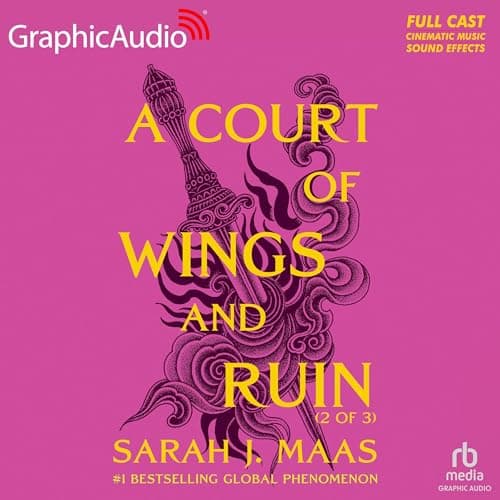

I was grading sophomore essays on The Great Gatsby — it was pushing midnight, the red pen was bleeding dry, and I needed something to keep me from writing "WHERE IS YOUR THESIS STATEMENT" in all caps one more time. So I put on Part 2 of the A Court of Wings and Ruin dramatized adaptation. Look, I know. Marcus Williams, the guy who once spent an entire podcast episode on the semicolons in Mrs Dalloway, listening to a Sarah J. Maas fantasy romance. My students would be thrilled. Denise already thinks it's hilarious.
But here's the thing — I'm a sucker for a well-executed production, and this one is genuinely trying to do something ambitious.
The High Lords Meeting Is Political Theater Done Right
Let's talk about what Maas is really saying in the centerpiece of this installment: the High Lords meeting. It's a scene built on centuries of grudges, fragile alliances, and characters who'd rather burn the world than admit they need each other. This reminds me of what Hemingway said about writing — the dignity of the iceberg. What's unsaid in that room carries more weight than the speeches. Feyre navigating the politics, reading the room, playing multiple sides — it's not subtle, but it's effective. And in the dramatized format, with different actors voicing each High Lord, you get the tension of an actual negotiation. You hear the distrust. The cast doesn't need to explain that these people hate each other; you feel it in the pauses and the vocal temperature shifts between speakers.
The production layers in orchestral swells and ambient sound — chairs scraping, the echo of a vast hall — and for the most part, it works. It makes the scene feel like a diplomatic summit instead of people reading dialogue at each other. This is performance art territory. Not quite theater, not quite audiobook, but something in between that I find genuinely interesting as a format.
When the Sound Design Gets in Its Own Way
Now. The battle sequences. Here's where I have to be honest, because I nearly pulled my earbuds out during one of the major confrontations. The background score ramps up — drums pounding, strings surging — and it overwhelms the dialogue. I rewound twice trying to catch what was being said during a pivotal moment, and I still only got about 70% of it. The prose deserves to be savored, and you can't savor what you can't hear.
This is the paradox of the dramatized format: the sound effects and music create genuine cinematic moments (there's a sequence where power clashes and the audio design makes you feel the impact), but they also compete with the very words they're supposed to enhance. It's like watching a beautifully shot film where the soundtrack drowns out the actors. The intent is right. The mixing needed another pass.
And then there's the ending. Part 2 of a three-part split, and it cuts off at what I can only describe as the middle of a breath. Not a natural pause point. Not a chapter break that lets you sit with what happened. Just — done. I sat there in my kitchen with a stack of ungraded essays, staring at my phone like it had personally betrayed me. I've read enough serialized Victorian novels to understand the cliffhanger as a form (Dickens was shameless about it), but even Dickens had the decency to end on a complete scene. This felt like someone hit stop on the recording.
The Cast Earns Their Keep
What saves this production — and I mean genuinely saves it — is the cast's emotional commitment. The actor voicing Cassian brings a rawness to his lines that caught me off guard. There's a vulnerability underneath the bravado that you wouldn't necessarily get from a single narrator trying to pitch-shift between twenty characters. And the Nesta performance carries this simmering anger that's distinct from every other character's anger (and there's a lot of anger in this book). You can tell these actors understood their characters' inner lives, not just their lines.
With roughly 29 credited performers, this is a massive ensemble, and the fact that I could track who was speaking without constant confusion is a genuine achievement. The narrator understands that pause is punctuation — the moments of silence between characters carry as much weight as the dialogue itself.
Who Should Listen (And Who Should Skip)
If you loved Six of Crows for the ensemble dynamics and political scheming, this is its spiritual successor in audio form — bigger in scope, wilder in ambition. The same pull toward layered political maneuvering and a cast of characters who are all keeping secrets from each other is exactly what drew me to Against the Fire — different world, same addictive tension. If you're already invested in the ACOTAR series and you've listened to the previous dramatized parts, this is obviously a continuation you'll want. But if you're coming in cold? Don't. This is Part 2 of 3 of Book 3 of a series. You will be hopelessly lost. Skip it, too, if you're a casual listener who needs something for background while cooking or commuting — the sound design demands real focus, and it will punish half-attention.
Worth Pausing the Faculty Meeting For
Here's my honest take: this production is doing something brave and mostly pulling it off. The full-cast format elevates the political and emotional scenes in ways a solo narrator couldn't touch. The audio mixing occasionally undermines its own ambitions. And that cliffhanger ending is a genuine frustration — not because the story is bad, but because the split point was poorly chosen.
My students would love this. I love it too, even if I'd never admit that during my Faulkner episodes. The format is the future of fantasy audiobooks, imperfect as it still is. At 6.5 hours for a middle installment, it's a commitment that rewards focused listening but punishes you with that abrupt cutoff. Have Part 3 queued up. Trust me.










![A Court of Wings and Ruin (1 of 3) [Dramatized Adaptation] audiobook cover](/_next/image?url=https%3A%2F%2Fm.media-amazon.com%2Fimages%2FI%2F51TsSCZLoZL._SL1200_.jpg&w=1920&q=75)